Physician student loans: the complete 2026 guide
The short version
- Your repayment choice can swing six figures over your career. It's worth getting right.
- If you'll work for a nonprofit or government employer, PSLF usually wins, and your residency may already be counting.
- If you're private-practice with a manageable balance, refinancing is often cheapest.
- The 2025 law (OBBBA) reshaped the income-driven plans, when you borrowed matters more than ever.
Physician student loans are unlike any other debt: six-figure balances, a low-income training detour, and federal programs that can forgive enormous sums tax-free. Managing them well is worth more than almost any investment decision a young doctor makes. This complete guide walks through every major fork — PSLF, income-driven plans, refinancing, taxes, and the 2026 rule changes — so you can build a strategy that fits your career.
The physician debt landscape
Doctors and dentists graduate with some of the largest education balances of any profession, and they do it on a delayed earnings curve: years of low resident income before attending pay arrives. That combination — large balance plus a low-income window — is exactly what federal forgiveness programs reward, which is why physicians have more to gain from getting this right than almost anyone.
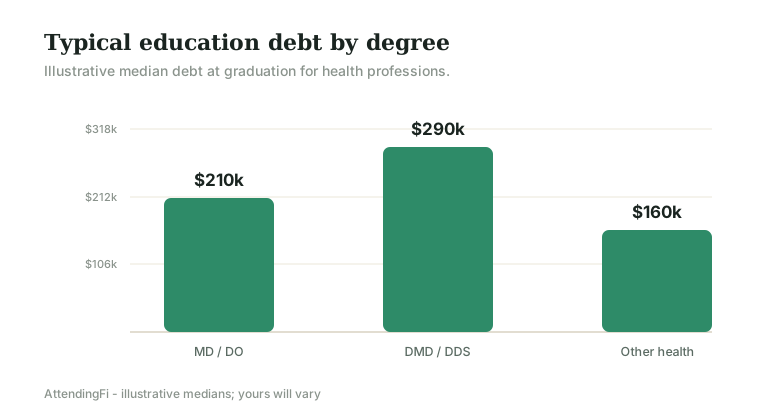
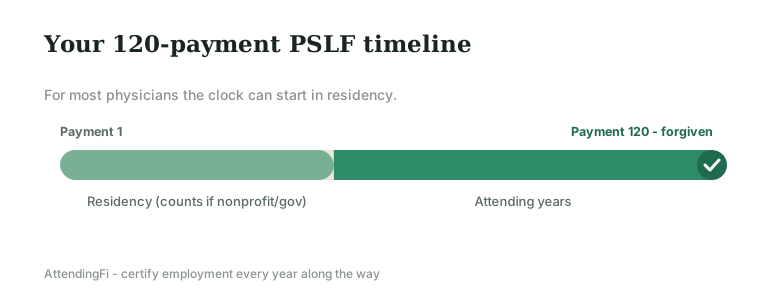
The stakes are measured in six figures. Choosing the right path can forgive or save more than $100,000; choosing wrong, by refinancing away forgiveness or ignoring a tax bomb, can cost just as much. The good news is that the decision reduces to a handful of well-defined forks.
The first fork: are you pursuing PSLF?
Everything starts with one question: will you work for a qualifying nonprofit or government employer? If yes, PSLF is usually the favorite, forgiving your balance tax-free after 120 qualifying payments. If no, the real choice is an income-driven plan versus refinancing.
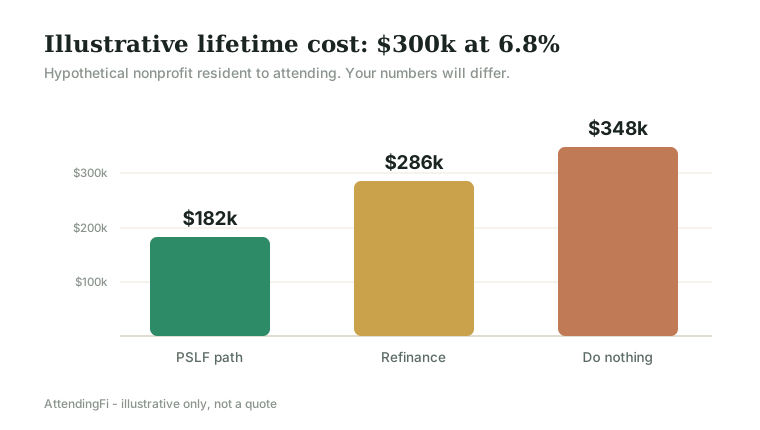
This single fact reorganizes the whole strategy. It also explains why residents should answer carefully: most training happens at nonprofit hospitals, so the PSLF clock can start years before you become an attending. We cover that decision in depth in PSLF vs refinancing for physicians.
Income-driven plans, explained
If you stay federal, an income-driven plan sets your monthly payment as a share of your income and underpins any forgiveness strategy. The plan you choose, and how it caps your payment as your income rises, can mean thousands of dollars a year and, on a forgiveness path, six figures over time.
The 2026 menu pairs a new Repayment Assistance Plan with a revised IBR. For high-earning attendings, the capped legacy plan often produces the lower payment, and on PSLF a lower payment means more forgiven. Compare them in RAP vs IBR.
When refinancing wins
Refinancing replaces your federal loans with a private loan at a lower rate. It wins in the mirror-image case: you are not pursuing PSLF, your income is strong relative to your debt, and a lender offers a rate well below your federal average. The tradeoff is permanent — refinancing forfeits PSLF, income-driven plans, and federal protections forever.
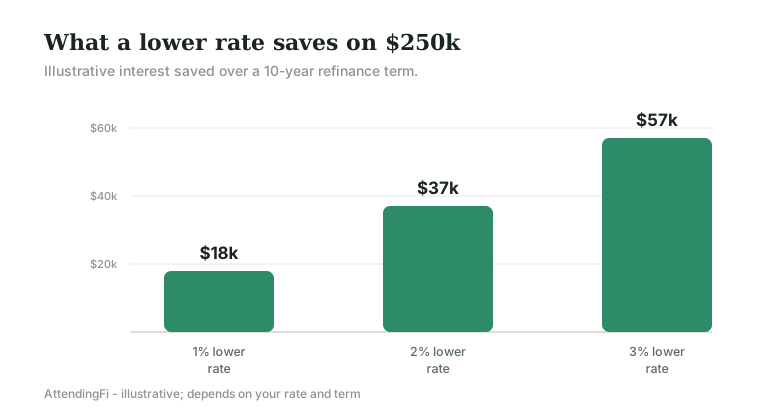
Because the move is irreversible, the order of operations is always the same: confirm you are not pursuing forgiveness first, then optimize the private loan. A lender's free calculator will not frame it that way, because refinancing is how it gets paid.
Taxes and the forgiveness tax bomb
Not all forgiveness is taxed the same. PSLF forgiveness is tax-free. Income-driven forgiveness at the end of a 20- or 25-year term can be taxed as ordinary income — the so-called tax bomb — and on a physician-sized balance that bill can reach tens of thousands of dollars in a single year.
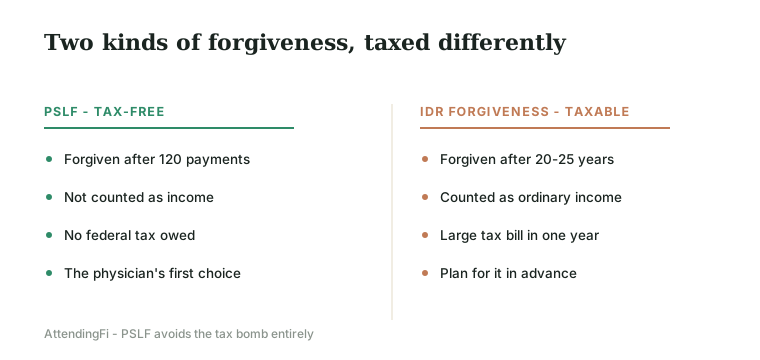
If you are on a non-PSLF forgiveness path, plan for it: a small monthly sinking fund started early covers the eventual bill. We cover this in the tax-bomb guide and the state-tax overview.
What changed for physicians in 2026
The repayment landscape shifted heading into 2026. The SAVE plan was halted by litigation, leaving borrowers in an interest-free forbearance; the 2025 budget law introduced the Repayment Assistance Plan and reshaped IBR; and the temporary federal tax exclusion for forgiveness is set to lapse. None of this changes the core PSLF structure, but it changes which plan sits underneath your strategy and how forgiveness is taxed.
We track the full set of changes in the 2026 changes guide and the OBBBA explainer. The headline for physicians: PSLF itself is intact, but a fresh look at your plan is worthwhile.
Your move by career stage
Strategy depends on where you are. As a resident, enroll in a qualifying income-driven plan immediately and certify employment, banking cheap PSLF months; see the residents guide. As a new attending, lock in the right base plan before your income jump and decide PSLF versus refinancing; see the new-attending checklist.
As an established attending, optimize the endgame — recertification timing, the tax bomb, and whether to accelerate payoff. The throughline at every stage is the same: confirm your forgiveness path first, choose the cheapest qualifying plan, and revisit the math whenever your income, employer, or the rules change.
Know your loan types first
Before any strategy, know what you hold. Most physicians carry federal Direct loans, which are eligible for PSLF, income-driven plans, and federal protections. Older borrowers may have FFEL or Perkins loans, which generally must be consolidated into a Direct Consolidation Loan before they count toward PSLF, and consolidating resets the qualifying-payment count on those loans. A minority hold private loans from school, which have none of the federal benefits and can only be refinanced.
This matters because the right move depends entirely on loan type. A Direct loan borrower has the full menu of forgiveness and income-driven options; a private loan borrower has only refinancing. Mixing them up is one of the most common and costly errors, because a borrower who assumes a private loan qualifies for PSLF can waste years before discovering it never counted.
Pull your full loan list at studentaid.gov and confirm each loan's type and servicer. If you find non-Direct federal loans and intend to pursue PSLF, the timing of consolidation matters, especially around mid-2026 deadlines; see our consolidation guide before acting. Getting the loan inventory right is the foundation every other decision rests on.
Married and dual-physician households
Your spouse changes the math. On most income-driven plans, how you file taxes affects your payment: married-filing-jointly counts both incomes, while married-filing-separately can lower the payment that feeds a PSLF strategy, at the cost of some tax benefits. For a household with one or two large balances, that filing choice can swing thousands of dollars a year.
Dual-physician couples have the most at stake and the most complexity. When both carry large balances and both work for qualifying employers, two PSLF paths run at once, and the filing decision links them. It is common, and sometimes optimal, for one spouse to pursue forgiveness while the other refinances, but those choices interact and should be modeled together rather than in isolation.
We unpack the filing tradeoff in married filing separately for student loans. The practical rule is to run the household numbers as a unit, not two separate problems, because the cheapest answer for the couple is often not the cheapest answer for each spouse considered alone.
Costly mistakes physicians make
A handful of avoidable errors account for most physician loan regret. Refinancing federal loans before ruling out PSLF is the most expensive, because it permanently forfeits forgiveness. Comparing monthly payments instead of lifetime cost is another, since the cheapest payment and the cheapest total are often different paths. Forgetting the tax treatment of non-PSLF forgiveness can flatter a path by tens of thousands of dollars.
Other common errors include letting qualifying payments go uncertified, choosing the wrong income-driven plan underneath PSLF, and putting off setup during the chaos of intern year when the cheapest qualifying months are slipping away. None require expertise to avoid; they require running the numbers once, carefully, before making an irreversible move.
The throughline is that physician loan mistakes are rarely exotic. They are ordinary missteps made on extraordinary balances, which is what turns a small error into a five- or six-figure one. A single careful analysis, revisited when your situation changes, prevents almost all of them.
How to build your plan
Pulling it together is straightforward. Inventory your loans and confirm their types. Determine whether a qualifying employer is in your future, which decides the PSLF-versus-refinancing fork. Choose the cheapest qualifying income-driven plan if you are pursuing forgiveness, or shop refinance offers if you are not. Account for the tax treatment of any forgiveness, and set up a sinking fund if a taxable forgiveness is in your future.
Then maintain it: certify employment annually if pursuing PSLF, recertify income on schedule, and revisit the whole plan whenever your income, employer, family, or the rules change. A physician loan strategy is not a one-time decision but a plan you steward across a decade or more, and small course corrections along the way protect large sums.
The fastest way to turn all of this into a concrete plan is to model your own numbers. Enter your balance, rate, specialty income now and later, employer, and family situation, and the engine compares PSLF, income-driven plans, and refinancing on a lifetime-cost basis, showing its work so you can act with confidence rather than guesswork.
The forgiveness math, in plain terms
It helps to see why forgiveness dominates so often for physicians. On an income-driven plan, your payment is capped at a share of your income, not your balance. For a doctor with a very large balance and a low training income, those early payments cover only a fraction of the interest, let alone the principal. By the time forgiveness arrives, a substantial balance remains, and on PSLF that entire remainder vanishes tax-free.
The larger your balance relative to your income, the more dramatic this effect. A $400,000 balance on a $250,000 income leaves far more to forgive than a $150,000 balance on the same income. This is why two physicians with identical incomes can reach completely different conclusions: the one carrying more debt has more to gain from forgiveness, while the one with a modest balance may pay the loan off before forgiveness ever matters.
The practical takeaway is to resist rules of thumb. Whether forgiveness beats payoff is a calculation involving your specific balance, rate, income trajectory, and employer. A back-of-the-envelope guess is exactly the kind of thinking that costs physicians six figures, in either direction, which is why modeling the actual numbers is not optional for a debt this size.
Federal protections worth keeping
Beyond forgiveness, federal loans carry protections that a private refinance loan does not. Income-driven repayment caps your payment during any future income dip, which matters more than physicians expect: a parental leave, a practice change, a health event, or an economic downturn can all temporarily shrink income, and a federal plan adjusts while a private loan does not.
Federal loans also offer generous deferment and forbearance, and they are discharged if the borrower dies or becomes permanently disabled, protecting your family in a worst-case scenario. These are not abstract benefits; for a young physician with a family and a long career ahead, the option value of federal flexibility is real, and it is forfeited permanently the moment you refinance.
This is why the decision to refinance should never be made casually or solely on the basis of a slightly lower rate. The right question is not only how much interest you would save, but what flexibility you would give up and how much that flexibility is worth to your particular situation. For some physicians the savings clearly justify it; for others the protections are worth more than the rate.
Finally, remember that a physician loan plan is never truly finished, because your career is not static. The strategy that is optimal in residency may not be optimal as a new attending, and the choice that fits a single resident may change with marriage, children, a move, or a switch between employed and private practice. The most successful borrowers treat their loan plan the way they treat their clinical knowledge: set up correctly once, then reviewed and updated as circumstances evolve.
A few minutes of attention at each major life or career change protects the large sums at stake and keeps you on the lowest-cost path available to you at every stage. When you are ready, run your real numbers in the engine below to see your own personalized plan in detail.
Get your personalized plan
Don't guess — model your exact numbers. AttendingFi runs the real federal-rules math on your numbers and shows its work. Free, no login needed to see your answer.
Run my numbers →Frequently asked questions
What are physician student loans?
"Physician student loans" are the education debts doctors carry from medical or dental school — frequently $200,000 to $300,000 or more — together with the federal repayment, forgiveness (PSLF), and refinancing options for managing them. This guide explains how each works under the 2026 rules.
How much do physicians owe in student loans?
Many physicians graduate with $200,000 to $300,000 or more in education debt, among the highest of any profession. Dentists often owe even more. The exact figure depends on your school and degree.
What is the best repayment strategy for physician student loans?
It depends on your employer and debt-to-income. Physicians at qualifying nonprofits with high debt usually benefit most from PSLF; high earners in private practice with modest balances often do better refinancing. Model both before deciding.
Should physicians refinance their student loans?
Only after ruling out PSLF and income-driven forgiveness, since refinancing federal loans is permanent. High-income, low-debt physicians in private practice are the strongest refinancing candidates.
Do physician residency years count toward forgiveness?
Usually yes, if your residency is at a nonprofit or government teaching hospital. Those low-income years count toward PSLF and are especially valuable.
What changed for physician student loans in 2026?
SAVE was paused, a new Repayment Assistance Plan and revised IBR arrived, and the federal tax exclusion for forgiveness is set to lapse. PSLF itself remains intact.