PSLF vs. refinancing: which wins for physicians?
For most physicians, the entire student-loan question collapses to one fork: pursue Public Service Loan Forgiveness (PSLF), or refinance to a lower rate and pay the balance off yourself. The PSLF vs refinancing choice is the single most expensive decision most doctors will make about their loans, and getting it wrong routinely costs six figures.
This guide walks through the seven factors that actually decide it, shows you the math on a real example, and points you to the calculators that run it on your own numbers. We will keep it specific to physicians and dentists, because the usual advice written for a $30,000 undergraduate balance falls apart at a $300,000 medical-school balance with a training-year detour through low-income residency payments. The stakes here are simply larger, and the right answer is less obvious.
The one question that decides PSLF vs refinancing
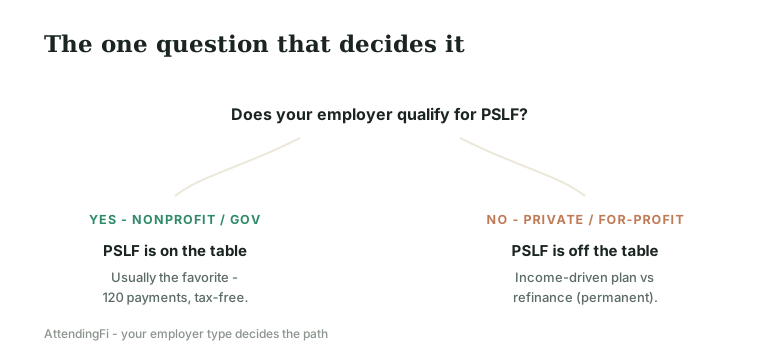
Before anything else, answer this: does your employer qualify for PSLF? The program requires a U.S. federal, state, local, or tribal government employer, or a 501(c)(3) nonprofit. Most academic medical centers, the VA, and a large share of community hospitals qualify. Private practices, for-profit hospital groups, and private-equity-owned practices do not.
That single fact reorganizes the whole decision. If you work, or plan to work, for a qualifying employer, PSLF is on the table and is usually the favorite, because forgiveness after 120 qualifying payments is completely tax-free. If you are firmly in the private, for-profit world, PSLF is off the table, and your real choice narrows to an income-driven plan versus refinancing. Everything downstream flows from this answer.
One nuance trips up a lot of residents. Your employer during training matters as much as your employer as an attending. Most residency and fellowship programs are run through nonprofit or government-affiliated hospitals, which means the years you spend earning a resident salary can also be years you are quietly banking qualifying PSLF payments, often at a very low monthly amount. Those cheap early payments are some of the most valuable months in the entire program.
When PSLF wins for physicians
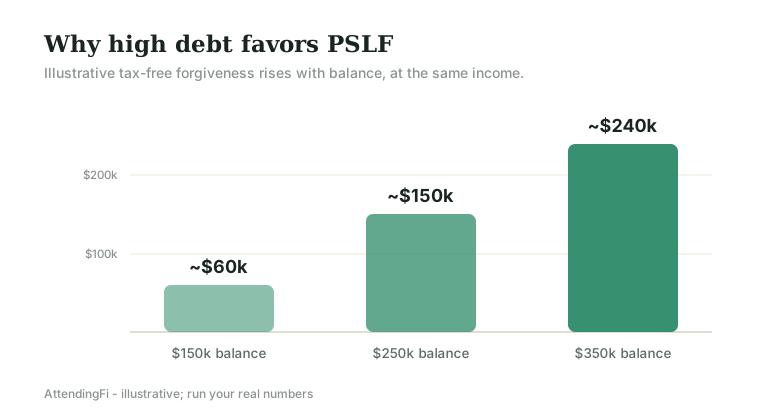
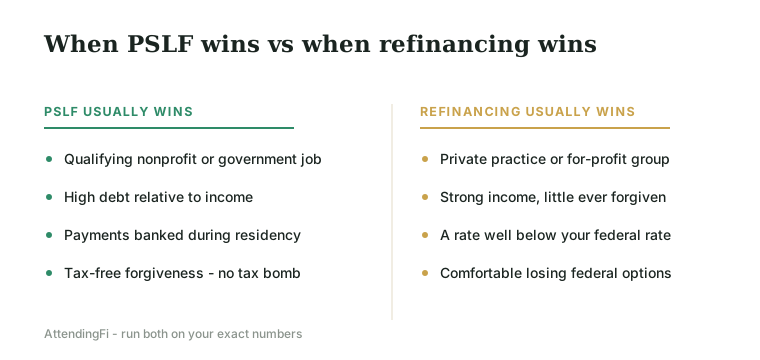
PSLF tends to win when the amount forgiven is large and the cost of getting there is small. Four conditions push the math firmly in its favor.
- You have, or will have, a qualifying employer. Nonprofit hospital, academic center, VA, or government. Without this, none of the rest applies.
- Your debt is high relative to your income. The more your balance outruns what an income-driven payment collects over ten years of qualifying payments, the more is left to forgive.
- You banked payments during residency or fellowship. Years at a resident salary produce small income-driven payments that still count. Those months are the engine of a strong PSLF case.
- You value the tax-free nature of the forgiveness. PSLF forgiveness is not treated as taxable income, so there is no "tax bomb" waiting at the finish line.
Put plainly: a resident with $300,000 in federal loans heading into a hospital-employed attending job is close to the archetype of a borrower for whom PSLF wins. By the time they finish training and a few attending years, a large slice of the balance can be forgiven tax-free, and the payments they made along the way were modest. Walking away from that to chase a slightly lower interest rate is usually a costly mistake.
When refinancing wins
Refinancing wins in the mirror-image situation: when little would ever be forgiven and a private lender will give you a meaningfully lower rate. Four conditions point this way.
- You are not pursuing PSLF. Private practice, a for-profit group, or any path where no qualifying employer is in your future.
- Your income is strong relative to your debt. A high earner with a moderate balance would pay the loan off well before any forgiveness arrived, so forgiveness has no value to capture.
- You can get a rate well below your federal rate. If your weighted-average federal rate is high and a lender offers something clearly lower, refinancing converts that gap directly into interest saved.
- You are comfortable giving up federal protections. Refinancing moves you to a private loan, so income-driven payments, generous deferment, and forbearance options go away.
A dermatologist or a private-practice anesthesiologist earning well into the mid-six figures, with a balance they could clear in a handful of years, is the classic refinancing candidate. For them, forgiveness is a mirage they would never reach, and every month at a lower rate is real money saved. The refinance savings calculator estimates exactly how much.
The math: a worked $300k example
Numbers make the fork concrete. Take an illustrative resident with $300,000 in federal loans at a 6.8% weighted-average rate, heading toward a hospital-employed attending position. The figures below are hypothetical and rounded for clarity, not a quote, but they capture the shape of the decision.
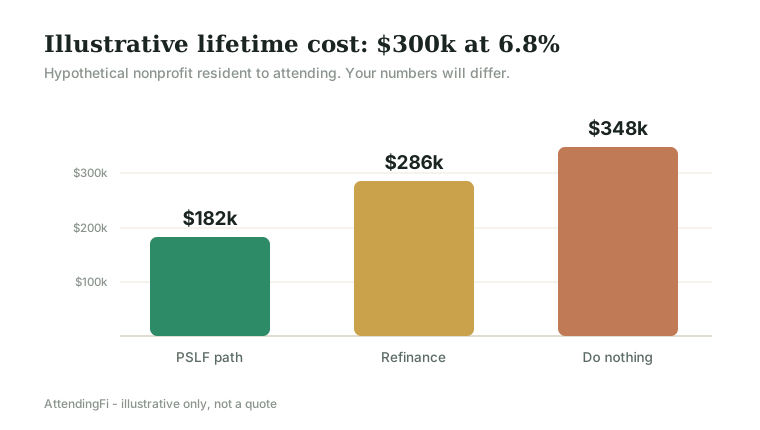
On a qualifying nonprofit path, the resident makes low income-driven payments through training, then larger but still capped payments as an attending until the 120-payment mark, where the remainder is forgiven tax-free. Total out of pocket lands far below the original balance. Refinancing to a lower rate and paying aggressively costs more here, because it throws away the forgiveness, even though the interest rate is lower. And doing nothing on a standard ten-year plan is the most expensive option of all.
Flip the inputs, though, and the ranking flips with them. Give that same person a $150,000 balance and a $450,000 private-practice income, and refinancing wins comfortably, because there was never enough debt to forgive. This is why a single "PSLF vs refinancing" verdict for all doctors is meaningless. The honest answer depends on your balance, rate, employer, specialty income now and later, and your family situation. That is exactly what our PSLF calculator and full engine model, month by month.
Why refinancing is a one-way door
Here is the asymmetry that should govern your timing. Staying federal keeps every option open. Refinancing closes them permanently. When you refinance federal loans into a private loan, you cannot undo it: PSLF and income-driven forgiveness are gone forever, and so is every qualifying payment you had already banked.
That is why the order of operations is always the same: confirm your PSLF path first, and only refinance once you have genuinely ruled forgiveness out. A lender-run "free" calculator will not frame it this way, because refinancing is how the lender gets paid. We have no loan to sell you, so we will tell you plainly when staying federal is the better move.
The trap: refinancing during residency to shave a point off the rate feels responsible, but it can quietly destroy a six-figure forgiveness opportunity you did not realize you were on track for. Run the forgiveness math before you sign anything private.
What changed in 2026
The repayment landscape shifted meaningfully heading into 2026, which makes a fresh look worthwhile even if you decided this once before. The SAVE plan was halted by litigation, leaving many borrowers in an interest-free forbearance while the courts and the Department of Education sorted out next steps; our SAVE forbearance guide covers what that means for your PSLF count.
The 2025 budget law also reshaped the income-driven menu, phasing in a new Repayment Assistance Plan (RAP) alongside a revised IBR, and narrowing the choices available to newer borrowers. We compare them head to head in RAP vs IBR for physicians and summarize the full set of changes in our 2026 changes guide. None of this alters the core PSLF vs refinancing logic, but it does change which income-driven plan sits underneath a PSLF strategy, and that affects your monthly payment.
One more moving piece worth watching: the federal tax treatment of non-PSLF income-driven forgiveness. PSLF forgiveness remains tax-free, but forgiveness at the end of a 20- or 25-year income-driven term can be treated as taxable income, and the temporary federal exclusion that applied through 2025 is set to lapse. Our tax-bomb guide and state-tax overview walk through who is exposed.
Special cases: couples, MFS, and old loans
A few situations deserve their own math before you commit to either path.
Dual-physician couples. When both spouses carry large balances and both work for qualifying employers, PSLF can be extraordinarily valuable, but the income-driven payment depends on how you file taxes. Married-filing-separately can lower the payment that feeds a PSLF strategy, at the cost of some tax benefits. We unpack the tradeoff in married filing separately for student loans.
One spouse on PSLF, one not. It is common for one partner to chase forgiveness while the other refinances. That can be the right answer, but the filing decision links the two, so model them together rather than in isolation.
Old FFEL or Perkins loans. Loans that are not Direct loans generally must be consolidated into a Direct Consolidation Loan before they count toward PSLF, and the timing of that consolidation matters. If this is you, read the double consolidation guide before refinancing anything, because refinancing forecloses the option entirely.
How to actually decide, step by step
You can resolve the PSLF vs refinancing question in an afternoon if you take it in order. The goal is not to find the path with the lowest payment this month, but the one with the lowest total cost across the years it takes to clear the debt. Work through these five steps with your real numbers in front of you.
- Step 1: Confirm your employer. Is your current or planned employer a qualifying nonprofit or government entity? If yes, treat PSLF as your default and try to disprove it. If no, move to the refinancing analysis.
- Step 2: Count what you have banked. Pull your qualifying-payment count from your servicer or the PSLF Help Tool. Months already earned are forgiveness you have paid for, so do not throw them away lightly.
- Step 3: Estimate the forgiveness. Use the PSLF calculator to see how much would be forgiven on your trajectory. A large, tax-free forgiveness number is hard for any refinance rate to beat.
- Step 4: Price the refinance alternative. Get real rate quotes and run the refinance savings calculator to see the interest you would save by paying it off privately.
- Step 5: Compare lifetime cost, not monthly payment. The cheapest monthly payment and the cheapest lifetime cost are often different paths. Decide on total cost over the life of the loan.
Don't guess, get your personalized plan
AttendingFi runs the real federal-rules math on your exact numbers: PSLF, RAP, capped IBR, refinancing, and your year-by-year income, and it shows its work. Free, no login to see your answer, and yours to keep as your career changes.
Run my numbers →5 common mistakes doctors make with PSLF vs refinancing
Most expensive student-loan errors are not exotic. They are a handful of avoidable missteps that show up again and again in physician finances.
- Refinancing before checking PSLF eligibility. The most costly mistake of all. Once you refinance federal loans, forgiveness is gone for good, even if a qualifying employer was in your future. Always confirm your PSLF path before signing anything private.
- Comparing monthly payments instead of lifetime cost. A lower monthly payment can hide a higher total cost, and vice versa. The number that matters is what you pay over the entire life of the loan, including any tax-free forgiveness at the end.
- Forgetting the tax treatment. PSLF forgiveness is tax-free, but forgiveness at the end of a 20- or 25-year income-driven term may be taxable. Pricing a non-PSLF forgiveness path without accounting for that tax can flatter it by tens of thousands of dollars.
- Choosing the wrong income-driven plan underneath PSLF. PSLF sits on top of an income-driven plan, and the plan you pick sets your monthly payment. With RAP and a revised IBR now in the mix, the right base plan can lower what you pay while you march toward forgiveness.
- Letting payments go uncertified. Qualifying months only help if they are documented. Certify employment regularly so your count is accurate, and so you are not surprised near the finish line. If your count looks short, our buyback tools may help recover missing months.
None of these require a finance degree to avoid. They require running the numbers once, carefully, before you make an irreversible move, and revisiting them when your employer, income, or the rules change. That is the entire reason the PSLF vs refinancing decision deserves more than a five-minute lender calculator.
Frequently asked questions
Is PSLF or refinancing better for doctors?
It depends entirely on your employer and your debt-to-income ratio. If you work for a qualifying nonprofit or government employer and carry high debt, PSLF usually wins, especially with training-year payments banked. If you are in private practice with strong income and a modest balance, refinancing typically wins. Run both on your numbers before deciding.
Can I switch from refinancing back to PSLF?
No. Refinancing federal loans into a private loan is permanent and forfeits PSLF and all federal forgiveness forever. That is why you should confirm you are not pursuing PSLF before you refinance.
Does residency count toward PSLF if I later refinance?
Only if you do not refinance. Qualifying residency payments count toward PSLF, but refinancing erases that progress by converting your federal loans to private debt.
How much can a physician save by choosing correctly?
For a high-debt borrower on a qualifying employer path, choosing PSLF over refinancing can mean six figures of tax-free forgiveness. For a high-income, low-debt private-practice physician, choosing to refinance can save tens of thousands in interest. The size of the swing is exactly why the decision is worth modeling carefully.
Should I refinance during residency to lock in a low rate?
Usually not, if a qualifying employer is anywhere in your plans. Refinancing during residency can quietly destroy a forgiveness opportunity worth far more than the interest you would save. Confirm your PSLF path first.
Educational estimates, not financial, tax, or legal advice. Verify program rules at studentaid.gov and confirm major decisions with a qualified advisor. See our methodology and disclosures.