The married-filing-separately move
Married filing separately for student loans is one of the most powerful and most misunderstood levers a physician couple has. On income-driven plans, filing separately can exclude your spouse's income from your payment calculation, sometimes slashing the monthly payment that feeds a PSLF strategy and dramatically increasing what gets forgiven. But it comes at a real tax cost. This guide explains exactly when married filing separately pays off for student loans, when it backfires, and how to decide on your own numbers.
How filing status affects your loan payment
Income-driven repayment plans base your monthly payment on your income, but exactly whose income counts depends on how you file your taxes. When a married borrower files jointly, the plan generally counts both spouses' incomes, raising the payment. When they file separately, the plan can count only the borrower's own income, often producing a substantially lower payment.
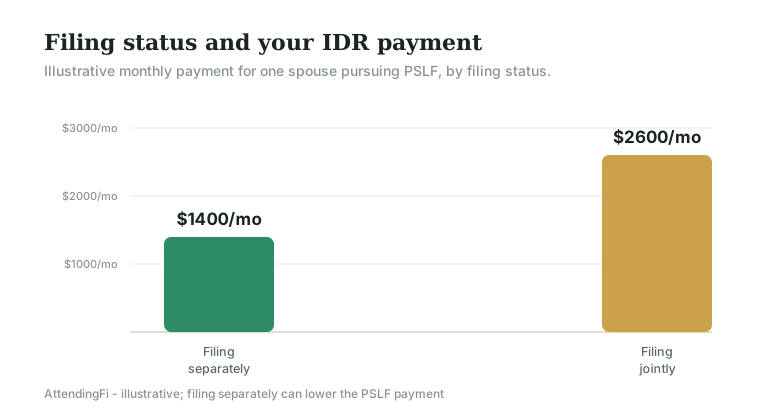
For a physician married to a high earner, this difference can be enormous. Filing jointly might push their income-driven payment up sharply by including the spouse's salary; filing separately can keep the payment tied to the physician's income alone. On a PSLF path, where a lower payment means more is forgiven, that gap translates directly into dollars of forgiveness.
This is the entire reason married filing separately is a student loan strategy at all. It is not about the loans in isolation but about the interaction between your tax filing and your repayment plan. Understanding that your filing choice changes your loan payment is the first step to deciding whether the trade is worth it for your household.
What married filing separately can gain
The gain from filing separately is a lower income-driven payment, and on a forgiveness path, more forgiven. By excluding a spouse's income from the calculation, a physician can keep their payment low, banking the difference as additional forgiveness at the end of a PSLF or income-driven term. For a high-debt physician with a high-earning spouse, this can be worth tens of thousands of dollars over the life of the loan.
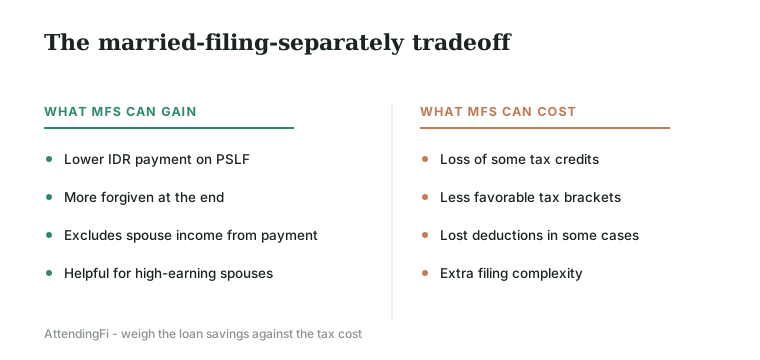
The magnitude of the gain depends on the gap between your income and your household income. The larger your spouse's income relative to yours, the more filing jointly would have inflated your payment, and the more filing separately saves. For a single-physician household where the spouse earns little, the gain may be small; for a physician married to another high earner, it can be substantial.
Crucially, the gain shows up as reduced payments now and increased forgiveness later, both of which are real money. On a PSLF path especially, every dollar of payment you avoid is a dollar added to your tax-free forgiveness, which makes the filing decision one of the higher-leverage choices a married physician can make about their loans.
What married filing separately can cost
Filing separately is not free. The tax code generally treats married-filing-separately less favorably than married-filing-jointly, and choosing it can cost you various tax benefits. These can include the loss of certain credits and deductions, less favorable tax brackets in some situations, and added filing complexity. For some couples, the tax cost is significant.
This is the heart of the tradeoff. Filing separately lowers your loan payment but raises your tax bill, and the net result depends on the relative size of those two effects for your specific household. A couple whose loan savings dwarf the tax cost should file separately; one whose tax cost exceeds the loan savings should file jointly. There is no universal answer, only the answer for your numbers.
Because the tax cost varies so much by situation, this is a calculation that genuinely requires running both scenarios. A common mistake is to assume filing separately always wins because it lowers the loan payment, ignoring the tax side. The right decision balances both, which is why modeling the full picture, loan savings and tax cost together, is essential.
Why MFS matters most on a PSLF path
Married filing separately delivers its biggest benefit for borrowers pursuing PSLF, because on a forgiveness path the money you do not pay is forgiven tax-free. A lower payment from filing separately does not just ease cash flow; it directly increases the balance forgiven at payment 120. The loan savings are amplified by the forgiveness, making the strategy especially valuable.
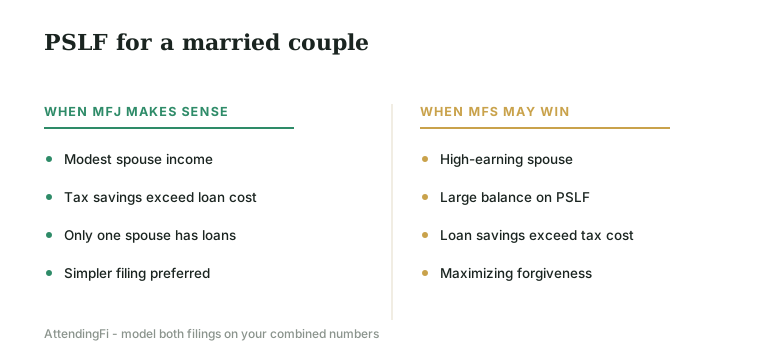
For a non-PSLF borrower heading toward a taxable income-driven forgiveness, the calculus is murkier, since a lower payment leaves a larger balance to be forgiven and taxed. The MFS benefit is cleanest when the forgiveness is tax-free, which is the PSLF case. This is one more reason the strategy is so closely associated with physicians pursuing PSLF.
The practical takeaway is that a married physician on a PSLF path with a higher-earning spouse should seriously evaluate filing separately, because the potential forgiveness gain is large. The tax cost still has to be weighed, but the upside on a tax-free forgiveness path is exactly where MFS most often comes out ahead.
Dual-physician and high-earning couples
Couples where both partners are physicians, or where one physician is married to another high earner, face the most consequential filing decision. With two large incomes, filing jointly would inflate the income-driven payment substantially, so the loan savings from filing separately can be very large. At the same time, two high earners often face a meaningful tax cost from filing separately.
The result is a genuine optimization problem unique to each couple. For some dual-physician households, the loan savings on one or both partners' PSLF paths exceed the tax cost, and filing separately wins. For others, the tax cost dominates. The answer depends on each spouse's income, each one's loan balance and forgiveness path, and the specific tax effects.
These couples also have to consider that both partners' loans interact with the single filing decision. You cannot file separately for one spouse's benefit and jointly for the other's; the household files one way. So the optimization is at the household level, weighing the combined loan savings across both partners against the combined tax cost, which is exactly the kind of analysis worth modeling carefully.
How to decide on married filing separately
Deciding comes down to a comparison: estimate your household tax under both filing statuses, and estimate your loan payments (and resulting forgiveness) under both. If the loan savings from filing separately exceed the additional tax it costs, file separately; if not, file jointly. The decision is a net-dollars calculation, run on your actual numbers.
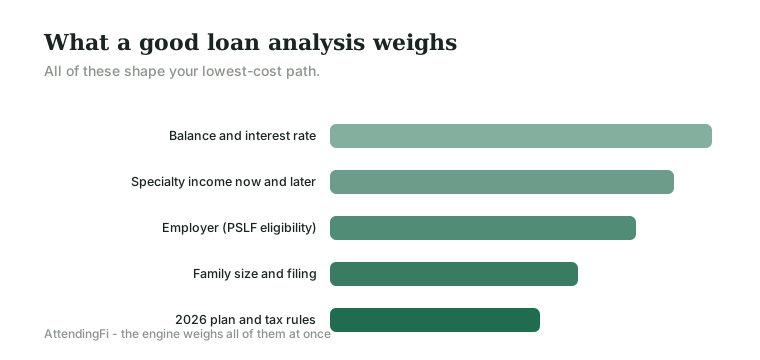
Because both the loan and tax sides depend on detailed specifics, this is best done with real figures rather than rules of thumb. A tax professional can quantify the tax cost of filing separately, while a loan analysis quantifies the payment savings and forgiveness gain. Putting the two together gives you the net answer for your household.
The engine handles the loan side, showing how your payment and forgiveness change with filing status on a PSLF path. Pairing that with a tax estimate lets you see the complete tradeoff. Run your numbers below to see the loan-side impact, then weigh it against the tax cost to make the call with confidence.
What changed for filing status in 2026
The 2026 changes to income-driven plans can affect how filing status interacts with your payment, since the new Repayment Assistance Plan and the revised IBR calculate payments under their own rules. Whether and how spousal income is counted, and therefore how much filing separately helps, can depend on which plan you are on, which now depends partly on when you borrowed.
This means the value of filing separately is not static; it depends on your current plan and the current rules. A strategy that clearly paid off under older plans should be re-evaluated under the 2026 menu, because the payment formulas, and thus the benefit of excluding spousal income, may differ. We cover the plan differences in RAP vs IBR.
The practical implication is to verify how your specific plan treats spousal income before assuming filing separately helps. For many PSLF borrowers on a qualifying plan that excludes spousal income when filing separately, the strategy remains powerful. But confirming the treatment under your current plan, rather than relying on past behavior, is the prudent step in 2026.
How to actually file separately for the benefit
If you decide filing separately is worth it, the mechanics matter. You and your spouse each file your own return as married-filing-separately, and you then recertify your income-driven plan using your separate income, so the plan reflects only your earnings. The timing of recertification relative to your tax filing can affect when the lower payment takes effect.
It is worth coordinating with a tax professional the first year you make the switch, both to confirm the tax cost you are accepting and to handle the filing correctly. Errors in how income is reported or recertified can undermine the benefit, so getting the process right the first time protects the savings you are pursuing.
Revisit the decision annually, since incomes change and so can the rules. A filing status that wins one year may not win the next if your or your spouse's income shifts, or if a plan change alters how spousal income is treated. Treating the filing decision as a yearly optimization, rather than a one-time choice, keeps you on the cheapest path.
Filing separately without PSLF
For couples not pursuing PSLF, married filing separately is a more complicated call. A lower income-driven payment still leaves more balance to be forgiven at the end of a 20- or 25-year term, but that non-PSLF forgiveness can be taxable, so a larger forgiven balance can mean a larger eventual tax. The clean PSLF benefit, lower payment equals more tax-free forgiveness, does not fully apply.
For these couples, filing separately may still help with monthly cash flow, but the long-run benefit is muddier and has to be weighed against both the current tax cost and the eventual forgiveness tax. This is another situation where modeling the complete picture, rather than assuming the PSLF logic carries over, prevents a decision that looks good monthly but costs more over time.
Key takeaways on married filing separately
Married filing separately can sharply lower a PSLF payment by excluding spousal income, but it carries a real tax cost. The right choice is a net-dollars calculation.
- Filing separately can exclude spouse income from your IDR payment.
- A lower payment means more forgiven on a PSLF path.
- But filing separately costs some tax credits, deductions, and brackets.
- The right choice depends on whether loan savings exceed the tax cost.
- Dual-physician and high-earning couples have the most at stake.
- Re-evaluate under the 2026 plan rules, which affect spousal-income treatment.
Weigh the loan savings against the tax cost on your real numbers. Run the loan side in the engine below, then pair it with a tax estimate to decide.
Get your personalized plan
Don't guess — model your exact numbers. AttendingFi runs the real federal-rules math on your numbers and shows its work. Free, no login needed to see your answer.
Run my numbers →Frequently asked questions
Does married filing separately lower student loan payments?
It can. On income-driven plans, filing separately may exclude your spouse's income from the payment calculation, lowering your payment, which on a PSLF path increases how much is forgiven. But it costs some tax benefits.
Is married filing separately worth it for PSLF?
Often, for a physician with a higher-earning spouse and a large balance, because the lower payment increases tax-free forgiveness. It is worth it when the loan savings exceed the additional tax cost, which you should calculate.
What does married filing separately cost in taxes?
It can cost certain credits and deductions and apply less favorable brackets, raising your tax bill. The size of the cost varies by household, so estimate it and weigh it against the loan savings.
Should dual-physician couples file separately?
It depends on their combined numbers. With two high incomes, filing separately can save a lot on loan payments but can also cost a lot in taxes. Model both the loan and tax sides at the household level.
Did the 2026 changes affect married filing separately?
They can. The new plans calculate payments under their own rules, and how spousal income is treated may differ by plan. Re-evaluate the strategy under your current 2026 plan rather than relying on past behavior.
Common mistakes with married filing separately
The most frequent mistake is treating married filing separately as automatically better because it lowers the loan payment, without ever quantifying the tax cost. Filing separately almost always reduces an income-driven payment when a spouse earns meaningful income, so the loan side looks like an obvious win in isolation. But the tax code penalizes separate filers in ways that can exceed the loan savings, and a couple that never runs the tax comparison can end up paying more overall while believing they optimized. The discipline of modeling both sides every year is what separates a real strategy from a costly assumption.
A second mistake is forgetting to recertify after changing filing status, so the lower payment the strategy promises never actually takes effect. The payment your servicer uses reflects the income documentation on file, and switching to separate filing only helps once that separate income is recertified. Couples who change their tax filing but neglect the loan-side paperwork capture the tax cost without the loan benefit, the worst of both worlds. Coordinating the tax return and the recertification is essential to realizing the gain you filed separately to get.
A third mistake is ignoring how the 2026 plan rules and a borrower's specific plan treat spousal income, and assuming behavior from prior years still applies. Because the new plans calculate payments under their own formulas, the value of excluding spousal income can differ from what it was, and a strategy that clearly won before may be weaker now. Verifying the treatment under your current plan, rather than relying on memory, prevents a stale assumption from driving an expensive decision.
Avoiding these mistakes comes down to a simple habit: each year, quantify both the loan savings and the tax cost, confirm the recertification follows the filing change, and verify the rules for your current plan. Couples who build that habit capture the full benefit of married filing separately when it wins and correctly choose joint filing when it does not, which is exactly the outcome the strategy is meant to produce.