Community property states and PSLF: how separate filing changes your payment
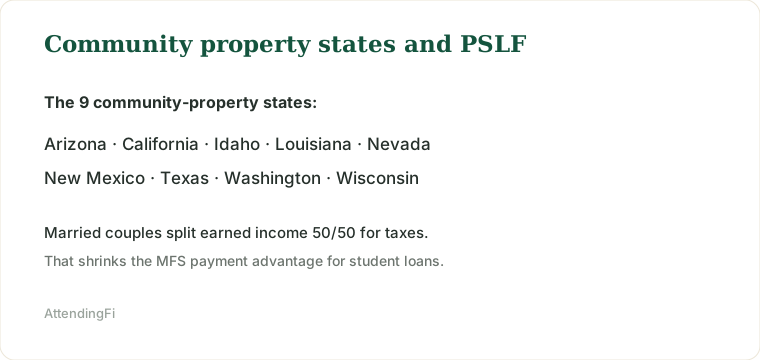
The nine community-property states
| Arizona | California | Idaho |
| Louisiana | Nevada | New Mexico |
| Texas | Washington | Wisconsin |
How the 50/50 split works
In these states, community (earned) income is treated as belonging equally to both spouses. So when you file separately, each return generally reports the average of the two earned incomes rather than your own. If one spouse earns $300k and the other $180k, both report about $240k on a separate return.
Community property states and PSLF: what it does to your payment
Income-driven payments are built on the income your return reports. Outside community-property states, filing separately lets a borrower pay on their own (often lower) income. Inside them, the split pushes both spouses toward the average, so:
- The higher-earning borrower benefits — their counted income drops toward the average.
- The lower-earning borrower is hurt — their counted income rises toward the average.
So the usual MFS payment advantage is muted, and which spouse it helps depends on who earns more and who carries the loans.
It also tends to erase the tax penalty
There’s an upside: because the split equalizes the two reported incomes, the federal “marriage penalty” of filing separately (which comes from income inequality) often shrinks to near zero. So in community-property states, MFS can lower the higher earner’s payment with little federal tax cost — a combination that occasionally makes MFS surprisingly strong for PSLF couples.
RAP and community property
RAP counts spousal income regardless of filing, so the community-property split doesn’t change a RAP payment. The split only matters on IBR-style plans.
Run it for your state
Because the direction depends on your income split and who has the loans, this is exactly the kind of question to model rather than guess. The physician couple calculator applies the community-property split automatically for these nine states and shows the result with a confidence level.
Frequently asked questions
Which states are community-property states for student loans?
Arizona, California, Idaho, Louisiana, Nevada, New Mexico, Texas, Washington, and Wisconsin. In these states, filing separately generally splits earned income 50/50 across the two returns.
Does community property help or hurt MFS for student loans?
It depends. The 50/50 split helps the higher earner (their counted income drops toward the average) and hurts the lower earner (theirs rises). It also tends to erase the federal tax penalty of separate filing, which can make MFS attractive for the higher-earning, loan-carrying spouse.
Does the community-property split affect RAP?
No. RAP counts spousal income regardless of filing status, so the split changes nothing for a RAP payment. It only affects IBR-style income-driven plans.
Free, no login, no email. Compare every plan’s monthly payment, total cost and forgiveness.
Run the couple calculator →