Physician couples student loans: a 2026 strategy guide
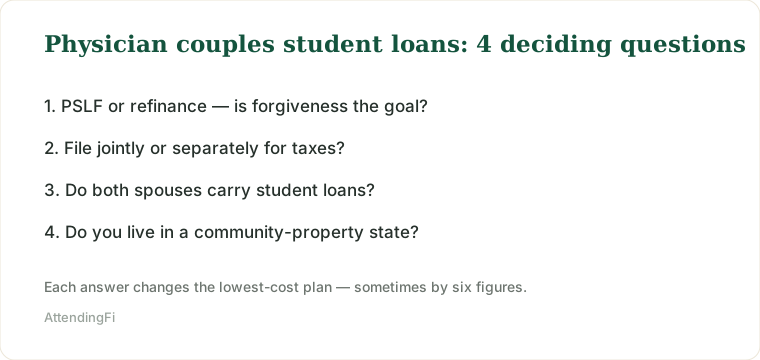
Physician couples student loans: the questions to answer
- Who has loans? One spouse, or both? Both-borrower households have more to optimize.
- Who is pursuing PSLF? Each spouse’s employer (nonprofit/government vs for-profit) is decided independently.
- How do you file? Jointly (MFJ) or separately (MFS) — a single shared choice that changes both spouses’ payments and your tax.
- What state? Community-property states change the separate-filing math.
One borrower vs. both borrowers
If only one spouse has loans, the question is whether to shield the other spouse’s income by filing separately. If both have loans, the calculus is richer: on a joint return each spouse’s payment is prorated by their share of the couple’s total debt; filing separately lets each pay on their own income (and each applies the family-size deduction). That can lower both payments — valuable if you’re both pursuing PSLF.
Dual PSLF, or a PSLF + refinance mix
When both spouses pursue PSLF, separate filing often lowers both payments and sends more to tax-free forgiveness. When one spouse refinances (leaving the federal system) and the other pursues PSLF, the refinanced loan is fixed and filing-invariant, so the decision reduces to the PSLF spouse’s situation — usually still favoring whatever minimizes their qualifying payments.
The filing decision is the big lever
For most physician couples, the joint-vs-separate filing choice moves the number more than the choice of plan. Separate filing lowers IBR-style payments but raises taxes; the right answer is whichever leaves more in your pocket once both are counted. See when MFS saves more than it costs for the decision framework and MFJ vs MFS for PSLF for the PSLF angle.
Run your couple’s numbers
Because the answer depends on both incomes, both balances, both employers, your state, and your children, there’s no rule of thumb that’s reliable. Model it: the physician couple calculator compares joint vs separate across both spouses and reports the lifetime difference with a confidence level.
Frequently asked questions
Should a physician couple file taxes jointly or separately for student loans?
It depends on who pursues PSLF, your income split, your state, and whether both spouses have loans. Separate filing lowers income-driven payments but raises taxes; the right choice is whichever lowers lifetime cost. Model your specific numbers and confirm with a CPA.
What if both spouses are physicians with loans?
Then the filing choice affects both payments plus one shared tax return. On a joint return each payment is prorated by debt share; separate filing lets each pay on their own income and apply the family-size deduction. Dual-PSLF couples often benefit from separate filing — model it.
Does it matter which spouse pursues PSLF?
Each spouse's PSLF eligibility is independent (it depends on their own employer). A couple can have one, both, or neither spouse pursuing PSLF, and that mix changes the optimal filing strategy.
Free, no login, no email. Compare every plan’s monthly payment, total cost and forgiveness.
Run the couple calculator →