Should I refinance my medical school loans?
Refinancing replaces your federal (or existing private) loans with a new private loan, ideally at a lower interest rate. Done at the right moment, it can save a physician tens of thousands of dollars. Done at the wrong moment, it can permanently destroy a benefit worth far more. The trick is knowing which situation you're in. Work through these questions in order.
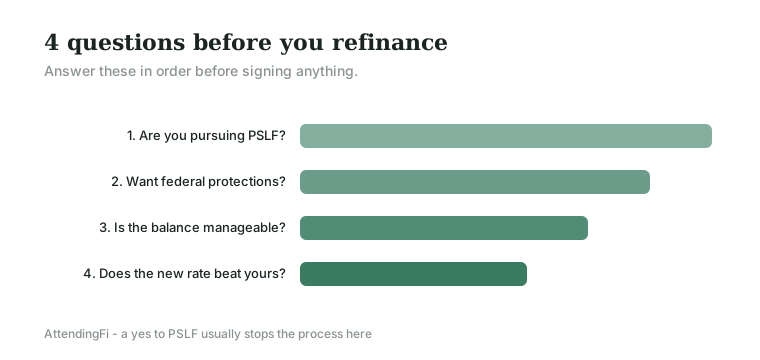
Question 1: Are you pursuing PSLF, or might you?
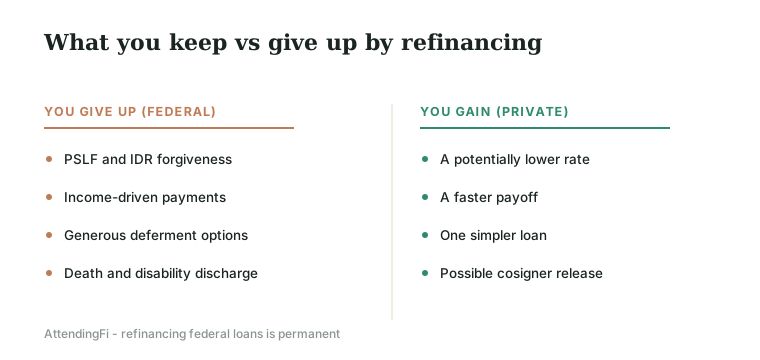
This is the gate, and it stops most physicians before they go any further. If you work, or might work, for a nonprofit or government employer, you may be on track for Public Service Loan Forgiveness, and refinancing your federal loans would forfeit it permanently. Because the value of PSLF for a high-debt physician routinely runs into six figures of tax-free forgiveness, even a small chance you will pursue it is usually reason enough not to refinance the federal portion yet.
The honest version of this question is not "am I certain about PSLF today," but "could a qualifying employer realistically be in my future." Residents especially should answer carefully, because their training years may already be banking qualifying payments. If you are confidently headed for private practice with no nonprofit employer in sight, you can move past this gate. Otherwise, confirm your PSLF math first; our PSLF vs refinancing guide walks through that comparison directly.
If you work (or expect to work) for a nonprofit hospital, academic center, or government employer, do not refinance. Refinancing converts your loans to private debt and permanently forfeits Public Service Loan Forgiveness, potentially six figures of tax-free forgiveness. Even if you're unsure, the option to pursue PSLF has real value; don't give it away cheaply. This single question disqualifies refinancing for a large share of physicians.
Rule of thumb: if there's a reasonable chance you'll spend your career at a qualifying employer, stay federal until you're certain. You can always refinance later; you can't un-refinance.
Question 2: Do you still want federal protections?
Federal loans come with protections that a private refinance loan simply does not offer, and once you refinance you cannot get them back. Income-driven repayment caps your payment at a share of your discretionary income, which is invaluable during a low-earning residency or any future income dip. Federal loans also offer generous deferment and forbearance, and they are discharged if the borrower dies or becomes permanently disabled, protecting your family in a worst-case scenario.
Federal loans come with safety nets private loans don't: income-driven payments if your income drops, generous deferment and forbearance, and the income-driven forgiveness backstop. If your balance is very large relative to your income, those protections, and the possibility of forgiveness, may be worth more than a slightly lower rate. Refinancing trades all of that for a fixed contract.
Question 3: Is your balance manageable for your income?
Refinancing rewards borrowers whose debt is small relative to their income, because they will clearly pay the loan off in full and never reach any forgiveness. A high earner with a moderate balance is the classic candidate: there is nothing to forgive, so a lower rate is pure savings. If, on the other hand, your balance dwarfs your income and you work for a qualifying employer, forgiveness is likely the bigger prize and refinancing would throw it away.
A useful rule of thumb: when your student debt is greater than about twice your income and a nonprofit employer is in the picture, lean toward keeping federal loans and pursuing forgiveness. When your debt is well under your income and you are in private practice, refinancing usually wins. Anywhere in between, the answer depends on the details, which is exactly what the engine models.
For an attending with a balance that's modest relative to a strong, stable income, say, you'll comfortably pay it off in 5–10 years, refinancing to a lower rate is often the cheapest path. You won't reach income-driven forgiveness anyway (you'd pay it off first), so the federal benefits aren't doing much for you, and a lower rate simply saves interest.
Question 4: Will the new rate actually beat your current one?
Only once the first three questions point toward refinancing does the interest rate matter. Compare any offer against your weighted-average federal rate, not your highest single loan, since refinancing replaces all of them at once. A rate that is only marginally lower may not justify giving up federal protections, while a rate a full point or two below your federal average can save real money over the life of the loan.
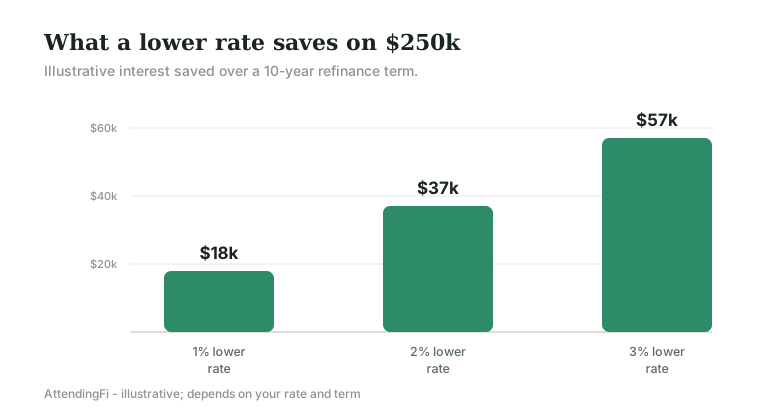
Refinancing only helps if the new rate is meaningfully lower than what you're paying now. Physicians with strong credit and stable income tend to qualify for the best available rates, in 2026, competitive fixed physician rates have run roughly 4.0–5.5%, with shorter terms priced lowest. If your federal rate is already below that, refinancing may not save enough to justify losing federal flexibility.
Should you refinance during residency?
Residency is the moment many physicians are tempted to refinance, because lenders market low "resident" rates and a $100-a-month payment looks attractive against a federal bill. In most cases, it is the wrong move. Refinancing during training converts your federal loans to private debt and erases any qualifying PSLF payments you are quietly banking at your nonprofit teaching hospital, often the most valuable months you will ever make because your income is so low.
There are narrow exceptions. A resident with a modest balance, a spouse with strong income, and a confirmed private-practice future might refinance to lock a rate. But for the typical resident carrying $200,000 or more and headed for a hospital-employed job, the right move is to stay federal, enroll in an income-driven plan, and certify employment, then revisit refinancing as an attending once the PSLF question is truly settled.
Common refinancing mistakes physicians make
A handful of avoidable errors account for most refinancing regret. Refinancing before ruling out PSLF is the costliest. Chasing the lowest advertised rate without reading whether it is a variable rate that can climb is another. Picking a term purely for the lowest monthly payment, and quietly paying far more interest over time, is a third. And refinancing the entire balance when only part of it makes sense, rather than keeping a federal slice for flexibility, is a fourth. Each is easy to sidestep once you know to look for it.
Choosing a term once you've decided to refinance
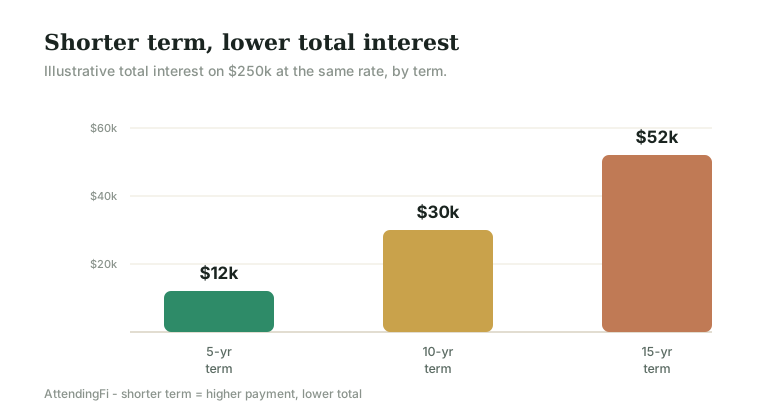
Shorter terms carry lower rates and far less total interest, but higher monthly payments. Longer terms lower the monthly bill but cost more overall. The right term is the shortest one whose monthly payment fits comfortably in your budget, that minimizes total interest without straining your cash flow. Seeing all the terms side by side (monthly vs. total cost) makes the tradeoff obvious.
Timing: now or wait?
If you're a resident a year or more from finishing, there's a strong case to wait. Your best refinance rates arrive once you're an attending with a high, stable income, and staying federal during your low-income training years keeps your payments tiny and your PSLF option open. Refinancing in residency locks in a worse rate and closes federal doors. Most physicians who ultimately refinance do it after starting as an attending.
If you're already an attending with no PSLF plans and a manageable balance, you're in the strongest position to refinance, and locking a fixed rate sooner protects you if rates rise.
Don't guess your rate. Our engine models refinancing at today's actual physician rates across every term, compares it against doing nothing, PSLF, and income-driven plans, and tells you whether refinancing is truly your cheapest path, before you ever talk to a lender.
A worked example: when refinancing wins, and when it loses
Numbers make the decision concrete. Picture two physicians, each with $250,000 in loans. The first is a private-practice dermatologist earning $450,000 with no nonprofit employer in her future. For her, no forgiveness will ever arrive, so refinancing from a 7% federal average to a 4.5% private rate turns the rate gap into tens of thousands of dollars of real savings over a short, aggressive term. Refinancing clearly wins.
The second is a hospital-employed internist earning $250,000 at a nonprofit, who already banked four years of qualifying payments in residency. For him, staying federal and finishing PSLF forgives a large, tax-free balance that no private rate could match. Refinancing would torch that opportunity to save a comparatively small amount of interest. Same balance, opposite answer, because the employer and debt-to-income are different. This is why a blanket "you should refinance" or "never refinance" is useless, and why running your own numbers matters.
How to refinance medical school loans, step by step
If the four questions have pointed you toward refinancing, here is a clean way to do it without missteps.
- Confirm PSLF is truly off the table. Re-check that no qualifying employer is in your plans, because this step is irreversible.
- Gather your loan details. Know your total balance and your weighted-average interest rate, so you can judge offers accurately.
- Shop multiple lenders. Rates and terms vary, and most lenders let you check offers with a soft credit pull that does not affect your score. Compare at least three.
- Choose fixed vs variable and a term you can sustain. Favor a fixed rate and the shortest term whose payment you can comfortably carry, since that minimizes total interest.
- Consider refinancing only part of the balance. Keeping a federal slice preserves some flexibility while still capturing savings on the rest.
- Re-evaluate later. Rates change and so do careers. Refinancing once does not mean you cannot refinance again to a better private rate down the road.
Compare lender offers and estimate your savings with the refinance savings calculator, and see how refinancing stacks up against every federal path in the full engine before you commit.
Fixed vs variable, and how physician rates are set
Once you have decided to refinance, the fixed-versus-variable choice is the next real decision. A fixed rate stays the same for the entire term, so your payment is predictable no matter what happens in the broader economy. A variable rate is tied to a benchmark and can rise or fall over time; it often starts lower than a comparable fixed rate, which is the bait, but it shifts the risk of rising rates onto you.
For a physician who values certainty and plans to carry the loan for several years, a fixed rate is usually the safer call, and the peace of mind of a payment that never moves is worth a great deal during the unpredictable early-attending years. A variable rate only makes sense if you intend to pay the balance off very quickly, before rate movements have time to matter.
Lenders set the rate they offer you based on your credit profile, your income and specialty, your chosen term, and whether you add a cosigner. Physicians are attractive borrowers because of their strong and rising income trajectory, which is why specialized lenders compete for medical refinances and why shopping multiple offers pays off. A shorter term almost always carries a lower rate than a longer one, so the term you choose affects both your monthly payment and the rate itself.
Do not assume the first offer is the best one; a second or third quote frequently beats it, and the difference of even a quarter point on a large balance is real money. Many lenders also waive fees for physicians, so confirm there are no origination or prepayment penalties before you sign.
Finally, treat refinancing as a decision you can revisit rather than a one-time gamble. If rates fall later, or your income climbs and you want a shorter term, you can refinance again. The irreversible part is leaving the federal system in the first place, which is why every section above keeps returning to the same discipline: rule out forgiveness first, then optimize the private loan as much as you like. Get that order right and refinancing becomes a straightforward way to save money rather than a costly mistake. When you are ready, model your exact numbers below and see the lifetime cost of every path side by side.
Frequently asked questions
Should I refinance my medical school loans during residency?
Usually not, if a nonprofit or government employer is anywhere in your future. Refinancing during residency forfeits PSLF and erases qualifying payments you may be banking at low resident income. For most residents, staying federal and revisiting the decision as an attending is the better move.
Can I refinance only some of my loans?
Yes. You can refinance a portion of your balance and keep the rest federal. Some physicians refinance a private or high-rate slice while keeping federal loans for their protections and forgiveness options. Just remember anything you move to a private lender loses federal benefits permanently.
Does refinancing federal student loans hurt my credit?
A refinance involves a hard credit inquiry and opens a new loan, which can cause a small, temporary dip. The bigger consideration is not your credit score but the permanent loss of federal protections and forgiveness when you refinance federal loans.
Fixed or variable rate when I refinance?
A fixed rate locks your payment for the life of the loan; a variable rate may start lower but can rise. For most physicians who want predictability, a fixed rate on a term they can pay off quickly is the safer choice. A variable rate makes more sense only if you plan to pay the loan off very fast.
Related guides
Educational only, not financial advice. Refinancing federal loans permanently forfeits federal benefits. Get personalized quotes (soft credit check) before deciding.
Model how fast you could be debt-free with our student loan payoff calculator.