Refinancing student loans: the real pros and cons for doctors
The short version
- Refinancing can save a physician $20,000–$100,000+ in interest, but only if you're not pursuing forgiveness.
- Refinancing federal loans is permanent and irreversible: you give up PSLF, income-driven plans, and disability discharge forever.
- Analysis across the field suggests refinancing is right for only about 20–30% of physicians, mostly private-practice attendings with manageable balances.
- The honest answer depends on your numbers. Run them free before you talk to any lender.
Understanding refinancing student loans pros and cons is the difference between a smart financial move and an irreversible mistake. For an attending physician with a large balance, a strong income, and no plan to pursue forgiveness, refinancing can shave real money off the cost of debt. For a resident or anyone counting on Public Service Loan Forgiveness, the same decision can quietly destroy a far more valuable benefit. This guide lays out the genuine pros, the permanent cons, and exactly who should and should not refinance, so you can decide with clear eyes.
What refinancing student loans actually is
Refinancing replaces one or more existing student loans with a single new loan from a private lender, ideally at a lower interest rate. It is fundamentally different from federal consolidation: consolidation keeps your debt inside the federal system and is about repayment-plan access, while refinancing moves your debt out of the federal system entirely in exchange for new private terms. That distinction is the root of every pro and con that follows, because leaving the federal system means leaving behind everything the federal system provides.
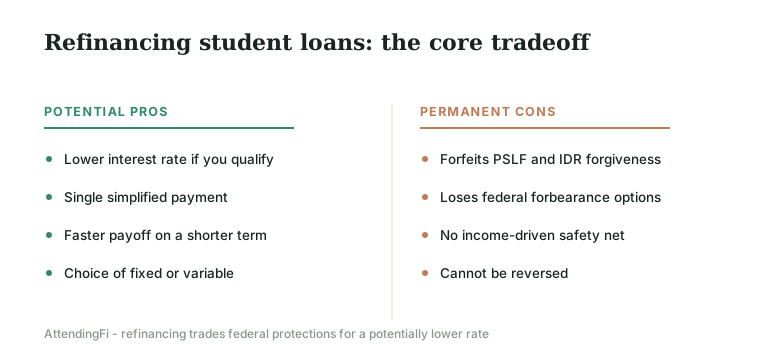
When you refinance, a private lender pays off your old loans and issues you a new one, with an interest rate based on your credit, income, and the term you choose. You can often pick a fixed or variable rate and a repayment term from roughly five to twenty years. A shorter term and a lower rate reduce total interest; a longer term lowers the monthly payment but usually raises lifetime cost. None of this involves the federal government, which is precisely why it carries both the upside and the risk it does.
Because refinancing is a private transaction, it is also essentially permanent in one direction. Once your federal loans are paid off by the private lender, you cannot move that debt back into the federal system to recover income-driven plans or forgiveness. You can refinance a private loan again later to chase a better rate, but you can never reverse the original step from federal to private. Treating refinancing as a one-way door is the single most important framing for weighing its pros and cons honestly.
The real pros of refinancing
The headline benefit is a lower interest rate. For a borrower with strong credit and a stable, high income, a private lender may offer a rate well below the federal rate, and on a large physician-sized balance even a modest reduction can translate into substantial savings over the life of the loan. Because physicians often carry six-figure balances, the dollar value of a rate cut can be larger for them than for almost any other type of borrower, which is what makes refinancing genuinely attractive in the right circumstances.
Refinancing can also simplify and accelerate payoff. Multiple loans with different rates and servicers collapse into a single monthly payment, which is easier to manage and harder to mishandle. And because you choose the term, a borrower who wants to be debt-free quickly can select a shorter repayment period and a correspondingly lower rate, aggressively retiring the balance. For someone who has decided they are not pursuing forgiveness and simply wants to pay the debt off efficiently, that control is a real advantage.
Finally, refinancing gives you a choice between fixed and variable rates, letting you match the loan to your risk tolerance and timeline. A borrower confident they will pay the loan off in a few years might accept a lower variable rate; one who wants certainty can lock a fixed rate for the full term. This flexibility, combined with the potential rate savings, is why refinancing is a legitimate and often excellent tool for the right borrower. The catch is entirely in what you give up to get it.
The permanent cons of refinancing
The defining con is that refinancing forfeits every federal benefit, permanently. Income-driven repayment plans, which cap payments at a share of your income, disappear. Public Service Loan Forgiveness, which can erase a large balance tax-free after ten years of qualifying work, becomes impossible for the refinanced debt. Federal forbearance and deferment protections, which let you pause payments during hardship, no longer apply. You trade a suite of powerful, government-backed safety nets for a private loan that offers none of them.
These protections are not abstract. A physician who refinances and then faces a disability, a job loss, an income drop, or a family emergency has no income-driven plan to fall back on and no federal forbearance to lean on; they owe the private payment regardless. The federal system's flexibility during hard times is one of its most valuable features, and it is exactly what refinancing surrenders. For borrowers whose income or circumstances are not yet stable, that lost safety net can matter more than any rate savings.
And because the step cannot be reversed, a con that looks minor today can become severe later. Someone who refinances while planning to stay in private practice, then unexpectedly takes a qualifying nonprofit or government job, has permanently forfeited the forgiveness they would otherwise have earned. The irreversibility means you are not just weighing your current situation but every plausible future one, which is why even financially strong borrowers should refinance only when they are confident they will never need what they are giving up.
Why PSLF changes the entire calculation
Public Service Loan Forgiveness is the single factor that most often turns refinancing from a smart move into a costly error. PSLF can forgive a physician's entire remaining federal balance, tax-free, after 120 qualifying monthly payments while working full-time for a qualifying government or nonprofit employer. On a large balance, the value of that forgiveness can dwarf any interest savings from refinancing, sometimes by a wide margin. Refinancing destroys PSLF eligibility for the refinanced loans the instant it happens.
This is why the very first question before refinancing should be whether PSLF is even possible for you. If you work, or might work, for a qualifying employer, refinancing forecloses a benefit that could be worth far more than a lower rate. Many academic medical centers, public hospitals, and nonprofit health systems qualify, so a large share of physicians have a realistic PSLF path whether or not they have committed to it. Giving that up should never be accidental.
The interaction with timing makes this even sharper for those early in training, because the years spent in residency at a qualifying hospital can generate a substantial number of qualifying payments at a low income-driven payment, which is the most valuable kind. We cover the forgiveness program in detail in our how PSLF works for physicians guide, and the comparison directly in PSLF vs refinancing. Anyone weighing refinancing should read those before deciding.
Residents, timing, and the refinancing trap
Residents face a particular version of this decision, and the most common mistake is refinancing too early. Lenders aggressively market low resident refinancing rates, and the offer can be tempting to a trainee tired of watching interest accrue. But residents are usually the borrowers with the most to lose from refinancing, because their residency years at a qualifying hospital can count toward PSLF at a very low income-driven payment, and refinancing throws away both the qualifying months and the option to keep accruing them.
For a resident who will pursue PSLF, the income-driven payment during training is often far lower than a refinanced payment would be anyway, so refinancing can cost more in the near term and forfeit forgiveness in the long term. Even a resident who is genuinely uncertain about PSLF is usually better off staying federal during training to preserve the option, because the cost of waiting is small and the cost of a wrong, irreversible refinance is enormous. Optionality is especially valuable when the future is uncertain.
The narrow exception is a resident who is certain they will enter private practice with no qualifying employer, has stable finances, and wants to start retiring debt early. Even then, many advisors suggest waiting until the attending transition, when income jumps and refinancing offers improve, to avoid locking in a permanent decision during the most uncertain phase of a career. The general rule for residents is simple: when in doubt, stay federal and refinance later if it still makes sense.
How much a lower rate actually saves
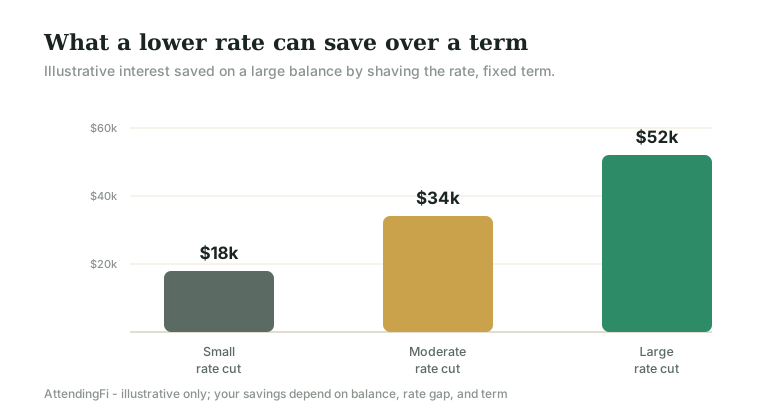
The savings from refinancing depend on three things: the size of your balance, the gap between your old and new interest rates, and the repayment term. On a large physician balance, a meaningful rate reduction can save tens of thousands of dollars over the term, because interest compounds on a big principal for years. The larger your balance and the wider the rate gap, the more refinancing saves, which is why it appeals most to high-balance borrowers with strong credit.
But the term matters just as much as the rate. Choosing a shorter term with a lower rate maximizes total interest savings but raises the monthly payment; choosing a longer term lowers the monthly payment but can erode or even erase the lifetime savings by stretching interest over more years. A lower monthly payment is not the same as a cheaper loan, and lenders often lead with the monthly figure. Always compare total cost over the full term, not just the payment, when judging an offer.
Crucially, the rate savings only count as a true benefit if you were never going to use the federal options you are giving up. For a PSLF-bound borrower, the right comparison is not the old federal rate versus the new private rate, but the lifetime cost with forgiveness versus the lifetime cost after refinancing, and forgiveness usually wins decisively. Modeling your actual numbers, rather than reacting to an advertised rate, is the only reliable way to know whether the savings are real for you.
When refinancing fits and when it does not
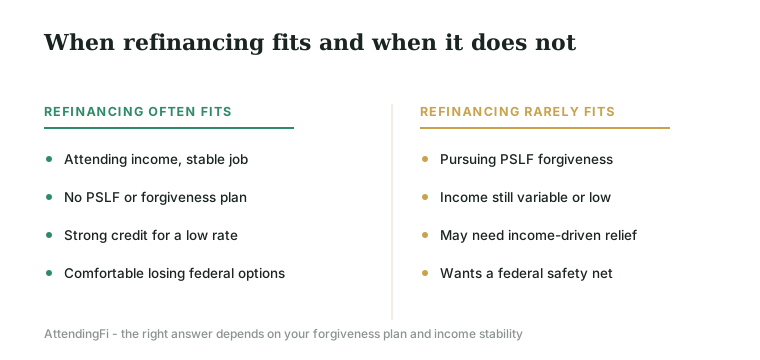
Refinancing fits best for an attending physician with a stable, high income, strong credit, and no plan to pursue forgiveness. For that borrower, the federal protections are unlikely ever to be needed, the safety net is largely redundant, and a lower private rate is close to pure savings. Someone in private practice at a for-profit employer, comfortable with their finances, and focused on paying down debt efficiently is the classic case where refinancing is the right and even obvious move.
Refinancing rarely fits a borrower pursuing PSLF, a resident or fellow whose income is still low and variable, or anyone who might need income-driven relief or a federal safety net in the foreseeable future. For these borrowers, the permanent loss of federal options outweighs the rate savings, often by a large margin. The presence of a realistic forgiveness path or unstable income is usually enough on its own to take refinancing off the table until circumstances change.
The honest answer for many borrowers is somewhere in between, which is why this is a decision to model rather than to make on instinct. If you are confident you will never use federal benefits, refinancing likely helps; if there is real uncertainty, the value of keeping your options usually wins. Running your specific balance, rate, income, and forgiveness path through a careful comparison is the only way to turn this from a guess into an informed choice.
How to refinance well, if you decide to
If you have concluded that refinancing fits your situation, do it deliberately. Shop multiple lenders, because rates and terms vary widely and the best offer can be meaningfully better than the first; most lenders let you check a personalized rate with a soft credit pull that does not affect your score. Compare offers on total cost over the full term, not just the monthly payment, and weigh fixed against variable rates based on how quickly you expect to pay the loan off and your tolerance for rate movement.
Make sure you have truly accounted for what you are giving up before you sign. Confirm you are not on, and do not expect to be on, a PSLF path; confirm your income is stable enough that you will not need income-driven relief; and confirm you are comfortable without federal forbearance if hardship strikes. Because the step is irreversible, this final check is not a formality but the most important part of the process, and it is worth being conservative about future uncertainty.
Finally, consider timing and sequencing. Refinancing offers generally improve as your income rises and your credit strengthens, so the attending transition is often the natural moment if refinancing is right at all. And if any part of your debt could benefit from federal options while another part clearly cannot, you do not have to refinance everything at once. A measured, well-timed refinance of the right loans beats a hasty refinance of all of them.
Key takeaways on refinancing student loans
Refinancing can lower your rate and save real money, but it permanently forfeits PSLF, income-driven repayment, and federal protections. The right choice hinges on your forgiveness path and income stability.
- Refinancing moves federal debt to a private loan, permanently and irreversibly.
- The main pro is a lower rate, valuable on large physician balances.
- The main con is losing PSLF, income-driven plans, and federal forbearance.
- PSLF eligibility usually outweighs rate savings, so check it first.
- Residents should usually stay federal to preserve forgiveness and optionality.
- Refinancing fits stable, high-income borrowers with no forgiveness plan.
Model your real numbers before giving up federal options. Run your balance, rate, income, and forgiveness path through a full comparison to decide with confidence.
Get your personalized plan
Don't guess — model your exact numbers. AttendingFi runs the real federal-rules math on your numbers and shows its work. Free, no login needed to see your answer.
Run my numbers →Frequently asked questions
What are the main pros and cons of refinancing student loans?
The main pro is a potentially lower interest rate, which on a large balance can save substantial money. The main cons are permanent: you lose PSLF, income-driven repayment plans, and federal forbearance protections, and the step cannot be reversed.
Should I refinance if I'm pursuing PSLF?
No. Refinancing permanently destroys PSLF eligibility for those loans, and PSLF's tax-free forgiveness usually far exceeds any interest savings on a physician-sized balance. Check your PSLF eligibility before considering refinancing.
Should residents refinance their student loans?
Usually not. Residency years at a qualifying hospital can count toward PSLF at a low income-driven payment, and refinancing forfeits that. Most residents should stay federal to preserve forgiveness and optionality, refinancing later only if it still fits.
How much can refinancing save me?
It depends on your balance, the gap between your old and new rates, and the term. On a large balance, a meaningful rate cut can save tens of thousands over the term, but only if you were never going to use the federal benefits you give up.
Can I undo a student loan refinance?
Not back into the federal system. Once a private lender pays off your federal loans, you cannot return that debt to federal status or recover income-driven plans and forgiveness. You can refinance a private loan again for a better rate, but the federal step is permanent.
Related guides
Educational only, not financial advice. Rates and figures are illustrative and change with the market; confirm current federal program rules at studentaid.gov. Refinancing federal loans permanently forfeits federal benefits.