How Public Service Loan Forgiveness works for doctors
The short version
- PSLF forgives your remaining federal Direct Loan balance tax-free after 120 qualifying monthly payments (about 10 years).
- You must work full-time for a nonprofit or government employer and repay on an income-driven plan.
- For physicians, residency usually counts, most teaching hospitals are nonprofit or government.
- The step doctors miss: certify your employment every year, not just at the end.
- PSLF eligibility checker
- Physician couple (MFJ vs MFS) calculator
Public Service Loan Forgiveness (PSLF) is the single most valuable student-loan benefit available to most physicians. It was created by Congress in 2007 and is written into federal law (Section 455(m) of the Higher Education Act), which matters: the core program cannot be ended by an executive order or agency decision, only Congress can repeal it, and it hasn't. Here's exactly how it works and how to use it correctly.
The core rule: 120 qualifying payments
PSLF forgives the entire remaining balance on your federal Direct Loans after you make 120 qualifying monthly payments, about ten years' worth. The forgiven amount is not taxed as income under federal law, which sets PSLF apart from income-driven forgiveness (which is taxable). For a physician carrying $200,000+ at a high attending salary, that tax-free forgiveness routinely outweighs anything refinancing could save.
A payment only "qualifies" when all of these are true at once:
- You have federal Direct Loans (other federal loans must be consolidated into a Direct Consolidation Loan first).
- You're on a qualifying income-driven repayment plan.
- You're working full-time (at least 30 hours/week) for a qualifying employer.
- The payment is on time (within 15 days of the due date) and for the full amount.
The 120 payments don't have to be consecutive. If you leave qualifying work and come back, your count picks up where it left off. There is also no cap on the amount that can be forgiven, which is precisely why the benefit scales so well with a large physician balance: the more principal and accrued interest remain at payment 120, the more disappears, tax-free.
How much PSLF is actually worth for a physician
The reason PSLF dominates the math for so many doctors is the size of the number. Because forgiveness arrives tax-free and physician balances are large, the value captured is often greater than a full year of attending take-home pay. The more you owe relative to your income, the more is left standing when payment 120 lands.
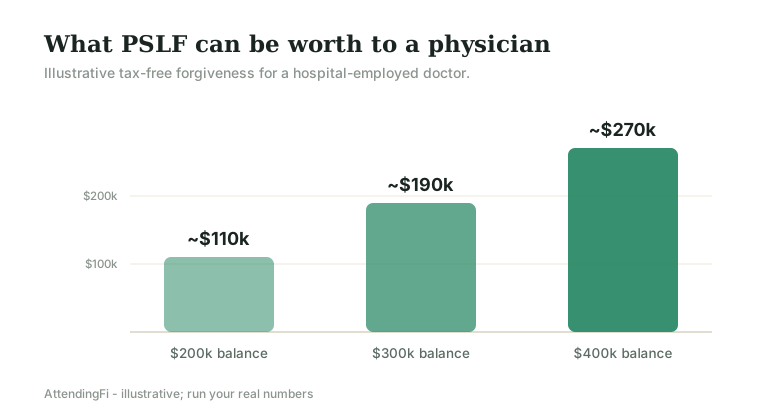
Consider a physician who finishes training with $300,000 in Direct Loans and moves into a hospital-employed attending role. Across roughly ten years of qualifying payments, much of which were small resident-salary payments, the remaining balance can be six figures, and none of it is taxed. To beat that with refinancing, a private lender would have to erase an enormous amount of interest, which almost never happens at these balances. This is the core reason we tell high-debt, nonprofit-employed physicians to confirm PSLF before considering anything else.
The 10-year path, visualized
Who counts as a "qualifying employer"?
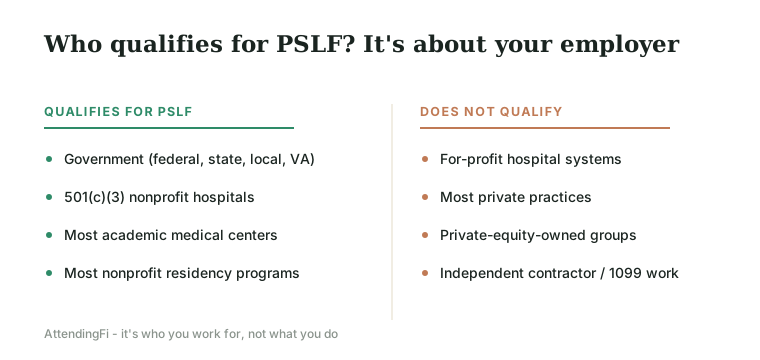
Qualifying employers are about who you work for, not what you do:
- Government at any level, federal, state, local, or tribal (including the VA and public hospitals).
- 501(c)(3) nonprofit organizations, which includes most academic medical centers and a large share of hospitals.
For-profit employers, including for-profit hospital systems and most private practices, do not qualify. Because roughly 70% of U.S. healthcare employers are nonprofit or government, a large share of physicians can qualify for PSLF if they plan around it.
PSLF for 1099, locum, and independent-contractor physicians
Full guide: PSLF for 1099 and locum physicians.
This is the single biggest reason physicians lose PSLF without realizing it: PSLF credit follows W-2 employment by a qualifying nonprofit or government employer — not who owns the building you work in. If you are paid as a 1099 independent contractor, you are generally not an employee of the hospital at all, so those months do not count toward PSLF, even if the hospital itself is a 501(c)(3) nonprofit.
Locum tenens work is the classic trap. Locums are almost always 1099 through a staffing agency, and a staffing agency is a for-profit company — so locum months typically earn zero PSLF credit no matter where you are placed. The same applies to physicians who contract with a hospital through their own LLC or S-corp: your own entity is not a qualifying employer, so the arrangement does not qualify.
The fix, if PSLF is your goal, is structural: you need to be a W-2 employee of the qualifying nonprofit or government organization, not a contractor to it. Before you accept a job, ask one question — “Will I be a W-2 employee of the nonprofit/government entity, or a 1099 contractor?” That single answer decides whether the years count.
One important exception: a handful of states (including California and Texas) legally bar nonprofit hospitals from employing physicians directly, so doctors there are employed by a separate medical group. Federal rules carve this out — if you provide care at a qualifying nonprofit or government facility in such a state, those hours can count even though a medical group issues your W-2. If that is your situation, confirm it in writing with the facility.
If your work is genuinely 1099 and W-2 employment is not realistic, PSLF probably is not your path — and that is fine. A high-earning 1099 physician is often better off comparing income-driven forgiveness (IBR or the new RAP) against simply refinancing and paying the loan down. Compare those paths on your numbers →
Why residency is the secret weapon
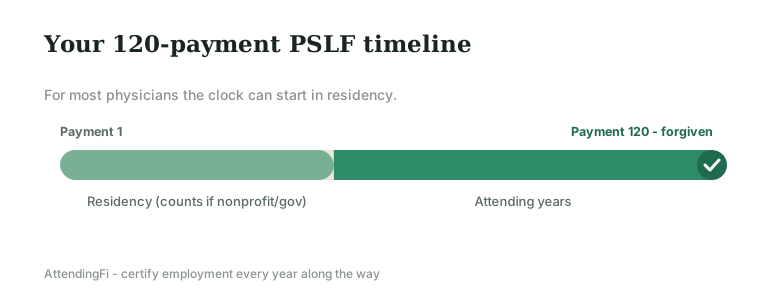
Most residencies and fellowships are based at nonprofit or government teaching hospitals. If yours is, those training years count toward your 120 payments, and because your resident income is low, your income-driven payments during training are tiny. That combination (qualifying employment + minimal payments) is exactly what makes PSLF so powerful for doctors: you can knock out 3–7 years of your 120 while paying very little, then finish the clock as an attending. If you train at a for-profit hospital, those years don't count and your clock effectively starts when you reach a qualifying employer. Our PSLF-for-residents guide covers this in detail.
How physicians lose PSLF credit (and how to keep it)
Almost every PSLF horror story traces back to the same handful of avoidable errors. None of them require bad luck. They happen quietly, and they are all preventable if you know to look.
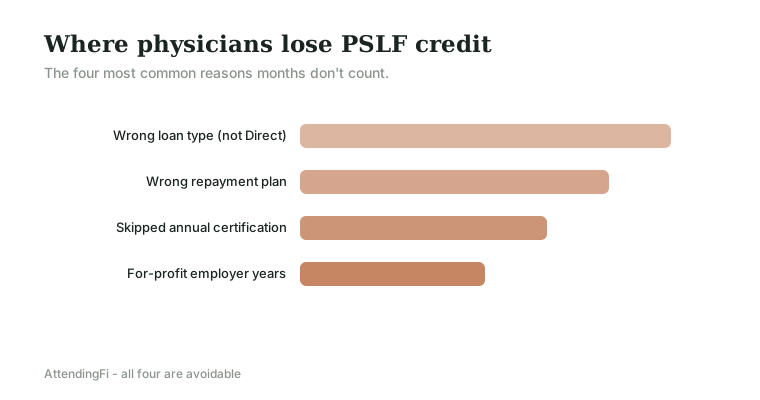
The biggest is having the wrong loan type. Only federal Direct Loans count, so older FFEL or Perkins loans must be consolidated into a Direct Consolidation Loan first, and consolidating resets the count on those loans. The second is being on a non-qualifying repayment plan, such as a standard or graduated plan that is not income-driven. The third is skipping annual certification, which lets errors pile up unnoticed. The fourth is time spent at a for-profit employer, which simply does not count. Catch these early and PSLF is remarkably forgiving; catch them at year ten and the fix is painful.
What counts as full-time, and what about part-time or two jobs
PSLF requires full-time work for a qualifying employer, which the program defines as at least 30 hours per week. For most employed physicians this is a non-issue, but a few situations deserve attention. If you work part-time for a single qualifying employer at fewer than 30 hours, those months may not count on their own.
If you hold more than one part-time job, you can combine the hours: as long as your total across all qualifying employers is at least 30 hours per week, you can still meet the full-time requirement. This matters for physicians who split time between, say, a nonprofit hospital and a separate academic appointment. Locum tenens and independent-contractor arrangements are trickier, because PSLF credit follows W-2 employment by a qualifying organization, not 1099 contracting. If your work is structured as contracting, confirm how it is classified before assuming those months count.
Why the repayment plan underneath PSLF matters
PSLF does not stand alone. It sits on top of an income-driven repayment plan, and that plan sets the monthly payment you make for ten years. Two physicians with identical balances can pay very different amounts toward the same forgiveness, simply because they chose different base plans. Since anything you pay is money not forgiven, a lower qualifying payment generally means more forgiven at the end.
This is where the 2026 changes intersect with PSLF. The new Repayment Assistance Plan (RAP) and the revised IBR calculate payments differently, and for a high-earning attending the difference can be substantial. The right base plan depends on your income, family size, and how many qualifying months you make as a resident versus an attending. We compare the options directly in RAP vs IBR for physicians, and the engine models the combination so you can see which plan minimizes what you pay on the road to forgiveness. Choosing the base plan well is one of the highest-leverage decisions in a PSLF strategy, and it is easy to get wrong by defaulting to whatever your servicer suggests.
When PSLF is not the answer
PSLF is powerful, but it is not universal. If you work, or plan to work, in private practice or for a for-profit group, you cannot earn PSLF credit, and the real decision becomes an income-driven plan versus refinancing. High earners with modest balances are often better off refinancing and paying the loan down fast, because little would ever be forgiven.
The honest test is simple: estimate your tax-free forgiveness on a PSLF path, then estimate the interest you would save by refinancing, and compare lifetime cost. Our PSLF vs refinancing guide walks through that fork in detail, and the engine runs it on your exact numbers. The point is that PSLF should be chosen because the math favors it, not by default.
Step by step: set up PSLF correctly
If you have decided PSLF fits your career, set it up in this order and you will avoid almost every common pitfall.
- Confirm your loans are Direct. Check your loan types at studentaid.gov. If you hold FFEL or Perkins loans, consolidate into a Direct Consolidation Loan before counting on PSLF.
- Enroll in a qualifying income-driven plan. Your monthly payment, and how fast you reach forgiveness, depends on which plan sits underneath PSLF. Compare RAP and IBR before choosing.
- File your first employer certification. Use the official PSLF Help Tool and have your employer's HR sign it. This locks in your qualifying months on the record.
- Re-certify every year and at every job change. This keeps your count accurate and surfaces problems while they are still fixable.
- Track your count. Watch your qualifying-payment total climb, and investigate immediately if it stalls. If months are missing, PSLF buyback may recover some of them.
The step most physicians miss: certify every year
You do not wait until year 10 to deal with paperwork. Every year, and every time you change employers, you should submit a PSLF & Employment Certification Form, generated through the official PSLF Help Tool, signed by your employer's HR. This keeps your official payment count accurate and catches problems early, while they're still fixable. Skipping it is the number-one reason physicians arrive at year 10 with fewer counted payments than they expected.
Do this now if you're pursuing PSLF: confirm your loans are Direct (consolidate if not), enroll in an income-driven plan, and file your first employer certification through the PSLF Help Tool. Then re-certify annually.
What changed for 2026
Three things shifted, and each affects a different group:
| Change | What it means for you |
|---|---|
| Employer rule (July 1, 2026) | The Department of Education can disqualify a small number of employers found to have a "substantial illegal purpose." Officials estimate fewer than 10 organizations a year, and it doesn't remove credit you've already earned. For the overwhelming majority of hospitals, nothing changes. |
| The new RAP plan | The Repayment Assistance Plan is the new income-driven plan launching in 2026. It can serve as a qualifying PSLF repayment plan, but for high-earning attendings the capped legacy IBR is often cheaper. See RAP vs IBR. |
| Consolidation deadlines | If you need to consolidate non-Direct loans to qualify, the timing around mid-2026 matters. Check current deadlines at studentaid.gov before acting. |
The headline: PSLF itself is intact. The 120-payment, 10-year structure is unchanged, and existing payment counts and completed forgiveness are protected.
See your PSLF timeline on your real numbers. AttendingFi models exactly when you'd hit 120 payments, accounting for whether your residency counts, and compares the tax-free forgiveness against refinancing and every other plan. Free, no login.
Frequently asked questions
Does residency count for PSLF?
Yes. Residency and fellowship years count toward PSLF as long as your program is a qualifying employer — which most nonprofit and government-run programs are — and you make qualifying payments on an income-driven plan. Those are often the cheapest qualifying payments of your career.
Does residency count toward PSLF?
Usually yes. Most residencies and fellowships are based at nonprofit or government teaching hospitals, and those years count toward your 120 payments. Because resident income is low, your income-driven payments during training are small, which makes those qualifying months especially valuable. If you train at a for-profit hospital, those years do not count.
Is PSLF forgiveness taxed?
No. PSLF forgiveness is tax-free under federal law. That is a key advantage over income-driven forgiveness, which can be treated as taxable income at the end of a 20- or 25-year term.
Can PSLF be canceled by a new administration?
The core program is written into federal law and can only be repealed by Congress, not by executive order or agency decision. Payment counts you have already earned and forgiveness already granted are protected.
Do I need to make all 120 payments in a row?
No. The 120 qualifying payments do not have to be consecutive. If you leave qualifying employment and return, your count resumes where it left off.
What if my employer will not certify my employment?
Use the PSLF Help Tool to generate the form, and work with your HR or payroll department to get it signed. If an employer is unresponsive, the Department of Education has alternative documentation processes. Certifying every year makes this far easier than waiting until the end.
Does PSLF work for dentists?
Yes. PSLF rules are the same for dentists as for physicians: the question is whether your employer is a qualifying nonprofit or government organization. Dentists employed by nonprofit hospitals, community health centers, or academic dental schools can qualify, while those in private dental practices generally cannot. A dental residency at a nonprofit teaching hospital typically counts toward your 120 payments.
What happens to PSLF if I switch jobs mid-career?
Nothing is lost as long as both employers qualify. Your payment count carries across jobs. The one thing to do is certify employment with your old employer before you leave, and with your new employer once you start, so there is no gap in your documented record. If you move to a for-profit employer for a stretch, those months simply do not count, and your clock resumes when you return to qualifying work.
One last point worth internalizing: PSLF rewards patience and paperwork, not cleverness. There is no trick that beats simply having Direct Loans, staying on a qualifying income-driven plan, working for a qualifying employer, and certifying every year. Physicians who treat it as a ten-year administrative habit, rather than a one-time decision, are the ones who reach payment 120 with their count intact and a six-figure balance erased. Set the system up correctly once, check it annually, and let the math work in your favor while you focus on medicine. If you would rather see your own PSLF date and forgiveness amount than read another rule, run your numbers below and the engine will lay out the entire timeline for you.
Related guides
Educational only, not financial advice. Program rules change; confirm current requirements and deadlines at studentaid.gov and certify your employment with the official PSLF Help Tool.