The student-loan "tax bomb," explained
There are two flavors of student-loan forgiveness, and they're taxed very differently. Understanding the difference is worth a great deal of money, because one of them can leave you with a five- or six-figure tax bill in a single year.
PSLF forgiveness is tax-free. Other forgiveness usually isn't.
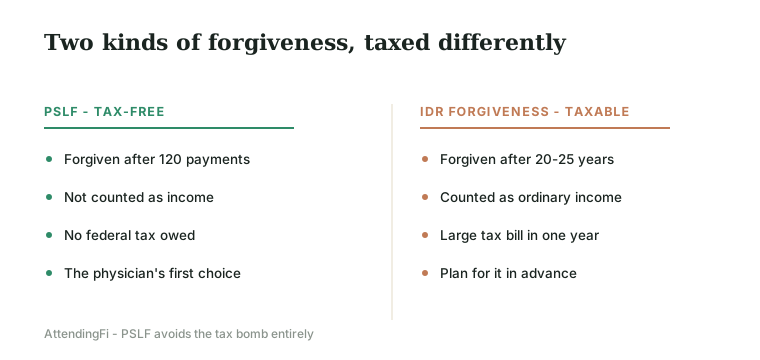
There are two paths to having a federal student loan wiped out, and the tax code treats them as opposites. Public Service Loan Forgiveness erases your balance after 120 qualifying payments and is explicitly tax-free under federal law. Nothing is added to your income, and no tax is owed. This is a large part of why PSLF is the single most valuable benefit available to most doctors.
Income-driven repayment forgiveness is different. If you are not pursuing PSLF and instead make income-driven payments for the full term, 20 or 25 years depending on the plan, any remaining balance is forgiven at the end, but that forgiven amount can be counted as ordinary taxable income in the year it happens. On a physician-sized balance, that is where the "tax bomb" detonates.
When you complete Public Service Loan Forgiveness, 120 qualifying payments at a nonprofit or government employer, your remaining balance is wiped out and, under current federal law, it is not treated as taxable income. That's what makes PSLF so powerful.
Forgiveness at the end of an income-driven plan (such as reaching the 20-, 25-, or 30-year mark on RAP or IBR without PSLF) is different. The forgiven balance can be counted as ordinary taxable income in the year it's forgiven. That's the "tax bomb."
A concrete example. Suppose you ride an income-driven plan to the finish line and $150,000 is forgiven in that final year. If that amount is added to your income, a high earner could owe roughly $50,000+ in additional federal and state tax, due that April. The forgiveness is still a win, but only if you saw the bill coming and saved for it.
What exactly is the tax bomb?
The "tax bomb" is the lump-sum income-tax bill that can arrive in the single year your income-driven loans are forgiven. Because the IRS can treat cancelled debt as income, forgiveness of a large balance can push you into top tax brackets for that one year and generate a bill in the tens of thousands of dollars, all due at once and not eligible for the slow payoff you enjoyed on the loan itself.
One critical exception shaped recent years: the American Rescue Plan Act of 2021 (ARPA §9675) temporarily excluded student-loan forgiveness from federal taxable income through December 31, 2025. That exclusion has now expired. For income-driven forgiveness received in 2026 and later, the forgiven balance is once again treated as federally taxable income in the year it is granted. (PSLF forgiveness stays tax-free under separate, permanent law.) Unless Congress restores the exclusion, the safe planning assumption for a non-PSLF borrower is that the forgiven amount will be taxed — so plan for it rather than be surprised.
Why physicians are especially exposed
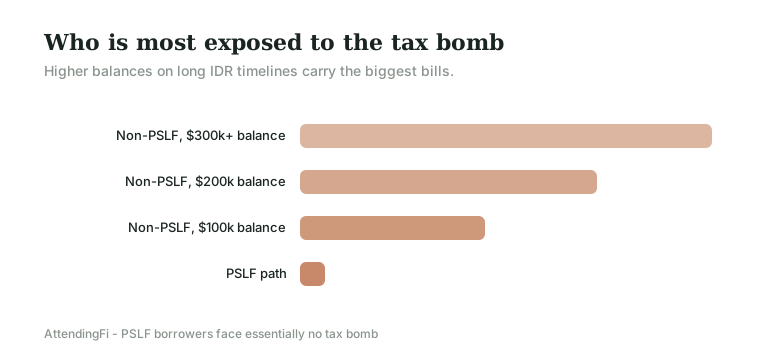
Physicians carry two features that make the tax bomb larger than it is for almost anyone else: very high balances and, eventually, very high incomes. A six-figure forgiven balance generates a correspondingly large taxable event, and because it lands in a year when you are likely already a high earner, much of it is taxed at top marginal rates. A borrower who finishes a 25-year income-driven term with $200,000 still outstanding could face a tax bill large enough to require its own multi-year savings plan.
Because attending incomes are high, a doctor who pursues long-term income-driven forgiveness can accumulate a large forgiven balance (income-driven payments often don't fully cover interest, so the balance can grow before it's forgiven). The bigger the forgiven amount and the higher your income in that year, the larger the tax bomb. This is precisely the scenario where the math needs to be run carefully, sometimes long-term forgiveness still beats paying the loan off, even after the tax, and sometimes it doesn't.
How big could your tax bomb be?
The size depends on how much is forgiven and your tax bracket in that year. The illustration below shows the rough scale of a federal tax bill on different forgiven amounts at a high marginal rate. These are hypothetical figures, not a forecast of your situation, but they convey why this is worth planning for years in advance.
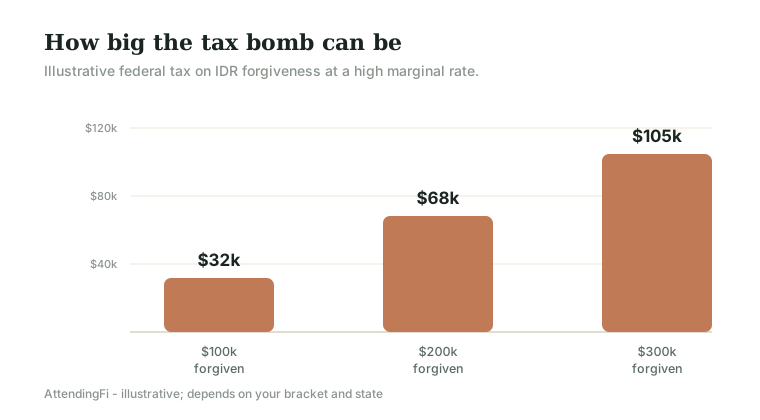
Notice the shape: the bill grows roughly in proportion to the forgiven balance, and it all comes due in one tax year. That concentration is the real danger. A $100,000 loan paid slowly over decades is manageable; a $30,000-plus tax bill due in twelve months is a genuine cash-flow shock if you have not set anything aside.
How to plan for it
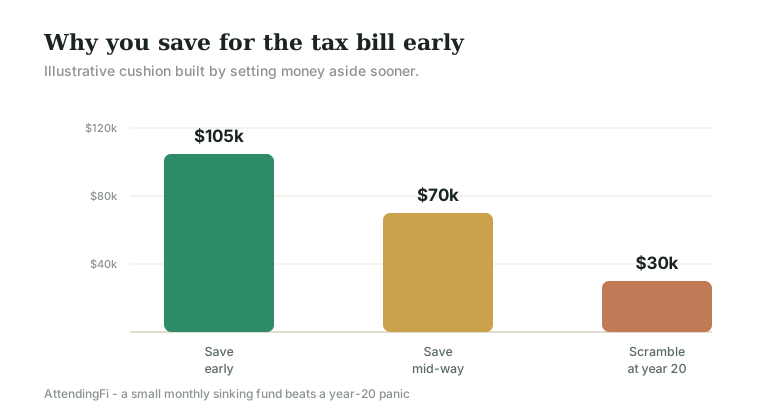
The cleanest defense is a sinking fund: estimate the eventual tax bill and set aside a small amount every month into a dedicated investment account so the money is there when forgiveness arrives. Started early, the required monthly contribution is modest and has years to grow. Started late, it becomes a scramble. Treat the future tax bill as a known liability and fund it gradually, the same way you would any large planned expense.
- Know which track you're on. If you're pursuing PSLF, there's no tax bomb, the forgiveness is tax-free. The planning below is for non-PSLF income-driven forgiveness.
- Save as you go. Treat the eventual tax as a known liability and invest toward it in a separate account, so the bill is fully funded before it arrives.
- Model the after-tax outcome. Compare the total cost of the forgiveness path including the projected tax against simply paying the loan off or refinancing. For many high earners with manageable balances, payoff or refinancing wins once the tax bomb is included.
- Watch the rules. The tax treatment of forgiveness has changed before and could change again; confirm the current law in your forgiveness year.
State taxes can add to the bill
Even when forgiveness is handled at the federal level, your state may treat it differently. Some states conform to federal rules and exclude forgiven amounts; others count them as taxable income and send their own bill on top of the federal one. Because state treatment varies and can change, a borrower on a long income-driven path should check their own state's current rules. Our state-tax overview walks through how different states approach it.
Ways to reduce or avoid the tax bomb
There are several levers, and the best one depends on your situation.
- Pursue PSLF if you qualify. The most complete fix. PSLF forgiveness is tax-free, so a qualifying nonprofit or government employer removes the tax bomb entirely.
- Build a sinking fund. If you are on a non-PSLF income-driven path, save monthly toward the future bill so it never becomes a crisis.
- Reconsider whether forgiveness is even your best path. For some high earners, aggressively paying off or refinancing the loan beats waiting 25 years for a taxable forgiveness. Compare lifetime cost, including the tax, before assuming forgiveness wins.
- Mind your filing and income in the forgiveness year. Because the bill scales with your bracket, large one-time income events in the same year can make it worse. Coordinate with a tax professional as the date approaches.
A worked example: the tax bomb in numbers
Picture an internist who never pursued PSLF and spent 25 years on an income-driven plan. Her payments were modest relative to her balance, so by the end roughly $180,000 remains and is forgiven. If that forgiven amount is treated as ordinary income and she is in a high bracket that year, the federal tax could land somewhere around $55,000 to $65,000, due in a single tax year. The loan is gone, which is good, but the bill is real and concentrated.
Now compare her to a colleague at a nonprofit hospital who pursued PSLF. He reached forgiveness in ten years, the same balance was wiped out, and he owed nothing in tax because PSLF forgiveness is tax-free. Same debt erased, but one walked away clean and the other faced a five-figure bill. That contrast is the entire reason this topic matters, and why confirming your PSLF eligibility is the first move for any physician carrying large federal loans.
When does the tax bomb actually hit?
The bomb only goes off at the very end of a non-PSLF income-driven term, after 20 or 25 years of qualifying payments, in the single year the remaining balance is forgiven. That distance is a double-edged sword. On one hand, it is decades away, which makes it easy to ignore. On the other, that long runway is exactly what makes it manageable: a small amount saved every month for twenty years grows into more than enough to cover the bill, whereas ignoring it until the final year guarantees a painful surprise.
This is also why the decision is not purely about the tax. Spending two decades making payments only to owe a large lump sum at the end may or may not beat simply paying the loan off faster, depending on your numbers. The honest comparison weighs the total of all those income-driven payments plus the eventual tax against the cost of an aggressive payoff or a refinance. Our engine runs that full comparison so the tax bomb is included in the lifetime cost, not bolted on as an afterthought.
Who should worry about the tax bomb, and who shouldn't
Not every physician needs to lose sleep over this. If you are pursuing PSLF at a qualifying employer, the tax bomb simply does not apply to you, because your forgiveness is tax-free. If you expect to pay your loans off in full within a normal timeframe, there is no forgiveness and therefore no tax event. And if your balance is small relative to your income, even a worst-case forgiveness would be modest.
The borrowers who genuinely need a plan are those on a non-PSLF income-driven path with a large balance that will not be paid off before the 20- or 25-year forgiveness mark. For them, the tax bomb is a real, predictable liability decades out, and the right response is calm preparation rather than worry: confirm whether forgiveness is actually your cheapest path, and if it is, start a small sinking fund now so the eventual bill is already covered. Framed that way, the tax bomb stops being a scary unknown and becomes just another line item in a well-run financial plan.
The mistake to avoid is discovering the bill in the year it arrives. Run your numbers early, revisit them whenever your income or the rules change, and you will never be ambushed. If you would like to see whether forgiveness or payoff is cheaper once the tax is included, model your exact situation below and the engine will show the lifetime cost of each path, tax bomb and all, completely free and with no login needed at all to see your full answer.
It accounts for your balance, your projected income in the forgiveness year, and the tax that would apply, so you are comparing the true all-in cost rather than a headline payment. That is the difference between guessing about a bill two decades away and knowing, today, exactly how to prepare for it.
The bottom line
The tax bomb isn't a reason to avoid forgiveness, for the right borrower, income-driven forgiveness is still the cheapest path even after tax. It's a reason to plan, so a predictable bill doesn't become a crisis. The mistake is reaching year 20 having never set the money aside.
See the after-tax comparison. Our engine flags when a forgiveness path may be taxable and ranks it against refinancing and payoff, so you can decide with the full picture.
Educational only, not financial, tax, or legal advice. Tax treatment of forgiveness varies and can change; confirm with your CPA and at studentaid.gov.
Frequently asked questions
Is PSLF forgiveness taxed?
No. PSLF forgiveness is tax-free under federal law. There is no tax bomb on a PSLF path, which is one of the biggest reasons it is so valuable for physicians.
Is income-driven forgiveness taxable?
Yes, for forgiveness received in 2026 onward. Forgiveness at the end of a 20-, 25-, or 30-year income-driven term is treated as taxable income federally. A temporary federal exclusion (ARPA §9675) applied through December 31, 2025 and has now expired, so a non-PSLF borrower whose forgiveness lands in 2026 or later should plan for the forgiven amount to be taxed. PSLF forgiveness stays tax-free.
How much should I save for a future tax bomb?
Estimate the forgiven balance you expect and your likely tax bracket in that year, then set aside a monthly amount that will grow to roughly cover it. Starting early makes the monthly figure small; a tax professional can help you refine the target as the date nears.
Can I avoid the tax bomb entirely?
Yes, in two main ways: qualify for tax-free PSLF, or pay the loan off (or refinance and pay it down) before any taxable forgiveness would occur. Which is better depends on your balance, income, and employer.
Does my state tax forgiven student loans?
It depends on your state. Some exclude forgiven amounts; others tax them. Check your state's current rules, since they vary and can change over time.
Does refinancing avoid the tax bomb?
It can, because refinancing replaces your federal loan with a private one that you pay off in full, so there is no forgiveness and therefore no taxable forgiveness event. But refinancing also forfeits PSLF and federal protections permanently, so it only makes sense if forgiveness was never your best path.
Is the tax bomb the same for dentists?
Yes. The tax treatment of forgiveness does not depend on your profession. Dentists on non-PSLF income-driven plans face the same potential tax on forgiven balances, and dentists employed by qualifying nonprofits can use tax-free PSLF the same way physicians do.