State tax on student loan forgiveness
State tax on student loan forgiveness is the overlooked half of the forgiveness tax question, and for physicians on a non-PSLF income-driven path it can add thousands of dollars to an already large bill. Even when forgiveness is handled one way at the federal level, your state may treat it differently. This guide explains how states approach forgiven student debt, which physicians are exposed, and how to plan so a state tax bill never catches you off guard. It is the kind of detail that is easy to miss and expensive to discover late, but straightforward to plan for once you know it exists and account for it well in advance of the forgiveness event itself.
Two layers of tax: federal and state
When a student loan balance is forgiven, two separate tax authorities can take an interest: the federal government and your state. These operate independently, so it is possible to owe state tax on forgiveness even when no federal tax applies, or vice versa. Physicians focused on the federal picture often miss the state layer entirely, which is exactly where surprises happen.
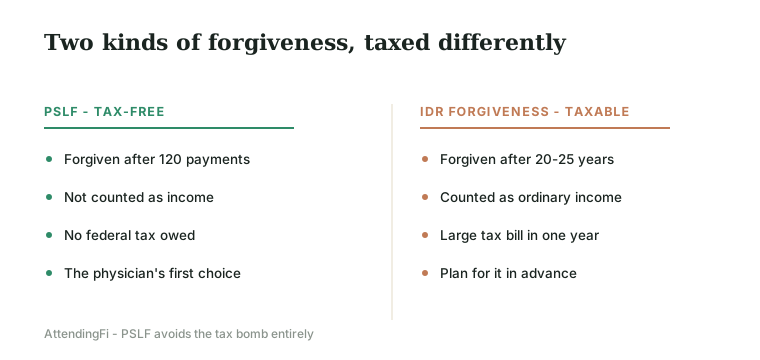
The federal treatment is the headline most people know: PSLF forgiveness is tax-free, while income-driven forgiveness after a 20- or 25-year term can be taxable, especially as a temporary federal exclusion lapses. The state treatment is the quieter second layer, and because it varies, it requires checking your own state rather than relying on a national rule.
For a physician, understanding both layers is what makes a forgiveness plan complete. A strategy that accounts for federal tax but ignores a potential state bill is only half a plan, and on a physician-sized balance the missing half can be a five-figure liability. The good news is that the state layer is knowable in advance with a little research.
PSLF forgiveness and state tax
For PSLF borrowers, the news is largely good on both layers. PSLF forgiveness is tax-free at the federal level, and most states either conform to that treatment or do not tax forgiven amounts in this context. For the great majority of physicians pursuing PSLF, neither a federal nor a state tax bill awaits at the finish line.
This is one more reason PSLF is so valuable for doctors: it sidesteps the entire forgiveness-tax problem, federal and state alike, in most cases. A physician who reaches 120 qualifying payments typically sees their remaining balance erased with no tax consequence at either level, which is part of what makes the program worth far more than its headline forgiveness number suggests.
That said, state conformity is not universal or permanent, and tax rules change. Even a PSLF borrower should confirm their own state's current treatment as they approach forgiveness, simply to rule out a surprise. The likelihood of a state tax on PSLF forgiveness is low, but verifying it costs nothing and removes any doubt.
Income-driven forgiveness and state tax
The real state-tax exposure lies with non-PSLF income-driven forgiveness, the kind received after a 20- or 25-year term. As the federal exclusion lapses and that forgiveness becomes federally taxable again, the state question becomes pressing too. A state that counts forgiven debt as income will send its own bill on top of the federal one.
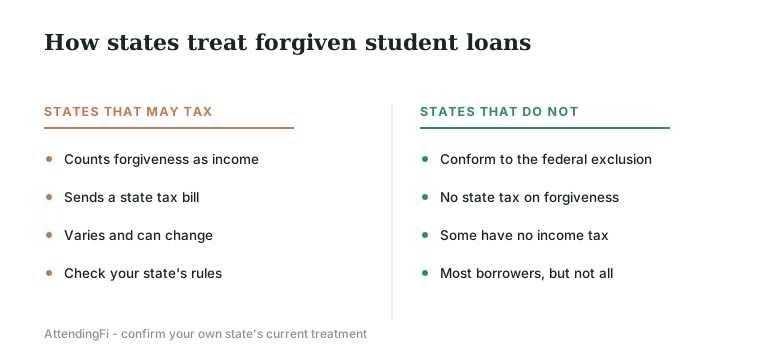
For a physician on a long income-driven path, this means the total tax on forgiveness can have two components. Whether the state component applies depends entirely on where you live when the forgiveness occurs, which could be decades from now and in a different state than where you trained. That uncertainty is part of why this deserves planning rather than last-minute attention.
The practical takeaway is that a non-PSLF borrower should treat a possible state tax as part of the cost of the forgiveness path. Pricing the path without it understates the bill and can make income-driven forgiveness look cheaper than it really is relative to simply paying the loan off, which is exactly the kind of distortion that leads to costly decisions.
Why it varies so much by state
States differ because each writes its own tax code and chooses whether to conform to federal definitions of income. Some states automatically follow federal treatment, so if forgiveness is federally excluded, it is state-excluded too. Others decouple from specific federal provisions and tax forgiven amounts even when the federal government does not. A handful of states have no income tax at all, sidestepping the question.
This patchwork means there is no shortcut national answer. Two physicians with identical loans and identical forgiveness can owe very different state taxes simply because they live in different states, and the same physician could face different outcomes depending on where they are when forgiveness lands. The only reliable approach is to check the current rules for your specific state.
Because state legislatures can change these rules, today's treatment is not a permanent guarantee. A state that conforms now might decouple later, or vice versa. For a forgiveness event that may be decades away, this argues for revisiting your state's treatment periodically rather than assuming the rule you learned once still holds when forgiveness actually occurs.
How much state tax could cost
The size of a state tax on forgiveness depends on the forgiven amount and your state's income tax rate. On a physician-sized balance, a state that taxes forgiveness at a typical income tax rate can generate a bill of several thousand to many thousands of dollars, all due in the single year forgiveness occurs, on top of any federal tax.
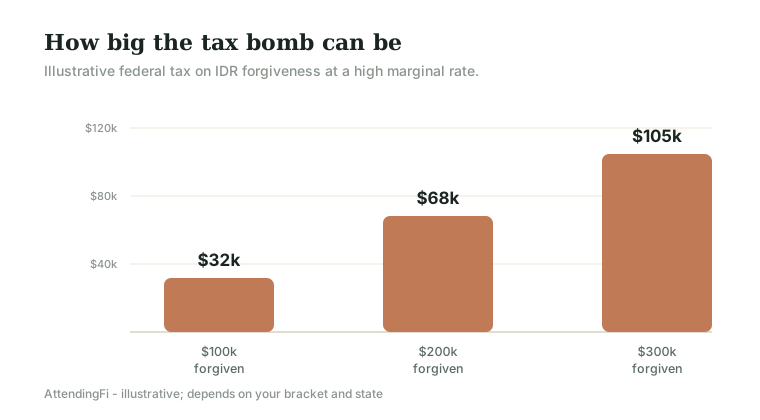
Like the federal tax bomb, the concentration is what makes it dangerous. A loan paid slowly over decades is manageable; a multi-thousand-dollar state tax bill due in twelve months is a cash-flow shock if nothing was set aside. For a physician already planning for a federal tax on forgiveness, the state component simply enlarges the target you are saving toward.
The encouraging news is that, because the event is so far off for most, even a modest monthly contribution to a sinking fund grows comfortably to cover both the federal and state portions. Treated as a known, plannable liability rather than a surprise, the combined tax becomes just another line item in a well-run physician financial plan.
How to plan for a state tax on forgiveness
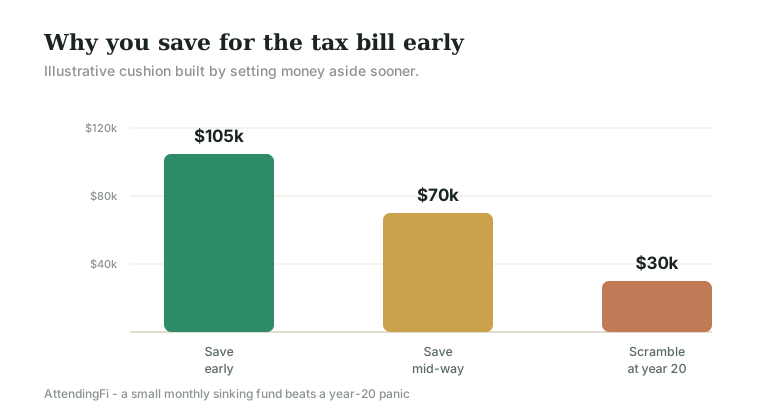
Planning for the state layer mirrors planning for the federal one. Estimate the forgiven balance you expect and apply your state's income tax rate to gauge the potential bill, then add it to your federal estimate to size a combined sinking fund. Set aside a small amount monthly into a dedicated account so the money is there when forgiveness arrives.
Beyond saving, the state layer can influence bigger decisions. If your state taxes forgiveness heavily, the income-driven forgiveness path looks relatively less attractive compared with PSLF (which avoids the tax) or with simply paying the loan off. Factoring the state tax into that comparison can change which strategy is genuinely cheapest for you.
The most efficient way to weigh all of this is to model it. The engine includes the tax treatment of forgiveness in its lifetime-cost comparison, so you are comparing the true all-in cost of each path rather than a pre-tax illusion. That is the difference between choosing a strategy on paper and choosing the one that actually costs you the least.
What happens if you move states
Physicians move, often more than once, and the state where you eventually receive forgiveness is the one whose rules apply, not the state where you trained or borrowed. A doctor who trains in a state that taxes forgiveness but practices for decades in a state that does not may face no state tax at all, and the reverse is equally possible.
This mobility cuts both ways. It introduces uncertainty, since you may not know today where you will live when forgiveness lands, but it also offers some control, because your future location, within the bounds of your career and life, can influence the bill. For a borrower on a long income-driven path, it is one more reason to revisit the state question as your plans firm up.
The practical posture is to plan for the possibility of a state tax without over-anchoring on any single state's current rule. Build a sinking fund sized for a plausible combined federal-and-state bill, and reassess as you approach forgiveness and your location becomes clearer. That way you are covered regardless of where you end up.
Key takeaways on state tax
State tax is the second, easily missed layer of the forgiveness tax question. For physicians on a non-PSLF path, it can add materially to the bill.
- Forgiveness can be taxed at both the federal and state level, independently.
- PSLF forgiveness is tax-free federally and is usually not taxed by states.
- Non-PSLF income-driven forgiveness is where state-tax exposure lives.
- Treatment varies by state and can change, so check your own state's rules.
- Size a sinking fund for a combined federal-and-state bill, started early.
- The state where forgiveness occurs is the one whose rules apply.
Do not let the state layer be the surprise that doubles your forgiveness tax. Run your numbers in the engine below to see the all-in cost of each path, taxes included.
States with no income tax
A subset of states levy no broad personal income tax, which neatly removes the state layer of the forgiveness tax question for residents there. A physician who receives income-driven forgiveness while living in such a state would face only the federal component, if any. For a doctor weighing where to practice long-term, this is a minor but real factor among many larger ones.
It would be a mistake, of course, to choose where to live primarily to avoid a tax on a forgiveness event that may be decades away and uncertain. Career, family, and lifestyle dwarf this consideration. But for a physician already deciding among locations for other reasons, the state tax treatment of forgiveness is a legitimate tiebreaker worth being aware of.
The broader point is that your geography interacts with your loan strategy in ways that are easy to overlook. Being aware that the state layer exists, and that it varies dramatically, lets you factor it appropriately, neither ignoring it nor overweighting it, into the larger picture of your physician financial plan.
How the state layer tilts toward PSLF
One underappreciated consequence of the state tax layer is how it strengthens the case for PSLF when you qualify. Because PSLF forgiveness is generally free of both federal and state tax, it sidesteps a liability that a non-PSLF income-driven path may face twice over. For a physician who could pursue either, the combined tax advantage is one more weight on the PSLF side of the scale.
This does not mean PSLF always wins, only that a fair comparison must include the full tax picture. A non-PSLF forgiveness path that looks competitive on a pre-tax basis can look meaningfully worse once both federal and state taxes on the forgiven amount are included. Pricing the paths honestly, taxes and all, is the only way to see which truly costs less.
A worked example with both layers
Picture a physician who finishes a 25-year income-driven term with $180,000 forgiven, living in a state that taxes forgiven debt as income. At the federal level, with the exclusion lapsed, that forgiveness is taxable; at the state level, her state adds its own tax at its income rate. The combined bill, federal plus state, arrives in a single year and can reach well into five figures, far larger than the federal portion alone would suggest.
Now place the same physician in a state with no income tax. Her federal bill is unchanged, but the state component disappears entirely, materially shrinking the total. The only difference between the two scenarios is geography at the moment of forgiveness, which is precisely why the state layer deserves attention rather than being folded silently into a federal-only estimate.
The practical response in both cases is the same: size your sinking fund for the worst plausible combined bill, started early so a small monthly amount grows to cover it. Run your numbers in the engine below, which includes the tax treatment of forgiveness, so the all-in cost of each path, both layers included, is clear before you commit. It applies the relevant tax treatment to your forgiven balance, so you can compare PSLF, income-driven forgiveness, and refinancing on an honest, after-tax basis rather than an optimistic pre-tax one that hides the bill waiting at the end.
Get your personalized plan
Don't guess — model your exact numbers. AttendingFi runs the real federal-rules math on your numbers and shows its work. Free, no login needed to see your answer.
Run my numbers →State-by-state: tax on student loan forgiveness (2026)
This table summarizes how each state and the District of Columbia treats forgiven student debt under the 2026 rules. The most reliable line is the income-tax column: the nine states with no state income tax can’t levy a state tax bomb at all. For the rest, the default is that long-term income-driven (IDR) forgiveness — federally taxable again as of January 1, 2026 — is also taxable at the state level to the extent the state conforms to federal income. PSLF forgiveness stays tax-free federally, and nearly every state follows that exclusion. Estimates only; state legislatures can change conformity, so confirm with your state Department of Revenue or a tax professional.
| State | State income tax? | Long-term IDR forgiveness (2026) | PSLF forgiveness |
|---|---|---|---|
| Alabama | Yes | Generally taxable¹ | Tax-free² |
| Alaska | No | Not taxed — no state income tax | Not taxed |
| Arizona | Yes | Generally taxable¹ | Tax-free² |
| Arkansas | Yes | Generally taxable¹ | Tax-free² |
| California | Yes | Generally taxable¹ | Tax-free² |
| Colorado | Yes | Generally taxable¹ | Tax-free² |
| Connecticut | Yes | Generally taxable¹ | Tax-free² |
| Delaware | Yes | Generally taxable¹ | Tax-free² |
| District of Columbia | Yes | Generally taxable¹ | Tax-free² |
| Florida | No | Not taxed — no state income tax | Not taxed |
| Georgia | Yes | Generally taxable¹ | Tax-free² |
| Hawaii | Yes | Generally taxable¹ | Tax-free² |
| Idaho | Yes | Generally taxable¹ | Tax-free² |
| Illinois | Yes | Generally taxable¹ | Tax-free² |
| Indiana | Yes | Generally taxable¹ | Tax-free² |
| Iowa | Yes | Generally taxable¹ | Tax-free² |
| Kansas | Yes | Generally taxable¹ | Tax-free² |
| Kentucky | Yes | Generally taxable¹ | Tax-free² |
| Louisiana | Yes | Generally taxable¹ | Tax-free² |
| Maine | Yes | Generally taxable¹ | Tax-free² |
| Maryland | Yes | Generally taxable¹ | Tax-free² |
| Massachusetts | Yes | Generally taxable¹ | Tax-free² |
| Michigan | Yes | Generally taxable¹ | Tax-free² |
| Minnesota | Yes | Generally taxable¹ | Tax-free² |
| Mississippi | Yes | Generally taxable¹ | Tax-free² |
| Missouri | Yes | Generally taxable¹ | Tax-free² |
| Montana | Yes | Generally taxable¹ | Tax-free² |
| Nebraska | Yes | Generally taxable¹ | Tax-free² |
| Nevada | No | Not taxed — no state income tax | Not taxed |
| New Hampshire | No | Not taxed — no state income tax | Not taxed |
| New Jersey | Yes | Generally taxable¹ | Tax-free² |
| New Mexico | Yes | Generally taxable¹ | Tax-free² |
| New York | Yes | Generally taxable¹ | Tax-free² |
| North Carolina | Yes | Generally taxable¹ ³ | Tax-free² |
| North Dakota | Yes | Generally taxable¹ | Tax-free² |
| Ohio | Yes | Generally taxable¹ | Tax-free² |
| Oklahoma | Yes | Generally taxable¹ | Tax-free² |
| Oregon | Yes | Generally taxable¹ | Tax-free² |
| Pennsylvania | Yes | Generally taxable¹ | Tax-free² |
| Rhode Island | Yes | Generally taxable¹ | Tax-free² |
| South Carolina | Yes | Generally taxable¹ | Tax-free² |
| South Dakota | No | Not taxed — no state income tax | Not taxed |
| Tennessee | No | Not taxed — no state income tax | Not taxed |
| Texas | No | Not taxed — no state income tax | Not taxed |
| Utah | Yes | Generally taxable¹ | Tax-free² |
| Vermont | Yes | Generally taxable¹ | Tax-free² |
| Virginia | Yes | Generally taxable¹ | Tax-free² |
| Washington | No | Not taxed — no state income tax | Not taxed |
| West Virginia | Yes | Generally taxable¹ | Tax-free² |
| Wisconsin | Yes | Generally taxable¹ ⁴ | Tax-free² |
| Wyoming | No | Not taxed — no state income tax | Not taxed |
Download CSV ↓Download JSON ↓
¹ Most states with an income tax conform to federal adjusted gross income, so IDR forgiveness that is federally taxable is generally taxable at the state level too. ² PSLF (and Teacher Loan Forgiveness, NHSC, and death/disability discharge) is excluded from federal income; nearly all states follow this exclusion. ³ North Carolina adds forgiven student-loan amounts back into state taxable income (except death/total-disability discharge). ⁴ Wisconsin taxes forgiven student debt except PSLF, Teacher Loan Forgiveness, NHSC, and disability discharge. Methodology: the state income-tax column reflects published state rates; the forgiveness columns reflect general federal-conformity rules as of June 2026 plus the two named statutory exceptions, not a guarantee for every borrower — verify your state.
Frequently asked questions
Is PSLF forgiveness taxed by states?
Usually not. PSLF forgiveness is tax-free federally, and most states either conform or do not tax it in this context. Confirm your own state's current treatment as you approach forgiveness to be sure.
Do states tax income-driven student loan forgiveness?
Some do and some do not. As the federal exclusion lapses and income-driven forgiveness becomes federally taxable again, states that count it as income will add their own bill. Check your state's rules.
How much could state tax on forgiveness cost a physician?
On a large forgiven balance, a state tax at a typical income rate can add several thousand to many thousands of dollars, due in the year forgiveness occurs, on top of any federal tax.
Which state's tax applies to my forgiveness?
The state where you live when the forgiveness occurs, which could be decades from now and different from where you trained or borrowed. Your future location determines the state-tax outcome.
How do I plan for a state tax on forgiveness?
Estimate the forgiven amount and your state's rate, add it to your federal estimate, and save into a sinking fund started early. Factor the combined tax into your forgiveness-versus-payoff decision.