PSLF for residents: how to start the 10-year clock the right way
Public Service Loan Forgiveness is the best deal in medicine that almost no one sets up correctly. Get it right and a nonprofit-employed physician can have a large balance, often well into six figures, forgiven tax-free after ten years of income-driven payments. Get it wrong, and you can quietly forfeit all of it. Residency is where it's won or lost.
The four conditions, in plain terms
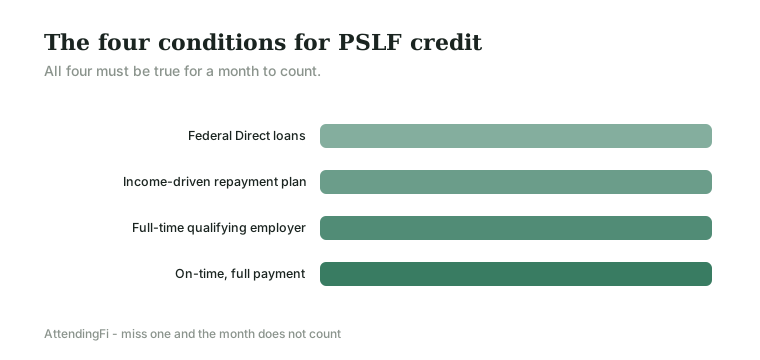
PSLF can feel complicated, but for a resident it comes down to four conditions that must all be true in the same month. You need federal Direct loans, you need to be on a qualifying income-driven repayment plan, you need to be working full-time for a qualifying nonprofit or government employer, and your payment needs to be on time and for the full amount. Meet all four and the month counts toward your 120. Miss any one and it does not.
PSLF still works the way it has, with 120 qualifying monthly payments, that's ten years, while you meet all of these:
- Qualifying employer. Full-time work for a government entity or a 501(c)(3) nonprofit. Most academic medical centers, the VA, and many public and nonprofit hospitals qualify. Many private practices and for-profit groups do not.
- Direct Loans. Your federal loans must be Direct Loans; older loan types may need consolidation first.
- A qualifying repayment plan. Income-driven plans count. Under the 2026 rules, that means RAP, and, for borrowers who first borrowed before July 1, 2026, the legacy IBR plan.
- 120 qualifying payments. They don't have to be consecutive, but they do have to be certified.
Why residency is the best time to be in PSLF
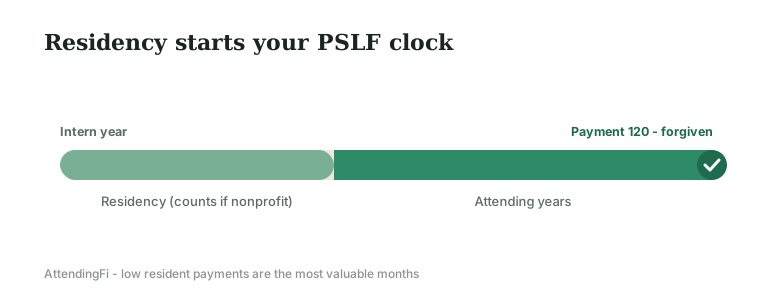
Most residencies and fellowships are based at nonprofit or government teaching hospitals, which means your training years can count toward PSLF. And because your resident income is low, your income-driven payments during those years are tiny, often a few hundred dollars or less. That combination is what makes residency the single best time to be in PSLF: you bank qualifying months while paying almost nothing.
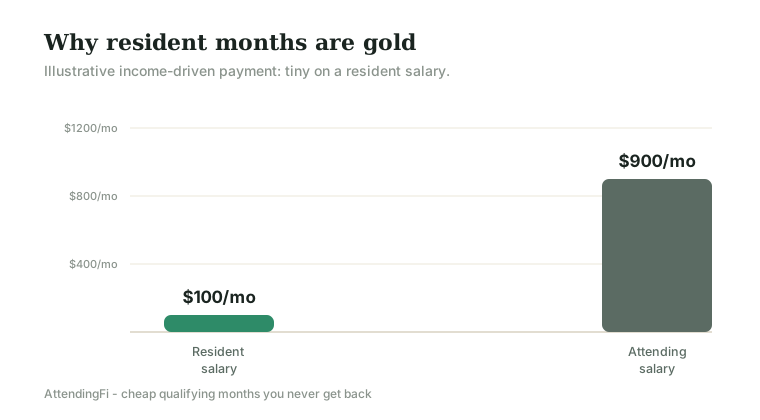
Think about what that means over a three-to-seven-year training program. A resident on PSLF can knock out a large share of the 120 required payments while making only token payments, then finish the clock as an attending. Each of those cheap qualifying months is worth exactly as much toward forgiveness as an expensive attending month, which is why skipping or delaying PSLF enrollment in residency is such a costly error: you can never get those low-cost months back.
Income-driven payments are based on your income, and your resident salary is low. That means your monthly payments during training are small, sometimes just a few hundred dollars, yet each one still counts as one of your 120. You're buying down a ten-year clock at resident prices. By the time you're an attending earning several times more, you may have already knocked out three to five years of qualifying payments at a fraction of the cost.
RAP or IBR for PSLF? Pay as little as legally possible
On a forgiveness track, your aim is to minimize what you pay over the 120 months, because whatever remains is forgiven. For high-earning attendings, legacy IBR's payment cap often produces lower payments, and therefore more forgiveness, than RAP, which has no cap. If you first borrowed before July 2026, protecting that legacy IBR option can be worth tens of thousands of dollars. We break down that comparison in detail in our RAP vs IBR guide.
The step most residents miss: certify every year
Submit the PSLF Employment Certification Form when you start, every year, and any time you change employers. This is how your qualifying-payment count gets tracked. Servicers are notorious for miscounting, and each uncounted month can cost you real forgiveness, so a clean, certified, from-day-one record is your protection. Don't wait until year ten to find out your count is wrong.
The six-figure mistake: refinancing during residency
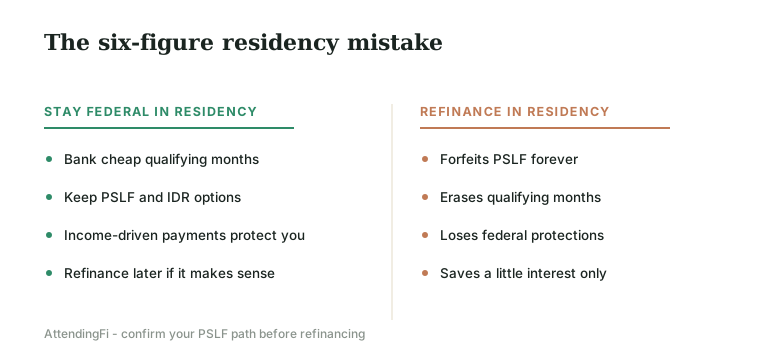
Lenders market aggressively to residents, and a lower interest rate sounds appealing when you're staring at a big balance. But refinancing converts your federal loans to private debt and permanently destroys PSLF eligibility. If there's any real chance you'll work for a qualifying employer, refinancing during residency can be the most expensive financial decision you ever make. Keep your loans federal, keep your payments low, and re-decide once your career path is settled.
A worked example: what a resident banks
Picture a PGY-1 with $250,000 in federal Direct loans who enrolls in a qualifying income-driven plan in intern year. On a resident salary, the monthly payment might be a few hundred dollars or even close to zero in the first year. Over a four-year residency, that resident banks roughly 48 qualifying months toward the 120 needed, while paying only a small fraction of what an attending would pay for the same credit.
By the time she finishes training and becomes an attending, she is already a third of the way to forgiveness, and the months she banked were the cheapest she will ever make. She then completes the remaining qualifying payments as an attending, and at payment 120 her remaining balance is forgiven tax-free. Contrast that with a resident who waits until attending years to start: he forfeits those cheap training months entirely and must make every one of his 120 payments at a far higher attending-level amount. The difference between the two, on a large balance, is easily a six-figure swing.
What happens to your PSLF after residency
Finishing residency does not reset anything. Your qualifying-payment count carries forward as long as you continue working for a qualifying employer, whether you stay at the same hospital or move to another nonprofit or government job. The main thing to watch is the jump in income: as an attending, your income-driven payment will rise, though on a capped plan it is limited to the standard ten-year amount. If you move to a for-profit employer, those months simply stop counting until you return to qualifying work.
This is why the plan you choose and how you time recertification matter at the residency-to-attending transition. Keeping your payment as low as legally possible during that handoff preserves more forgiveness. Our RAP vs IBR guide covers how the base plan affects your attending payment, and the engine shows how the transition plays out month by month.
Dual-resident and physician couples
When both partners are residents or physicians with large balances and both work for qualifying employers, PSLF can be extraordinarily valuable for the household, but the income-driven payment depends on how you file taxes. Married-filing-separately can lower the payment that feeds a PSLF strategy, at the cost of some tax benefits, so the filing decision should be modeled jointly rather than in isolation. We unpack that tradeoff in married filing separately for student loans.
The broader point for couples is that two PSLF paths interact. One spouse pursuing forgiveness while the other refinances can be the right answer, but the filing choice links them, so run the household numbers together. The savings from getting this right across two large balances can be substantial.
Your first-year PSLF setup, in five moves
If PSLF fits your career, set it up early in intern year and you will avoid almost every common mistake.
- Confirm your loans are Direct. Check at studentaid.gov. If you hold older FFEL or Perkins loans, consolidate into a Direct Consolidation Loan so they can count.
- Enroll in a qualifying income-driven plan. Pick the qualifying plan with the lowest payment so you bank cheap months. Compare RAP and IBR before choosing.
- File your first employer certification. Use the official PSLF Help Tool and have your program or HR sign it, locking in your qualifying months on the record.
- Do not refinance your federal loans. A low resident refinance rate is a trap that forfeits PSLF and erases qualifying months.
- Re-certify every year. This keeps your count accurate and surfaces problems while they are still fixable.
Five moves in your first months of residency set the foundation for a forgiveness that can be worth six figures. None of them are hard; they just have to actually get done, which is why it's best to handle them in intern year rather than putting them off.
If your residency program might be for-profit
The vast majority of residency programs run through nonprofit or government teaching hospitals, but a minority operate under for-profit ownership, and that distinction decides whether your training months count. If you are unsure, it is worth confirming your employer's tax status early, because the answer changes your entire strategy. At a qualifying nonprofit, every training month is bankable PSLF credit. At a for-profit employer, those years do not count, and your clock effectively starts when you next reach a qualifying employer.
Knowing this in intern year lets you plan rather than be surprised. A resident at a for-profit program who still wants forgiveness can aim for a qualifying attending job afterward, and should be especially careful not to assume training months are accruing when they are not. The simplest check is to ask your HR whether the employer is a 501(c)(3) nonprofit or a government entity; if it is neither, treat your PSLF clock as starting later.
The real cost of waiting one year to start
It is tempting, in the chaos of intern year, to put off the loan paperwork. The problem is that every month you delay enrolling in a qualifying plan is a qualifying month you can never recover. A resident who waits twelve months to set up PSLF does not just lose a year of progress; he loses a year of the cheapest, lowest-payment qualifying months he will ever have access to, and must replace them later with expensive attending-level payments.
Put concretely, delaying enrollment by a single year on a large balance can cost tens of thousands of dollars in additional payments and forgone forgiveness. That is an enormous price for paperwork that takes an afternoon. The takeaway is blunt: if PSLF is even possibly in your future, get your loans into a qualifying plan and file your first employer certification now, not next year. The months you bank early are the ones that make PSLF so powerful for physicians.
If you are not sure whether PSLF is even your lowest-cost path, that is exactly the question our engine answers. Enter your balance, your training and attending income, and your employer, and it compares PSLF against refinancing and every other plan, showing the lifetime cost of each so you can commit to the right strategy from intern year rather than guessing.
How to know if PSLF is your lowest-cost path
It usually is if you'll be nonprofit- or government-employed with a meaningful balance, but the only way to be sure is to compare it against the alternatives using your real numbers. Our free engine projects PSLF on both RAP and capped IBR, plus refinancing and straight payoff, and ranks them by what each truly costs you over time.
See your PSLF projection. Enter your balance, specialty and employer type and the engine shows your total out-of-pocket cost and forgiveness, in about a minute.
The bottom line for residents
For a physician carrying a large federal balance and headed for nonprofit or government work, residency is the most valuable window in the entire PSLF program. The four conditions are simple, the cheap qualifying months you bank in training are irreplaceable, and the biggest risks, refinancing too early or delaying enrollment, are entirely within your control. Set it up correctly in intern year, certify every year, and let the clock run.
None of this requires you to become a student-loan expert. It requires five deliberate moves in your first months of residency and then a simple yearly five-minute habit thereafter. Do that, and you protect a forgiveness that can rival a full year of attending pay. If you want to confirm that PSLF is your lowest-cost path before you commit, run your real numbers below and the engine will lay out your forgiveness timeline and compare it against every alternative, completely free, with no login needed at all to see your full answer.
Frequently asked questions
Does residency count toward PSLF?
Usually yes, if your residency is at a nonprofit or government teaching hospital, which most are. Those years count toward your 120 qualifying payments, and because resident income is low, the payments are small. Training at a for-profit hospital is the exception, since those years do not count.
Should I start PSLF in intern year or wait?
Start in intern year. Every qualifying month you make on a low resident salary is cheap progress toward forgiveness that you can never recover later. Waiting only throws away your most valuable, lowest-cost months.
Which repayment plan should a resident on PSLF choose?
The qualifying income-driven plan with the lowest payment, because on PSLF every dollar you are not required to pay is forgiven tax-free at the end. Compare RAP and IBR on your numbers before enrolling.
Is it ever okay to refinance during residency?
Rarely. If a qualifying employer is anywhere in your future, refinancing forfeits PSLF and erases qualifying months, which usually costs far more than the interest you would save. Confirm your PSLF path is truly off the table first.
What if my residency program is for-profit?
Then those years do not count toward PSLF, and your clock effectively starts when you reach a qualifying employer. It is worth confirming your program's status early so you know whether you are banking qualifying months.
Related guides
Educational only, not financial, tax, or legal advice. PSLF employer-eligibility and program rules can change; verify at studentaid.gov.