RAP vs IBR for physicians: which repayment plan actually wins in 2026?
If you trained before this summer, you're living through the biggest change to federal student loans in a generation. The 2025 federal law replaced the familiar income-driven plans with a new one called RAP, the Repayment Assistance Plan, that takes effect July 1, 2026. For most physicians, the practical question is simple to ask and surprisingly consequential to answer: should you be on RAP, or should you protect your access to the older Income-Based Repayment (IBR) plan?
The short version: for high-earning attendings, legacy IBR is often dramatically cheaper than RAP, but only if you first borrowed before July 1, 2026 and you don't trip the wire that strips your legacy eligibility. Here's why.
What RAP and IBR actually are
Both RAP and IBR are income-driven repayment plans: instead of a fixed bill, your monthly payment is set as a share of your income, and after a set number of years any remaining balance is forgiven. The difference is in the details of that formula, and for a physician those details translate into thousands of dollars a year and, on a forgiveness path, six figures over time.
Income-Based Repayment is the older, established plan. Its defining feature for high earners is a cap: your payment is never more than what you would owe on a standard ten-year plan, no matter how high your income climbs. The Repayment Assistance Plan (RAP) is the newer plan introduced for 2026. It reshapes how the payment is calculated and is part of a narrower menu of options for newer borrowers. Which one is available, and which is cheaper, depends on when you borrowed and how much you earn.
The one difference that matters most: the payment cap
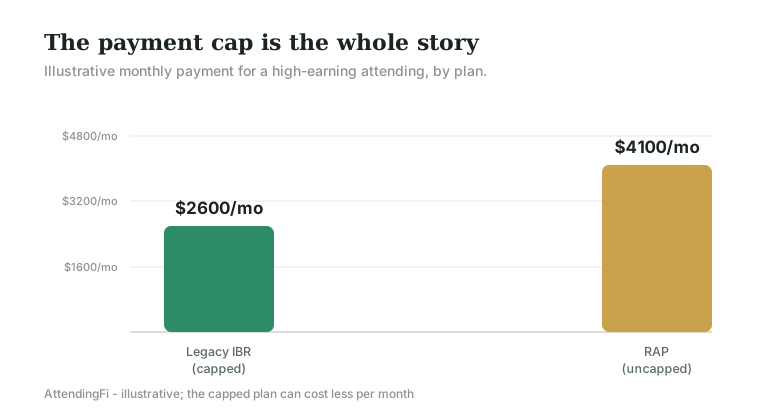
Here is the crux. As an attending, your income rises sharply, and an uncapped income-driven payment rises right along with it. The legacy IBR cap stops that climb at the standard ten-year amount, so a high earner with a large balance often pays less per month on capped IBR than on an uncapped plan. That cap is the single most important difference for most physicians, because it directly lowers what you pay.
Legacy IBR sets your payment at 10% of your discretionary income, but it caps that payment at what you'd owe on a standard 10-year plan. RAP has no such cap. Instead, RAP charges a percentage of your total income, scaling up to 10% above roughly $100,000 of income, with no ceiling.
For a resident earning a modest salary, the two plans produce similar low payments. But the moment you become an attending, the gap explodes. Consider a physician with around $200,000 of loans:
On legacy IBR, their payment is capped near the 10-year standard amount, roughly $2,000 a month even at a $500,000 income. On RAP, that same physician could owe closer to $4,000+ a month, because RAP keeps taking its percentage of income with no cap. Over a decade, that difference runs into six figures.
Why the cap flips the PSLF math too
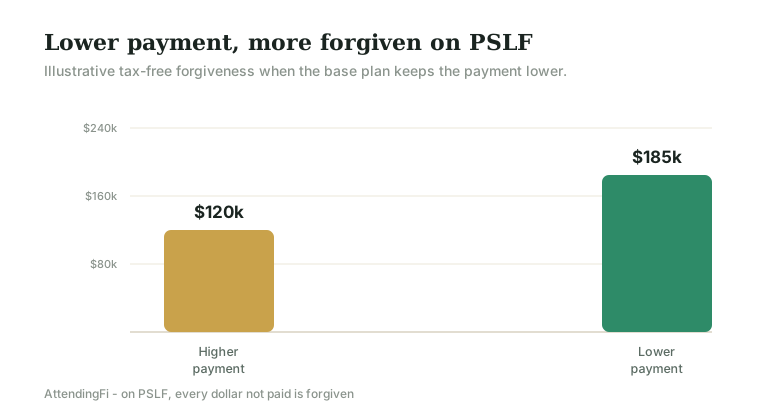
The cap matters even more if you are pursuing PSLF. On a forgiveness path, every dollar you are not required to pay is a dollar that gets forgiven tax-free at the end. So a plan that produces a lower monthly payment does not just ease cash flow, it increases your total forgiveness. For a high-debt attending marching toward 120 payments, choosing the base plan with the lower payment can be worth tens of thousands of dollars in additional forgiveness.
If you're pursuing Public Service Loan Forgiveness, your goal during those 120 qualifying payments is to pay as little as possible, since the balance is forgiven tax-free at the end. The capped IBR payment means a high-earning attending often pays far less over the 10 years, and therefore has more forgiven, than they would on RAP. That's the opposite of intuition, and it's exactly the kind of thing a single-purpose calculator misses.
A worked example
Picture an attending earning $300,000 with a large federal balance, pursuing PSLF. On a capped legacy IBR plan, the payment is held to the standard ten-year amount, keeping the monthly figure lower than an uncapped formula would. Because she is on PSLF, that lower payment means more of her balance survives to be forgiven tax-free at payment 120. On an uncapped plan, she would pay more each month and have less forgiven, a double loss.
Now change the inputs. A lower-earning borrower early in a non-PSLF career might find RAP's formula produces a comfortable payment and a workable path, especially if the legacy plan is not available to them. The lesson is the same one that runs through every income-driven decision: the right plan depends on your income trajectory, your balance, and whether forgiveness is your goal. There is no single winner, which is exactly why running your own numbers matters.
The trap: don't borrow again after July 1, 2026
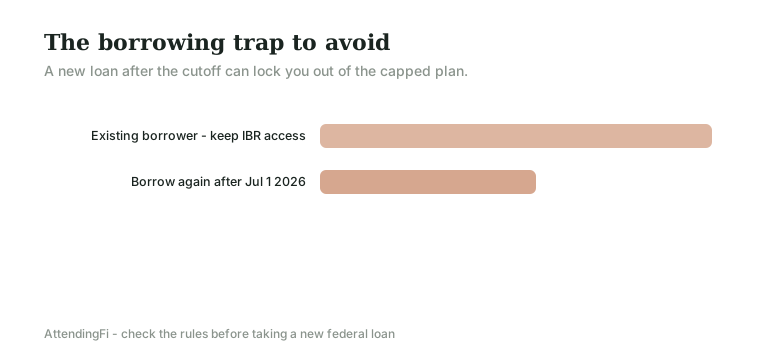
Here's the wire to avoid. If you took out federal loans before July 1, 2026, you generally retain access to legacy plans like IBR. But taking out any new federal loan after that date can sweep all of your loans, old and new, onto RAP, permanently closing the door on the capped legacy plan. For physicians considering additional training, a fellowship loan, or consolidation, the timing of any new borrowing is now a high-stakes decision.
When RAP is actually the better choice
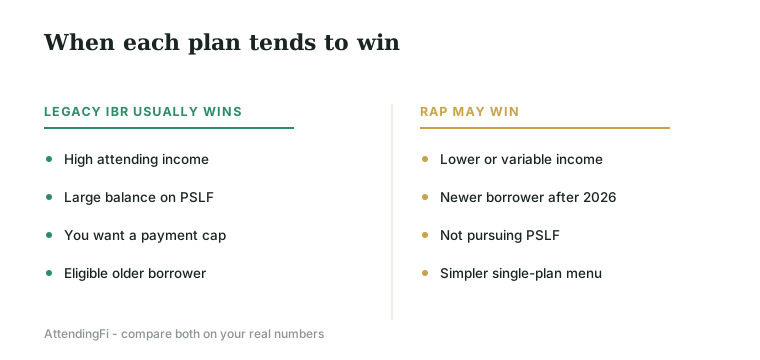
RAP isn't the villain. It waives unpaid interest each month, so your balance won't balloon from negative amortization, and it reduces your payment by $50 per month for each dependent child. For borrowers with lower attending incomes, larger families, or those who only began borrowing in the new regime, RAP can be the most affordable, and sometimes the only, income-driven option available.
How to choose between RAP and IBR, step by step
You can settle this in a few minutes with the right inputs in front of you.
- Confirm which plans you are eligible for. Eligibility depends on when you borrowed. Newer borrowers may have a narrower menu, so start by checking what is actually available to you.
- Decide whether you are pursuing PSLF. If you are, prioritize the qualifying plan that produces the lowest payment, because that maximizes tax-free forgiveness.
- Compare the monthly payment each plan would set. For a high-earning attending with a large balance, the capped legacy plan frequently wins on monthly cost.
- Look at lifetime cost, not just the payment. The cheapest monthly figure and the cheapest total can differ, especially across a long forgiveness horizon.
- Re-check after major income or family changes. Income-driven payments are recalculated periodically, so the better plan can shift as your life does.
The engine compares both plans on your exact numbers, including how each interacts with PSLF, so you can see the monthly payment and the lifetime cost side by side rather than guessing.
How each plan calculates your payment
Both plans start from your income and family size, but they apply different formulas to arrive at your monthly bill. Income-Based Repayment sets your payment as a percentage of your discretionary income, then caps it so it never exceeds the standard ten-year amount. That cap is the safety valve that protects high earners: once your income is high enough that the percentage-based figure would exceed the standard payment, the cap takes over and holds your payment steady.
The Repayment Assistance Plan calculates the payment differently and, for newer borrowers, may be the plan that is actually on the menu. Its formula can be gentler at lower incomes but, without the same cap, can rise more for very high earners. This is the heart of the trade: an uncapped formula may help when income is modest and hurt when income is high. Because a physician's income usually starts low and then climbs steeply, the plan that looks best in residency may not be the plan that is cheapest as an attending, which is why the decision deserves a fresh look at each career stage rather than a one-time pick.
One practical note: your payment on either plan is recalculated when you recertify your income, typically once a year. Timing that recertification well, especially around the jump from resident to attending income, can keep a lower payment locked in for longer. Our engine models this recertification timing so you can see how the choice of plan and the timing of recertification interact across your whole repayment.
Forgiveness timelines: how long until the balance clears
Beyond the monthly payment, the two plans differ in how long you make payments before any remaining balance is forgiven. On a non-PSLF path, that horizon stretches across decades, which means the plan you choose shapes both what you pay each month and how much is left to forgive, and possibly taxed, at the very end. On a PSLF path the horizon is the familiar 120 qualifying payments, roughly ten years, regardless of which qualifying plan sits underneath.
This is why the decision is never just about this month's bill. A plan with a slightly higher payment but a shorter road to forgiveness can beat a lower-payment plan that keeps you paying for many more years. For physicians, the cleanest way to weigh these against each other is to look at the total of everything paid plus any tax on forgiveness, which is exactly the lifetime-cost number our engine produces for each plan.
Common mistakes physicians make choosing a plan
A few avoidable errors show up again and again. The first is defaulting to whatever plan a servicer auto-enrolls you in, rather than checking whether a capped option would lower your payment. The second is optimizing for the lowest monthly payment without noticing it stretches your forgiveness timeline and raises your total cost. The third, on a PSLF path, is choosing a higher-payment plan and quietly shrinking the tax-free forgiveness waiting at payment 120. The fourth is forgetting to re-evaluate after a raise, a marriage, or a new child, any of which can change which plan is cheaper.
None of these require expertise to avoid. They require comparing the actual plans on your actual numbers once, and revisiting that comparison when your life changes. Treat the plan choice as a deliberate decision rather than a default, and you capture savings that compound for years.
So which one wins for you?
It comes down to four things: when you first borrowed, your balance, your projected attending income, and whether you'll work for a PSLF-qualifying employer. Those four variables interact in ways that are genuinely hard to eyeball, which is exactly why we built a free engine that runs the month-by-month math for your specific numbers and tells you the cheapest path, with the reasoning shown.
Run your own comparison. Our decision engine models RAP, capped IBR, PSLF and refinancing side by side on your exact numbers, free.
The bottom line on RAP vs IBR
For most attending physicians with large balances, especially those pursuing PSLF, the capped legacy IBR plan tends to produce the lower monthly payment and, on a forgiveness path, the larger tax-free forgiveness. RAP is the plan many newer borrowers will actually be offered, and it can be the right fit at lower incomes or where the legacy plan is unavailable. Neither is universally better; the answer turns on your eligibility, your income trajectory, your balance, and whether forgiveness is your goal.
The mistake to avoid is treating the plan as a default rather than a decision. A few minutes comparing both on your real numbers can be worth thousands of dollars a year and, over a forgiveness horizon, far more. Run your numbers below and the engine will show the monthly payment and the lifetime cost of each plan side by side, including how each interacts with PSLF, so the better choice is obvious rather than guessed.
Frequently asked questions
Is RAP or IBR better for physicians on PSLF?
For high-earning attendings with large balances, the capped legacy IBR plan often produces a lower monthly payment, which means more is forgiven tax-free on PSLF. RAP can be the better fit for lower-income or newer borrowers. The only way to be sure is to compare both on your numbers.
Can I switch between RAP and IBR?
Plan availability depends on when you borrowed and current rules, and switching plans can affect your payment and your forgiveness timeline. Check your eligibility and model the impact before changing, since the wrong switch can cost forgiveness on a PSLF path.
Does the plan I pick change my PSLF eligibility?
PSLF requires a qualifying income-driven plan. Both RAP and qualifying versions of IBR can count toward PSLF, but the one you choose sets your payment, and therefore how much is ultimately forgiven. Pick the qualifying plan with the lowest payment if forgiveness is your goal.
What changes for borrowers after July 1, 2026?
Newer borrowers face a narrower menu of income-driven options, and taking a new federal loan after the cutoff can affect which plans you can use. If you may borrow again, check the current rules first so you do not lose access to a plan that would have served you better.
Does RAP or IBR affect the tax bomb?
Indirectly. Both are non-PSLF income-driven paths where forgiveness at the end may be taxable. The plan you choose affects how much balance remains to be forgiven, and therefore the size of any eventual tax bill. See our tax-bomb guide for how to plan for it.
Which plan should a resident choose?
Residents pursuing PSLF should pick the qualifying plan with the lowest payment, because cheap resident-salary payments still count and leave more to forgive. Our PSLF for residents guide covers how to set this up early.
Related guides
This article is educational and not financial, tax, or legal advice. The 2026 rules are still being implemented; verify details at studentaid.gov.