What the 2025 law changed for medical school loans
The 2025 budget reconciliation law, often referred to as OBBBA, reshaped federal student loan repayment in ways that matter directly to physicians. It introduced a new income-driven plan, revised an existing one, and narrowed the menu of options for newer borrowers. For doctors carrying six-figure balances on long repayment horizons, these are not abstract policy details; they change which plan minimizes your cost and how you should approach forgiveness. This guide explains what OBBBA changed and what to do about it.
What OBBBA changed, in brief
At a high level, the 2025 law restructured the income-driven repayment system. It created a new plan, the Repayment Assistance Plan, modified the terms of Income-Based Repayment, and changed which plans are available depending on when a borrower took out their loans. It did not eliminate Public Service Loan Forgiveness, which continues to operate under existing law.
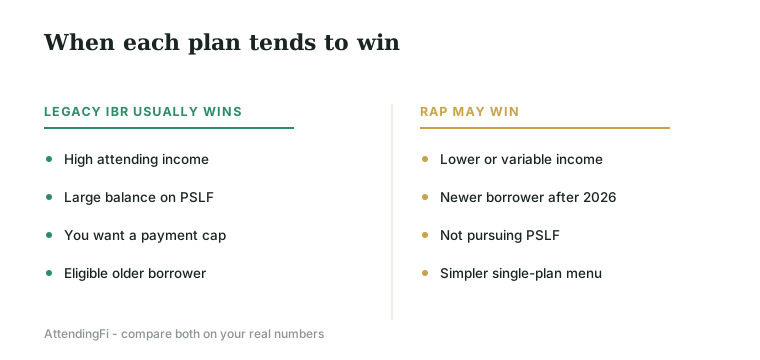
For physicians, the consequential parts are the ones that touch monthly payments and forgiveness. Because the plan you repay on determines both your cash flow and, on a forgiveness path, how much is ultimately forgiven, a change to the plan menu is a change to your strategy. The OBBBA reforms make the choice of income-driven plan more important, not less.
The rest of this guide walks through each piece, what RAP is, how IBR changed, who faces a narrower menu, and how PSLF and taxes fit in, and then turns to the practical question every physician actually cares about: given these changes, what should I do with my loans now.
The Repayment Assistance Plan
OBBBA's signature creation is the Repayment Assistance Plan, a new income-driven option phasing in for 2026. RAP sets your monthly payment using its own formula and, for many newer borrowers, is the primary income-driven plan available. Importantly for physicians, RAP can serve as a qualifying plan beneath PSLF, so pursuing forgiveness remains possible while repaying on it.
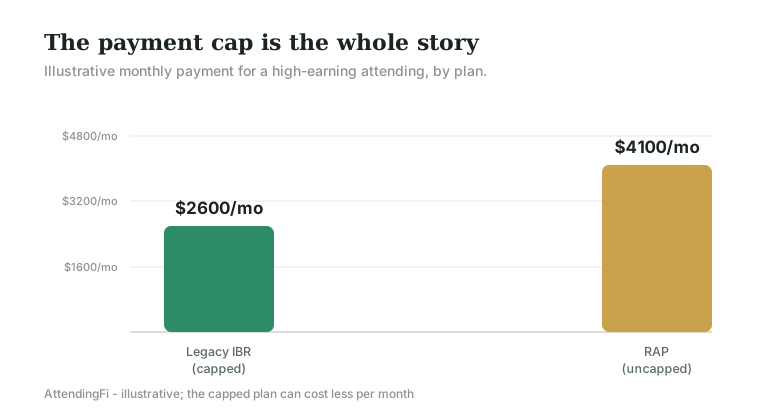
The strategic question RAP raises is how its payment compares to the alternatives for your situation. RAP's formula can be more generous at lower incomes, but it does not carry the same payment cap that legacy IBR offers high earners. Since physician incomes start low and rise steeply, RAP may be attractive during training yet more expensive than a capped plan once attending income arrives.
That makes RAP a plan to evaluate rather than adopt by default. We compare it head-to-head with IBR in RAP vs IBR for physicians, and the engine models which produces the lower lifetime cost on your numbers. The right answer genuinely varies, which is why a comparison beats a rule of thumb.
Changes to Income-Based Repayment
OBBBA also revised IBR, the plan whose payment cap has long made it valuable to high-earning physicians. That cap limits your payment to the standard ten-year amount no matter how high your income climbs, which is exactly what an attending with a large balance wants when an uncapped formula would otherwise produce a very high payment.
The catch is eligibility. Under OBBBA, which plans you can use depends partly on when you borrowed, so not every physician will have access to the same options. A doctor who borrowed under earlier rules may retain access to the capped legacy plan, while a newer borrower may be steered toward RAP. Confirming your eligibility is therefore the necessary starting point.
For those who can access it, capped IBR often remains the cheapest monthly option for a high-earning attending pursuing PSLF, and thus the one that forgives the most. But because eligibility and the cheapest choice both depend on your specifics, this is a conclusion to verify on your own numbers rather than assume from a guide.
A narrower plan menu for new borrowers
One of OBBBA's broader effects is to simplify, and narrow, the set of income-driven plans available to newer borrowers. Where borrowers once chose among several plans, the menu going forward is more limited. For a newer physician borrower, this means fewer levers to pull, which makes pulling the available lever correctly more important.
This is also where a subtle trap lives. Taking on a new federal loan after the relevant cutoff can change which plans you are eligible for, potentially closing off an option that would have served you better. If you may borrow again, it is worth understanding how a new loan affects your plan access before you sign, rather than discovering the consequence afterward.
The practical implication is that the OBBBA era rewards understanding your eligibility precisely. Two physicians with identical balances and incomes can face different optimal strategies simply because of when and how they borrowed. There is no universal answer, only the answer for your specific borrowing history, which is exactly what an analysis of your situation reveals.
What OBBBA means for PSLF
The reassuring headline is that OBBBA did not dismantle PSLF. The program continues under existing law: 120 qualifying payments at a nonprofit or government employer still lead to tax-free forgiveness, and counts you have earned are protected. If you are pursuing PSLF, your goal is unchanged by the 2025 law.
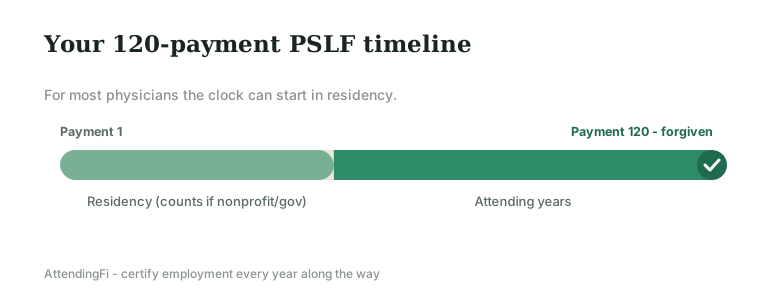
What OBBBA changes is the plan that sits underneath PSLF. Because PSLF requires a qualifying income-driven plan, and OBBBA reshaped that plan menu, the specific plan you use to march toward forgiveness may need to change. The destination, tax-free forgiveness, is the same; the vehicle may differ, and choosing the cheapest qualifying vehicle still maximizes what is forgiven.
So a physician on a PSLF path should treat OBBBA as a prompt to reconfirm their base plan, not to question forgiveness itself. Check which qualifying plans you can use, pick the one with the lowest payment, and continue certifying employment annually. The strategy is intact; only the plan selection underneath it may warrant an update.
Taxes and forgiveness after OBBBA
Tax treatment is the other piece physicians should track. PSLF forgiveness remains tax-free. But the temporary federal exclusion that shielded other forms of forgiveness from income tax is lapsing, which means non-PSLF income-driven forgiveness, received after a 20- or 25-year term, may again be taxable for borrowers who reach it in later years.
For a physician on a non-PSLF forgiveness path, this revives a meaningful liability. On a large balance, a taxable forgiveness can produce a bill of tens of thousands of dollars in a single year. The fix is the familiar one: plan for it with a sinking fund, and factor the eventual tax into any comparison between forgiveness and simply paying the loan off. Our tax-bomb guide covers the details.
Because the tax change can shift the math, some physicians who previously favored a long income-driven path may now find that refinancing or accelerated payoff is cheaper once the future tax is included. This is precisely the kind of conclusion worth re-checking on your numbers, since the OBBBA-era tax treatment was not a factor when many borrowers first chose their strategy.
Your OBBBA-era action plan
Translating OBBBA into action is straightforward. First, confirm which income-driven plans you are eligible for, since it depends on your borrowing history. Second, compare the available qualifying plans, RAP and IBR in particular, to find the lowest payment, because on PSLF that maximizes forgiveness. Third, if you are on a non-PSLF forgiveness path, plan for the returning tax bomb.
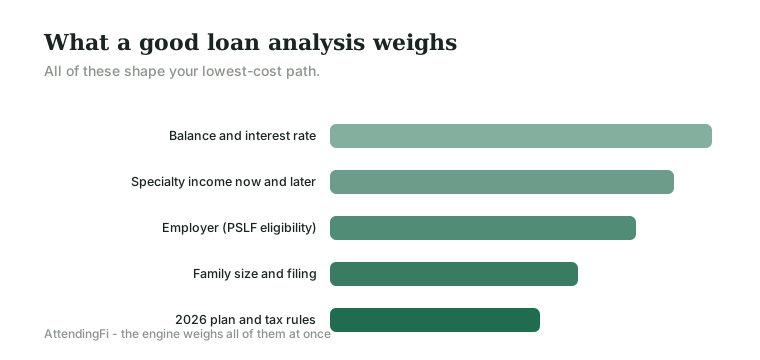
Fourth, re-run the comparison between forgiveness and refinancing under the new rules, since the changed tax treatment can move the answer. And throughout, keep certifying employment if you are pursuing PSLF, because none of the OBBBA changes alter that fundamental requirement. These steps turn a confusing law into a short, concrete checklist.
The most efficient way to work through it is to model your numbers under the current rules. The engine reflects the OBBBA plan menu and tax treatment, so it can tell you whether your existing strategy is still optimal or whether one of the changes has quietly made a different path cheaper for your specific situation.
Key takeaways on OBBBA
OBBBA reshaped the repayment system around forgiveness rather than removing forgiveness. For physicians, the law is a reason to reconfirm the plan beneath your strategy.
- RAP is a new income-driven plan; IBR was revised; both can qualify for PSLF.
- Which plans you can use now depends partly on when you borrowed.
- PSLF itself is intact; only the plan underneath it may need updating.
- The forgiveness tax exclusion is lapsing, reviving the tax bomb for non-PSLF paths.
- Compare RAP and IBR on your numbers to find the cheapest qualifying plan.
- Re-check forgiveness versus refinancing under the new tax treatment.
Treat OBBBA as a prompt to update your plan selection, not to abandon forgiveness. Run your numbers in the engine below to find your lowest-cost path under the new law.
Key dates and what they mean
OBBBA's provisions phase in rather than landing all at once, which is part of what makes the period confusing. The new plan is rolling out, eligibility rules tied to borrowing dates are taking effect, and the tax exclusion's lapse is scheduled rather than immediate. For a physician, the practical effect is that the rules you face depend on both your borrowing history and the timing of your decisions.
Because specific dates and mechanics can shift as implementation proceeds, the reliable approach is to verify the current state of your options against official guidance when you act, rather than relying on a single description. Studentaid.gov and your loan servicer reflect what is actually available to your account at any given moment, which is the information that matters for your decision.
The broader point is that OBBBA turned student loan strategy into something that rewards a periodic review. Checking your plan when you recertify income, and whenever a new provision takes effect, keeps your strategy aligned with the rules as they currently stand rather than as they were when you first chose.
OBBBA and dual-physician households
For couples where both partners are physicians, OBBBA's changes interact with the long-standing question of how to file taxes. On income-driven plans, married-filing-separately can lower the payment that feeds a PSLF strategy, at the cost of some tax benefits, and the OBBBA plan menu changes the specifics of that calculation. The household should model the filing choice together rather than separately.
Dual-physician couples also frequently run two different strategies, perhaps one spouse on PSLF and the other refinancing, and OBBBA's revised tax treatment of non-PSLF forgiveness can shift which combination is cheapest. Because two large balances are involved, getting this right is worth real money, and the interactions are exactly the kind a combined analysis handles better than intuition. We cover the filing tradeoff in married filing separately for student loans.
OBBBA and dual-physician households
For couples where both partners are physicians, OBBBA's changes interact with the long-standing question of how to file taxes. On income-driven plans, married-filing-separately can lower the payment that feeds a PSLF strategy, at the cost of some tax benefits, and the OBBBA plan menu changes the specifics of that calculation. The household should model the filing choice together rather than separately, because the cheapest answer for the couple is often not the cheapest answer for each spouse alone.
Dual-physician couples also frequently run two different strategies, perhaps one spouse on PSLF and the other refinancing, and OBBBA's revised tax treatment of non-PSLF forgiveness can shift which combination is cheapest. Because two large balances are involved, getting this right is worth real money, and the interactions are exactly the kind a combined analysis handles better than intuition. We cover the filing tradeoff in married filing separately for student loans.
The takeaway for two-physician households is to treat OBBBA as a prompt to revisit the whole household plan, not just one spouse's loans. Run the combined numbers under the new rules, because the law changed enough that a strategy set under the old system may no longer be the cheapest path for the family.
A worked example under OBBBA
Consider an attending earning $300,000 with a $320,000 federal balance, pursuing PSLF, who borrowed under earlier rules and retains access to the capped legacy IBR plan. Under OBBBA, she compares IBR against the new RAP. Because her income is high, IBR's cap holds her payment to the standard ten-year amount, producing a lower monthly figure than RAP's uncapped formula would. On a forgiveness path, that lower payment means more of her balance survives to be forgiven tax-free.
Now change the borrower. A newer attending who took loans after the relevant cutoff may not have access to capped IBR at all, and finds RAP is the plan available to him. His optimal move is different not because his finances differ, but because his borrowing history gives him a different menu. This is the heart of the OBBBA era: identical numbers, different strategies, driven by eligibility.
The lesson is that no single answer fits all physicians under OBBBA. The right plan depends on what you are eligible for and how your income compares to your balance, which is exactly why a comparison on your own numbers beats any general rule. The engine reflects the current plan menu and eligibility logic, so it can show your cheapest qualifying path rather than a generic one.
Get your personalized plan
Don't guess — model your exact numbers. AttendingFi runs the real federal-rules math on your numbers and shows its work. Free, no login needed to see your answer.
Run my numbers →Frequently asked questions
Did OBBBA end PSLF for physicians?
No. OBBBA left PSLF intact. It changed income-driven repayment plans and eligibility, but 120 qualifying payments at a nonprofit or government employer still lead to tax-free forgiveness.
What is the new plan OBBBA created?
The Repayment Assistance Plan, or RAP, a new income-driven plan phasing in for 2026. It can qualify for PSLF, but whether it is cheaper than the revised IBR depends on your income and balance.
How does OBBBA affect which plans I can use?
Plan eligibility now depends partly on when you borrowed. Newer borrowers face a narrower menu, and taking a new federal loan can change which plans you can access, so confirm your eligibility before borrowing again.
Is forgiveness taxable under OBBBA?
PSLF forgiveness remains tax-free. The temporary exclusion for other forgiveness is lapsing, so non-PSLF income-driven forgiveness may again be taxable for borrowers reaching it in later years.
What should physicians do in response to OBBBA?
Confirm plan eligibility, compare RAP and IBR for the lowest payment, plan for the returning tax bomb if on a non-PSLF path, and re-check forgiveness versus refinancing on your numbers.