Double consolidation: does it still work in 2026?
Double consolidation student loans was once the only way many Parent PLUS borrowers could reach the better income-driven repayment plans, but the rules have changed dramatically. The double consolidation loophole closed on July 1, 2025, and under the law now in effect a single consolidation reaches the same destination far more simply. More urgently, there is a hard deadline: Parent PLUS loans generally must be consolidated and disbursed before July 1, 2026, or they permanently lose access to income-driven repayment. This guide explains what changed, what to do now, and how little time is left.
What double consolidation student loans actually was
Double consolidation was a workaround built for Parent PLUS borrowers. Parent PLUS loans have always been the most restricted federal loans: on their own they could not access the income-driven plans that base payments on earnings, leaving borrowers stuck with fixed payments tied to what they owed rather than what they made. For a parent who borrowed heavily to fund a child's education, that limitation could mean an unaffordable payment with no income-based relief and no realistic path to forgiveness through public service work.
The strategy exploited how the federal system classifies consolidation loans. By consolidating Parent PLUS loans twice, in two separate groups through two different servicers, a borrower could reclassify the resulting loan so it no longer looked like a Parent PLUS consolidation. That reclassification unlocked income-driven plans that were otherwise off-limits, dropping payments substantially and opening a forgiveness path. It worked, but it was fragile, requiring precise timing, multiple servicers, and careful sequencing that left real room for costly errors.
Because it depended on a quirk in how loans were categorized rather than on an intended benefit, double consolidation was always vulnerable to being closed. It was a loophole in the literal sense: an unintended gap that knowledgeable borrowers and advisors used while it lasted. Understanding what it was matters now mainly because the landscape has shifted, and the workaround that borrowers spent years carefully executing is no longer the right move for anyone who has not already completed it.
Why the loophole closed in 2025
The double consolidation loophole closed on July 1, 2025. After that date, the federal rules changed so that a borrower whose Direct Consolidation Loan repaid a Parent PLUS loan, or repaid a consolidation loan that itself included a Parent PLUS loan, can no longer freely reclassify into the full menu of income-driven plans the way the double-consolidation trick allowed. The specific maneuver of consolidating twice to escape the Parent PLUS restriction was deliberately shut.
The closure was not purely a loss, however, because it arrived alongside a broader change that made the workaround unnecessary. Where a single Parent PLUS consolidation once reached only the most restrictive income-driven option, the current rules let a single consolidation reach Income-Based Repayment through a defined sequence. In other words, the door the loophole pried open is now reachable through the front entrance, without the second consolidation, the second servicer, or the timing risk that made the old approach so error-prone.
This is why the practical advice flipped overnight. Before July 2025, a Parent PLUS borrower who wanted real income-driven relief often needed the double consolidation. After it, that same borrower needs only a single, ordinary consolidation followed by the right enrollment steps. Anyone still planning to double-consolidate today is solving a problem that no longer exists, and adding complexity and processing delay at the worst possible moment given the deadline now bearing down.
The simpler path that replaced it
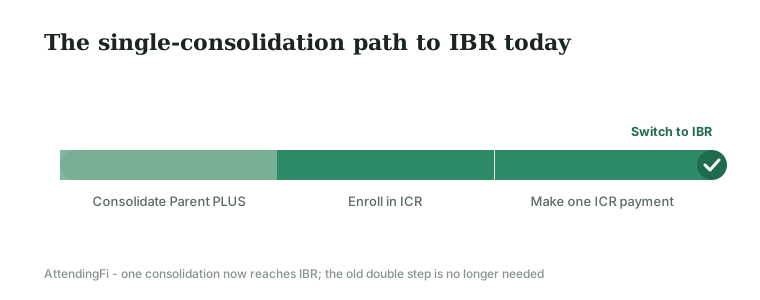
Under current law, a single consolidation now reaches Income-Based Repayment for Parent PLUS borrowers, through a specific and unavoidable sequence. The borrower consolidates their Parent PLUS loans into one Direct Consolidation Loan, enrolls that loan in Income-Contingent Repayment, makes at least one full payment under that plan, and then applies to switch into Income-Based Repayment if they meet its hardship requirement. ICR is not the destination; it is the bridge the rules require you to cross first.
This matters because Income-Based Repayment generally produces a meaningfully lower monthly payment than the Income-Contingent plan you pass through to reach it, and because reaching an income-driven plan is what makes Public Service Loan Forgiveness possible for these borrowers at all. A Parent PLUS borrower working for a qualifying employer cannot pursue tax-free forgiveness without first getting onto a qualifying plan, and the single-consolidation sequence is now the route there. The benefit is access to better plans, not a lower interest rate.
It is worth being clear about what consolidation does and does not do. It combines multiple loans into one and changes which repayment plans you can use, but it does not reduce your interest rate, does not shrink the balance, and does not transfer the debt to anyone else. The new rate is simply the weighted average of your old rates rounded up slightly. The entire value of consolidating here is the repayment-plan access it unlocks, which is precisely what the deadline below puts at risk.
The urgent July 1, 2026 deadline
This is the part that cannot wait. Under the law now in effect, Parent PLUS loans must be consolidated into a Direct Consolidation Loan, and that consolidation must actually disburse, before July 1, 2026. Parent PLUS loans that are not consolidated by that date permanently lose access to every income-driven repayment plan, including Income-Based Repayment and the forthcoming Repayment Assistance Plan. This is not a temporary pause or a soft target; there is no described extension mechanism, and missing it forecloses income-driven options for good.
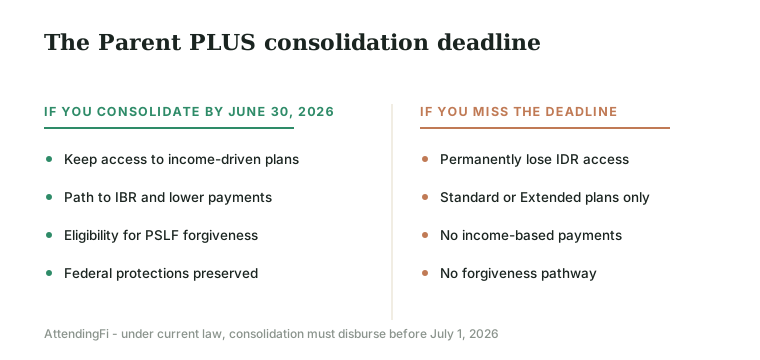
The timing is genuinely tight. Consolidation applications take roughly 30 to 90 days to process and disburse, and the deadline turns on disbursement, not merely on submitting the application. With only weeks remaining as of mid-2026, a borrower who has not yet applied should treat this as immediate. The Department of Education had recommended applying by April 1, 2026 to be safe; that date has passed, which means anyone still on the fence is now in the narrow window where every day counts.
There is also a second, later deadline worth knowing. Consolidating before July 2026 preserves eligibility, but borrowers still need to enroll in an income-driven plan, and the Income-Contingent plan that serves as the bridge is itself scheduled to end June 30, 2028. A borrower who consolidates in time but never completes the enrollment into an income-driven plan before that later date could still lose access. The safe approach is to consolidate now and complete the enrollment sequence promptly afterward.
The single-consolidation process step by step
The mechanics are straightforward, which is part of why double consolidation is now obsolete. You apply for a Direct Consolidation Loan at the official federal site, StudentAid.gov, where there is no fee and no credit check. You consolidate your Parent PLUS loans by themselves, even if you have only one, and you keep them in their own application rather than combining them with any other federal loans you might hold. Then you wait for the consolidation to process and disburse, which is the step the deadline measures.
Once the consolidation loan exists, you enroll it in Income-Contingent Repayment, the only income-driven plan a consolidated Parent PLUS loan can start on. You then make at least one full payment under that plan, because the rules require a posted ICR payment before you can move on. Skipping or fumbling this single-payment step breaks the sequence and is one of the more common ways borrowers stall, so it deserves attention even though it sounds trivial.
After that payment posts, you apply to switch into Income-Based Repayment, which generally lowers the payment further if you meet the partial-financial-hardship requirement. From there, if you work for a qualifying public-service employer, your payments can count toward forgiveness. You can estimate your post-consolidation payments on the Department of Education's Loan Simulator before you commit, which is a sensible way to confirm the plan will actually be affordable before you start the clock.
Mistakes to avoid right now
The most damaging mistake is combining your Parent PLUS loans with your own Direct loans in the same consolidation. If you fold them together, the entire consolidated loan is treated as a Parent PLUS consolidation, which drags your own student loans down to the more restrictive rules and can strip them of income-driven access and any forgiveness credit they had earned independently. Keep the Parent PLUS consolidation entirely separate, in its own application, and leave your other federal loans out of it.
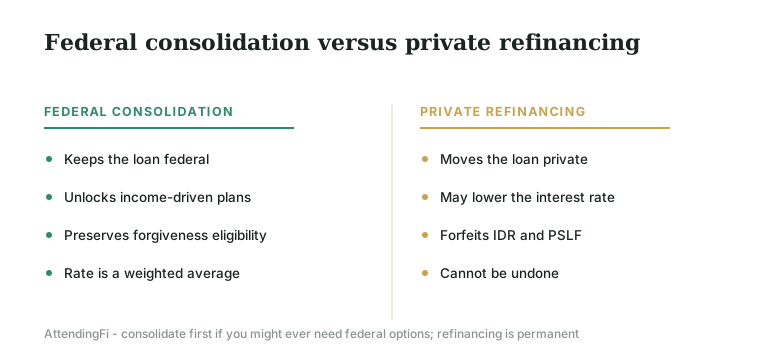
The second serious mistake is getting the order wrong with private refinancing. If you refinance a Parent PLUS loan into a private loan before consolidating it federally, you cannot later consolidate it back into the federal system, and the income-driven path disappears permanently. Because refinancing cannot be undone, anyone who might ever want federal options should consolidate first and only consider refinancing afterward, once they are certain they will not need income-driven repayment or forgiveness.
A third mistake is simply waiting. Given the disbursement-based deadline and the multi-week processing time, treating this as something to handle later is the error that forecloses the benefit by default. Even a borrower who is not sure they want income-driven repayment is usually better off consolidating before the deadline to preserve the option, because they can always decline to enroll later, but they cannot consolidate after the window closes. Preserving optionality is nearly free; losing it is permanent.
Consolidation versus refinancing
Federal consolidation and private refinancing solve different problems and lead to very different places, and conflating them is a recurring source of expensive mistakes. Federal consolidation keeps your loan inside the federal system, preserving deferment, forbearance, and forgiveness eligibility, and its benefit is access to an expanded set of repayment plans rather than a lower rate. The interest rate after consolidation is essentially unchanged, just a weighted average of what you already had.
Private refinancing, by contrast, replaces your federal loan with a new private loan, and its potential upside is a lower interest rate if your credit and income qualify. The trade-off is severe and permanent: income-driven repayment, federal forbearance protections, and every federal forgiveness program stop applying the moment you refinance, and there is no way to reverse the transaction to regain federal status. For a Parent PLUS borrower, refinancing before the consolidation deadline can quietly destroy the very option this guide is urging you to preserve.
The practical rule is one of sequence and certainty. If there is any realistic chance you will want income-driven payments or forgiveness, consolidate within the federal system first, and revisit refinancing only later if a clearly better private rate appears and you are confident you will never need the federal safety net. We cover the refinancing decision in depth in our refinancing pros and cons guide, which is worth reading before you give up federal protections.
Who this affects, and why physicians should care
This is fundamentally a Parent PLUS issue, so it reaches physician households in a few specific ways. A physician whose parents took Parent PLUS loans to help fund their education may be involved in managing or repaying that debt, and a physician who is themselves a parent may hold Parent PLUS loans for a child. In either case the deadline applies to the Parent PLUS borrower, and the household should make sure those loans are evaluated alongside the physician's own student debt rather than overlooked.
It is important not to confuse Parent PLUS loans with the Grad PLUS and Direct loans that make up most physicians' own balances. Those loans already have access to income-driven plans and are governed by different rules, so the double-consolidation history and the Parent PLUS deadline do not apply to them in the same way. The point of raising it here is that a complete household plan accounts for every federal loan, and Parent PLUS debt carries a uniquely unforgiving deadline that the rest does not.
If your household includes Parent PLUS loans and you have not yet consolidated them, the single most useful thing you can do after reading this is to verify their status and act before the window closes. The decision of whether income-driven repayment ultimately helps can be modeled carefully afterward, but the ability to make that decision at all depends on consolidating in time. Preserve the option first; optimize within it second.
Key takeaways on double consolidation
The double consolidation loophole closed in July 2025, a single consolidation now reaches IBR, and a hard July 1, 2026 deadline determines whether Parent PLUS loans keep income-driven access at all.
- Double consolidation closed July 1, 2025, and is no longer needed.
- A single consolidation now reaches IBR through an ICR bridge and one payment.
- Parent PLUS loans must be consolidated and disbursed before July 1, 2026.
- Missing that deadline permanently forecloses income-driven repayment and forgiveness.
- Never combine Parent PLUS loans with your own Direct loans in one consolidation.
- Consolidate before refinancing, because refinancing cannot be undone.
If your household holds Parent PLUS loans, verify their status and act before the deadline. Apply at StudentAid.gov, then complete the enrollment sequence promptly.
Get your personalized plan
Don't guess — model your exact numbers. AttendingFi runs the real federal-rules math on your numbers and shows its work. Free, no login needed to see your answer.
Run my numbers →Frequently asked questions
Is double consolidation still possible in 2026?
You can technically still consolidate twice, but there is no reason to. The loophole closed July 1, 2025, and a single consolidation now reaches Income-Based Repayment through an ICR bridge and one payment. Double consolidation only adds complexity and delay.
What is the Parent PLUS consolidation deadline?
Under current law, Parent PLUS loans must be consolidated into a Direct Consolidation Loan, and that consolidation must disburse, before July 1, 2026. After that, unconsolidated Parent PLUS loans permanently lose access to all income-driven repayment plans.
Does consolidation lower my Parent PLUS interest rate?
No. The new rate is a weighted average of your existing rates, rounded up to the nearest eighth of a percent. The benefit of consolidating is access to income-driven repayment plans, not a lower interest rate.
Can I combine Parent PLUS loans with my own student loans?
You can, but you should not. Combining them makes the entire consolidation a Parent PLUS consolidation, which can strip your own loans of income-driven access and forgiveness credit. Keep the Parent PLUS consolidation separate.
Should I refinance or consolidate my Parent PLUS loans first?
Consolidate first if there is any chance you will want income-driven repayment or forgiveness. Refinancing moves the loan private and is permanent, so doing it before consolidating forecloses the federal path for good.