The SAVE plan is over: what physicians on the forbearance should do now
1. What actually happened to SAVE
The SAVE plan forbearance left many physicians in limbo: enrolled in a plan that was halted by litigation, placed into a payment pause, and unsure whether those months still count toward forgiveness. For a doctor on a PSLF track, that uncertainty is not academic, because forbearance months generally do not advance the 120-payment clock. This guide explains what happened, what the forbearance means for your forgiveness progress, and the concrete moves to protect your strategy now. The disruption is real, but for most physicians it is fixable once you understand how a payment pause interacts with the forgiveness clock and what exactly to do about it right away today.
What happened to the SAVE plan
The SAVE plan, one of the income-driven options many borrowers had chosen, was challenged in court and halted. As the litigation proceeded, the Department of Education placed affected borrowers into a forbearance, frequently interest-free, that paused their required payments. The intent was to give borrowers relief while the legal questions were resolved, but it created a new problem for those pursuing forgiveness.
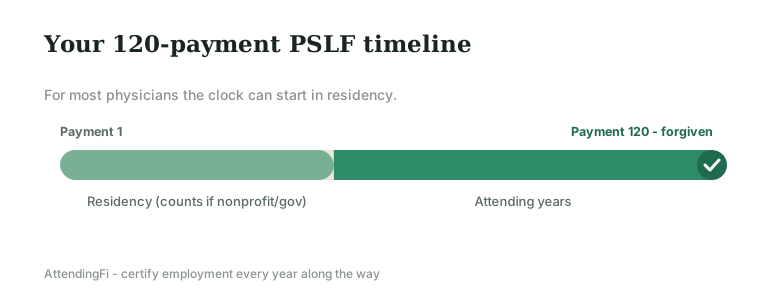
For physicians, the disruption matters because so many are pursuing PSLF, where steady qualifying payments are the whole point. A forbearance that pauses payments also generally pauses progress toward the 120-payment threshold, which means a borrower can remain employed at a qualifying hospital yet stop moving toward forgiveness during the pause.
The situation has continued to evolve as courts and the Department work through the issues, so the precise status of SAVE and its borrowers can change. The reliable approach is to confirm your own current standing rather than rely on a single snapshot, since the details that affect your forgiveness count are specific to your account and the moment you check.
What the forbearance means for your PSLF
The central question for a PSLF borrower in the SAVE forbearance is simple: am I still making progress toward forgiveness? In most cases, a forbearance is not a qualifying payment, so months spent paused do not count toward your 120. That makes a long forbearance a quiet stall, costing you time on the clock even though nothing about your employment changed.
This is why the forbearance is more than a convenience for physicians on a forgiveness path. A borrower who simply accepts the pause may look up months later to find their qualifying-payment count has not moved, lengthening the time until forgiveness. The relief of paused payments comes at the cost of paused progress, a tradeoff that is rarely worthwhile for someone close to or counting on PSLF.
The good news is that this is manageable once you understand it. The goal is to get back into a qualifying repayment status as soon as practical, so your months resume counting. Whether that means moving to a different income-driven plan depends on what is available to you, which is exactly the kind of thing to confirm with your servicer and against current guidance.
Do the forbearance months count toward forgiveness?
Generally, months in the SAVE-related forbearance do not count toward PSLF the way an on-time qualifying payment would. There have at times been specific provisions and adjustments that allowed certain paused periods to be credited, but these are situation-specific and have evolved, so you should not assume your paused months counted without verifying.
The practical implication is to find out exactly how the pause affected your count rather than guessing. Pull your qualifying-payment total and compare it to what you expected; if months are missing because of the forbearance, you can address them deliberately. The missing PSLF months checker helps you pinpoint any gap.
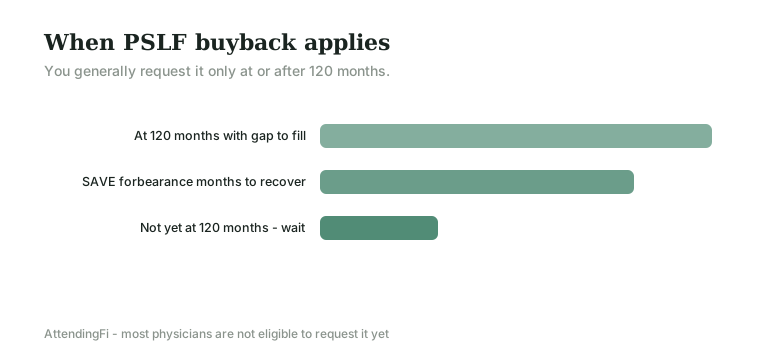
If genuine qualifying months were lost to the forbearance, the PSLF buyback program may let you recover some of them, typically once you are at or near 120 payments. We cover that in the buyback guide. The key is to know your true count so you can plan, rather than discovering a shortfall at the finish line.
Interest during the pause
One feature of the SAVE-related forbearance is that it has often been interest-free, meaning your balance did not grow while payments were paused. That is a genuine benefit and distinguishes it from an ordinary forbearance, where interest typically accrues and can capitalize. For a borrower not pursuing forgiveness, an interest-free pause can even be a small windfall.
For a PSLF borrower, though, the interest treatment is secondary to the count. Even an interest-free pause that protects your balance does not help if it stalls your march toward forgiveness, because on PSLF the goal is to reach 120 qualifying payments, not to minimize interest along the way. The two borrower types should weigh the pause very differently.
This is the crux of the SAVE forbearance decision: a non-PSLF borrower may rationally enjoy an interest-free pause, while a PSLF borrower usually wants to resume qualifying payments as soon as possible. Knowing which camp you are in determines whether the forbearance is a benefit to use or a stall to escape.
What to do right now
If you are a physician affected by the SAVE forbearance, take a few concrete steps. First, confirm your current status, whether you are still in forbearance, what plan you will be moved to, and your current qualifying-payment count. Second, if you are pursuing PSLF, prioritize returning to a qualifying repayment plan so your months resume counting toward forgiveness.
Third, certify your employment if you have not recently, so your record is current and any forgiveness credit is properly attributed. Fourth, check whether any missing months can be recovered through buyback. These steps re-establish forward progress and surface any damage the pause may have done while it is still addressable.
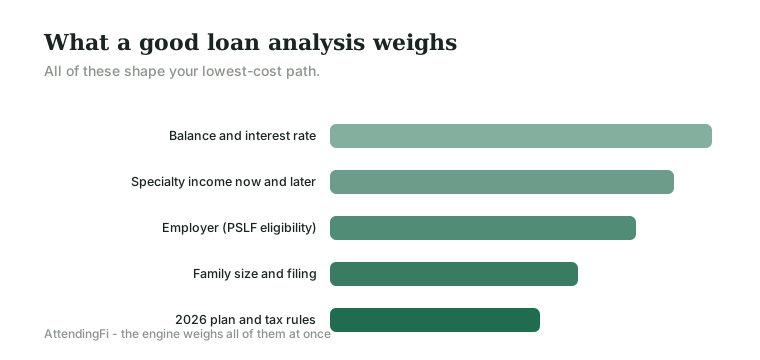
Because the rules have been in flux, verify each step against current guidance and your servicer rather than relying on older information. The engine can help you see how the interruption affects your forgiveness timeline and what plan now minimizes your cost, turning a confusing situation into a clear next action. It accounts for your current count, your plan options, and the 2026 rules, so the path back to steady progress toward forgiveness is laid out in plain terms rather than left to guesswork during a stressful and uncertain time.
Where PSLF buyback fits in
Buyback is the mechanism most relevant to physicians who lost qualifying months to the SAVE forbearance. It lets you make certain past months count by paying what you would have paid then, and it was designed precisely for situations where you were working full-time at a qualifying employer but were not making a qualifying payment, which describes a forbearance.
The important caveat is timing: buyback is generally something you request at or near 120 months, not mid-career. So a physician years from forgiveness usually cannot buy back forbearance months yet. What you can do now is document your employment through certification and keep a clean record, so that when you near the finish line any recoverable months are visible and addressable.
If you are close to 120 payments and find forbearance months standing between you and forgiveness, buyback can be extraordinarily valuable, since a modest payment can unlock a large tax-free forgiveness. Confirm whether the specific months qualify before paying, because buyback fills genuine gaps but cannot create credit for months that never qualified for other reasons.
If you are not pursuing PSLF
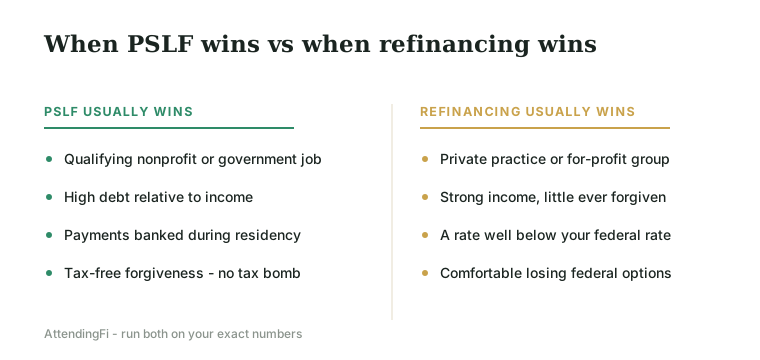
Not every physician affected by the SAVE forbearance is on a PSLF path, and for those who are not, the calculus is different. An interest-free pause that protects your balance is a genuine, if temporary, benefit, and the loss of qualifying-payment progress is irrelevant because you are not chasing forgiveness through employment.
For a non-PSLF borrower, the SAVE disruption is mostly a prompt to reconfirm your broader strategy. With the plan menu changing and the forgiveness tax exclusion lapsing, it is a good moment to re-check whether an income-driven path or refinancing is cheaper for you. The forbearance itself is less consequential than the larger 2026 shifts happening around it.
The unifying point is that the SAVE forbearance means very different things to different physicians. Identify your path first, then respond accordingly: resume qualifying payments if you are pursuing PSLF, or use the pause and reassess your overall plan if you are not. The engine can clarify which path is cheapest for your situation.
Key takeaways on the SAVE forbearance
The SAVE plan forbearance paused payments, but for PSLF borrowers it also paused progress. The response depends on whether forgiveness is your goal.
- A forbearance generally does not advance the PSLF 120-payment clock.
- Confirm your current status and qualifying-payment count, do not assume.
- If pursuing PSLF, return to a qualifying plan so months resume counting.
- Buyback may recover lost forbearance months once you near 120 payments.
- The pause has often been interest-free, a benefit mainly for non-PSLF borrowers.
- Verify everything against current guidance, since the rules have evolved.
- What replaced SAVE?
Do not let a payment pause quietly become a forgiveness stall. Run your numbers in the engine below to see how the interruption affects your timeline and what to do next.
Why SAVE was paused
SAVE was the successor to earlier income-driven plans and was designed to offer lower payments and faster forgiveness for some borrowers. Its generosity is also part of what drew legal challenges, with litigation questioning the authority behind certain provisions. As those challenges moved through the courts, enforcement of the plan was halted, and borrowers were paused rather than dropped.
For physicians, the underlying legal debate matters less than the practical effect: a plan many had relied on became unavailable, at least temporarily, and the path forward depends on how the litigation and the Department's response ultimately resolve. Because that resolution has been a moving target, the safest stance is to plan around your current, verifiable status rather than an expected outcome.
The broader lesson is that even well-intentioned programs can be disrupted, which is an argument for building a strategy that does not depend on any single plan surviving unchanged. A physician whose PSLF strategy rests on the durable, statutory core of the program, rather than on a specific income-driven plan, is better insulated from this kind of upheaval.
What to watch going forward
Because the SAVE situation continues to develop, a few things are worth monitoring. Watch for official guidance on whether and how paused months will ultimately be treated for PSLF, since adjustments have happened before. Watch for which plan you are transitioned to, as that determines your payment and your forgiveness eligibility going forward.
And watch your qualifying-payment count directly, rather than trusting that everything is being handled correctly behind the scenes. Servicer records have not always been perfect through periods of change, and catching an error early, while it is still fixable, is far easier than untangling it years later. A brief check each time you recertify income is cheap insurance.
A worked example of the forbearance trap
Consider a hospital-employed internist at month ninety of her PSLF journey when the SAVE forbearance begins. She accepts the pause for eighteen months, relieved to skip payments. When she checks her count later, it has not moved: she is still at ninety qualifying months, having lost a year and a half of progress toward forgiveness even though she never left her qualifying job. The pause felt like relief but cost her real time on the clock.
A colleague in the same situation responds differently. He confirms his status, moves promptly to a qualifying repayment plan as soon as one is available, and resumes counting. By the time the first internist realizes her count stalled, he has banked the months she lost. Same disruption, opposite outcomes, decided entirely by whether each understood that a forbearance pauses forgiveness progress.
The lesson is that the SAVE forbearance rewards attention and punishes passivity for PSLF borrowers. The fix is not complicated, it is simply to act rather than drift. Run your numbers in the engine below to see exactly how the pause affected your timeline and what to do to get back on track.
Get your personalized plan
Don't guess — model your exact numbers. AttendingFi runs the real federal-rules math on your numbers and shows its work. Free, no login needed to see your answer.
Run my numbers →Frequently asked questions
Do SAVE forbearance months count toward PSLF?
Generally no. A forbearance usually does not advance the PSLF 120-payment clock, though specific adjustments have applied at times. Confirm your actual count rather than assuming, and consider buyback for genuinely lost months.
Should I stay in the SAVE forbearance if I am pursuing PSLF?
Usually not. If you are pursuing PSLF, returning to a qualifying repayment plan lets your months resume counting toward forgiveness. A long pause stalls your progress even while you remain at a qualifying employer.
Is the SAVE forbearance interest-free?
It has often been interest-free, meaning your balance does not grow during the pause. That is a real benefit, but for PSLF borrowers the loss of qualifying-payment progress usually outweighs it.
Can I recover SAVE months with PSLF buyback?
Possibly, once you are at or near 120 payments. Buyback lets you make certain paused months count by paying what you would have paid. Confirm the specific months qualify before paying.
What should I do about my SAVE loans now?
Confirm your status and count, return to a qualifying plan if pursuing PSLF, certify employment, and check whether missing months can be recovered. Verify each step against current guidance.