Student loans in residency: the moves that matter
Your resident student loan strategy is the most consequential financial decision you will make in training, and most residents get it wrong by accident, simply by not acting. The years you spend on a resident salary are a rare, closing window to bank cheap forgiveness credit and lock in the right plan. This guide lays out the moves that matter, in order, so you finish residency with your options open and six figures of value protected rather than forfeited.
Why residency is the decisive window
Residency is the single best time in your career to be in a forgiveness program, and the reason is arithmetic. On an income-driven plan, your monthly payment is a share of your income, so on a resident salary it is tiny, sometimes only a few hundred dollars or less. Yet each of those cheap months counts exactly as much toward forgiveness as an expensive attending month.
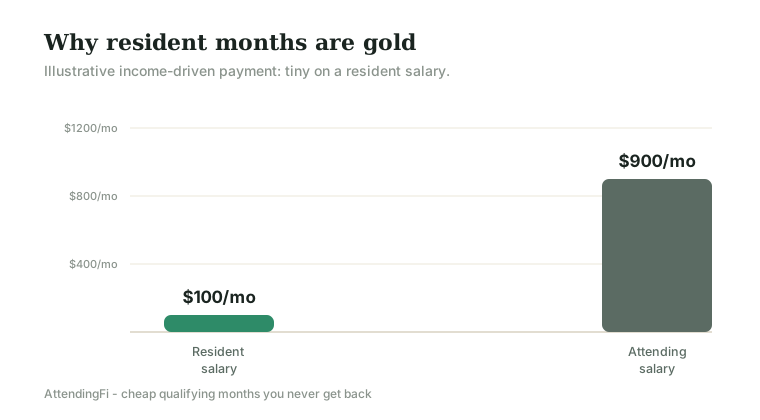
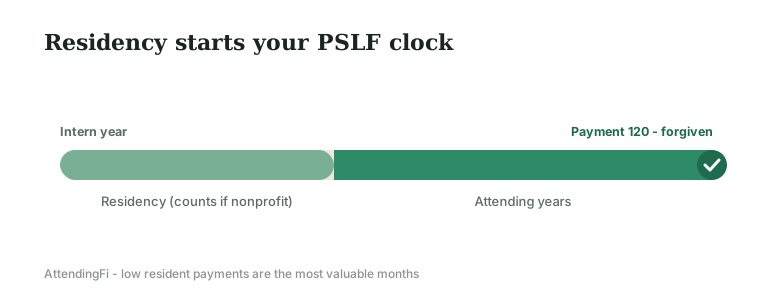
Over three to seven years of training, a resident pursuing PSLF can bank a large share of the 120 required payments while paying very little. By the time attending income arrives, you are already well down the road to forgiveness, having paid a fraction of what you would have paid by starting later. That is the heart of why your resident strategy matters so much.
The flip side is that this window closes and cannot be reopened. A resident who delays enrolling, or who refinances during training, forfeits those irreplaceable cheap months. There is no way to buy them back later at the same price. This is why the moves below should happen early in intern year, not someday when life is less hectic.
The conditions that make months count
For a month of residency to count toward PSLF, four things must be true at once. You need federal Direct loans; you need to be enrolled in a qualifying income-driven repayment plan; you need to be working full-time for a qualifying nonprofit or government employer; and your payment must be on time and for the full amount. Meet all four and the month counts.
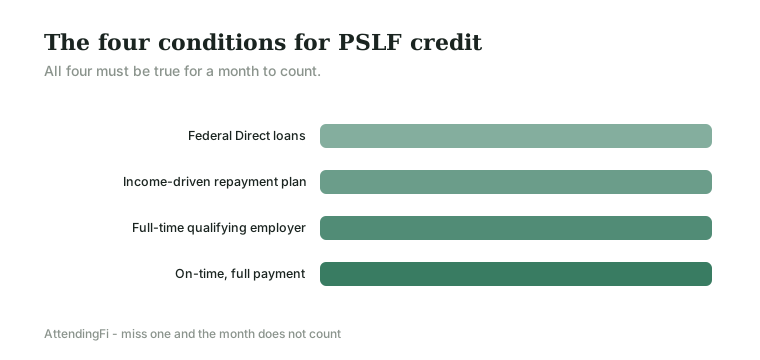
The good news for residents is that most of these are easy to satisfy. The great majority of residency programs are at nonprofit or government teaching hospitals, so the employer condition is usually met automatically. The loan-type and plan conditions are within your control and are exactly what the early setup moves address.
The condition residents most often stumble on is the loan type. If you hold older FFEL or Perkins loans, they must be consolidated into a Direct Consolidation Loan before they count, and the timing matters. Check your loan types at studentaid.gov early so you are not surprised to learn, years in, that some of your loans were never qualifying.
Choosing your repayment plan
If you are pursuing forgiveness, the plan you choose sets your payment, and on a forgiveness path a lower payment means more is ultimately forgiven. Your goal as a resident is therefore to pay as little as the rules legally allow, banking maximum qualifying months at minimum cost. The 2026 menu pairs a new Repayment Assistance Plan with a revised IBR.
For most residents the right move is to enroll in the qualifying income-driven plan that produces the lowest payment on your resident income, then revisit the choice as you approach attending earnings. We compare the options in RAP vs IBR, and the engine models which plan minimizes your cost across both training and attending years.
Timing your annual income recertification well matters too. Because payments are recalculated when you recertify, keeping a lower resident-based payment in place as long as the rules allow can extend your cheapest months. These details are small individually but compound into real money across a multi-year residency.
Certify employment every single year
The step most residents skip is annual certification, and it is the one that quietly sinks the most PSLF cases. Every year, and every time you change programs or employers, you should submit a PSLF employment certification through the official PSLF Help Tool, signed by your program or HR. This keeps your official qualifying-payment count accurate and current.
Certifying annually does two things. It confirms your months are counting as you go, so you catch any problem while it is still fixable, and it builds a clean documented record so you are not scrambling for old employment verification years later. Residents who wait until the end to deal with paperwork frequently discover their counted total is lower than they expected.
This is a five-minute habit with enormous payoff. The difference between a resident who certifies every year and one who does not is often the difference between reaching forgiveness on schedule and arriving short. Make it part of your annual routine, alongside license renewal and other yearly tasks, so it never slips.
The refinancing trap residents fall into
Lenders market low resident refinance rates aggressively, and a small monthly payment can look appealing against a federal bill. For most residents, refinancing during training is a serious mistake. It converts your federal loans to private debt, permanently forfeiting PSLF and erasing the cheap qualifying months you are banking, often the most valuable months you will ever make.
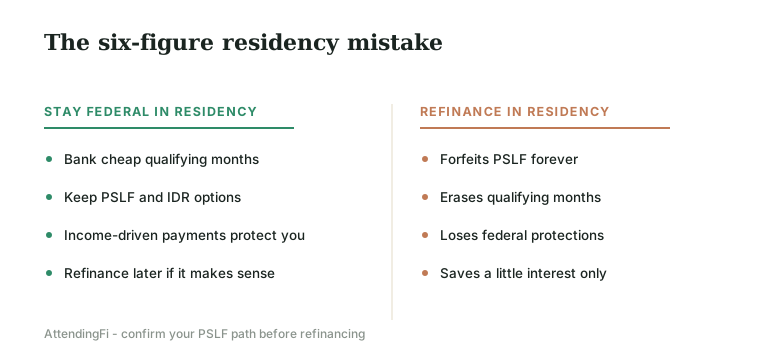
There are narrow exceptions. A resident with a small balance, a high-earning spouse, and a confirmed private-practice future might rationally refinance to lock a rate. But for the typical resident carrying a large balance and headed for a hospital-employed job, staying federal and revisiting refinancing as an attending is almost always the better move.
The discipline is to treat refinancing as a one-way door and not walk through it until you are certain forgiveness is off the table. Confirm your PSLF path first; only then is it safe to consider converting to private debt. A lender's calculator will not frame it this way, because refinancing is how the lender gets paid.
Handling any private loans you already hold
Some residents carry private loans from undergraduate or medical school alongside their federal debt. These never qualified for PSLF and have none of the federal protections, so they can be treated separately from your forgiveness strategy. You can keep paying them, and you may refinance them to a lower rate without affecting your federal plan at all.
The key is not to confuse the two. Refinancing your private loans is generally low-risk because you are not giving up federal benefits you never had. Refinancing your federal loans is the risky, irreversible move. Knowing which loans are which, by checking your loan list, lets you optimize the private portion while protecting the federal portion.
If your private loans carry a high rate and you have strong credit or a cosigner, refinancing that slice during residency can save money with little downside. Just keep the federal loans on their forgiveness-eligible track. This split approach captures savings where it is safe and preserves optionality where it matters.
Your residency loan checklist
Here is the whole strategy in order. Pull your loan list and confirm your loans are federal Direct, consolidating older FFEL or Perkins loans if needed. Enroll in the qualifying income-driven plan with the lowest payment. File your first employer certification through the PSLF Help Tool. Do not refinance your federal loans during training. Re-certify employment every year.
Those six moves, handled early and maintained annually, are the entire difference between a resident who finishes training with forgiveness on track and one who forfeits irreplaceable value by inattention. None of them are difficult; they simply have to actually get done, ideally in the first months of intern year rather than postponed.
If you are unsure whether PSLF is even your lowest-cost path, that is exactly what the engine answers. Enter your balance, your training and attending income, and your employer, and it compares PSLF against refinancing and every other plan, so you can commit to the right resident strategy with confidence rather than guessing.
Forbearance, deferment, and gaps in training
Residency rarely runs in a perfectly straight line, and gaps matter for your loan strategy. Months spent in deferment or forbearance generally do not count toward PSLF, so a long forbearance can quietly stall your progress even while you remain employed at a qualifying hospital. Where possible, staying in active repayment on an income-driven plan, even at a tiny payment, keeps your qualifying months accruing.
That said, life happens. A medical leave, a research year, or a fellowship at a non-qualifying employer can interrupt your count. The important thing is to understand which periods count and which do not, so you are not surprised later. If you discover qualifying months were missed because of a forbearance, PSLF buyback may let you recover some of them once you near 120 payments.
The practical move during any gap is to check how it affects your PSLF count before, not after, it happens. A brief conversation with your servicer or a quick model of the scenario can reveal whether a planned leave or fellowship will pause your clock, letting you plan around it rather than lose months you assumed were counting.
Planning the transition to attending
The handoff from resident to attending is the highest-leverage moment in your loan strategy after the initial setup. Your income jumps sharply, and with it your income-driven payment, unless you are on a capped plan that limits the increase. Choosing the right base plan before that jump, and timing your annual recertification well, can keep your payment lower for longer and, on PSLF, preserve more forgiveness.
This is also the moment to reconfirm your path. If you are staying at a qualifying employer, continue on PSLF and optimize the plan; if you are moving to private practice, this is when refinancing finally comes onto the table, since forgiveness is no longer in play. The decision you defer during residency becomes live the moment your attending contract starts.
Because so much value rides on this transition, it is worth modeling before you sign your first attending contract. The engine shows how your payment and forgiveness change as you move from resident to attending income under each plan, so you can lock in the cheapest path through the transition rather than discovering the consequences after the fact.
A resident strategy in action
Consider an incoming intern with $250,000 in federal Direct loans who acts in the first months of training. She consolidates a small FFEL balance so it qualifies, enrolls in the lowest-payment qualifying income-driven plan, and files her first employer certification. Over four years, her payments are modest, often only a few hundred dollars a month, yet she banks roughly forty-eight qualifying months toward PSLF.
By the time she becomes an attending, she is already a third of the way to forgiveness, having paid a small fraction of what those months would cost at attending income. She continues at a qualifying employer, finishes her 120 payments, and a large remaining balance is forgiven tax-free. The contrast with a peer who waited, or who refinanced during residency, is stark: that peer forfeited the cheap months and must make every payment at full attending cost.
The difference between the two residents is not income, intelligence, or luck. It is a handful of deliberate moves made early and maintained annually. That is the entire thesis of a good resident loan strategy: small, timely actions during training protect six figures of value later.
Key takeaways for residents
Your resident loan strategy comes down to acting early and maintaining the plan. The cheap qualifying months of residency are the most valuable in the entire PSLF program, and they cannot be recovered once the window closes. Protect them by setting up correctly in intern year and certifying every year thereafter.
- Confirm your loans are federal Direct; consolidate FFEL or Perkins loans if needed.
- Enroll in the qualifying income-driven plan with the lowest payment.
- File and re-file employer certification every year.
- Do not refinance federal loans during training if forgiveness may be in your future.
- Plan the resident-to-attending transition before your income jumps.
- Residency loans
- Residency relocation loans
- Physician student loans
- What replaced SAVE?
None of these moves require financial expertise, only a little attention at the right moments. A resident who treats their loan plan the way they treat any other professional responsibility, set up properly once and reviewed on a schedule, captures advantages that a peer who drifts will never recover. To see exactly how your own strategy plays out, including your forgiveness date and lifetime cost under each plan, run your real numbers in the engine below before another month of training passes.
Get your personalized plan
Don't guess — model your exact numbers. AttendingFi runs the real federal-rules math on your numbers and shows its work. Free, no login needed to see your answer.
Run my numbers →Frequently asked questions
What are residency loans?
The term usually means either a private relocation loan to cover the cost of starting residency, or managing your existing federal student loans on a low resident salary. See our residency loans guide for both; this page covers the repayment strategy.
What is the best student loan strategy for residents?
Enroll in a qualifying income-driven plan early, confirm your loans are federal Direct, certify employment annually, and do not refinance federal loans during training. This banks cheap PSLF-qualifying months at your low resident income.
Should residents refinance their student loans?
Usually not, if a qualifying nonprofit or government employer is in your future. Refinancing during residency forfeits PSLF and erases qualifying months. Revisit it as an attending once your path is settled.
Do residency years count toward PSLF?
Usually yes, if your residency is at a nonprofit or government teaching hospital, which most are. Those low-income years count toward your 120 payments and are especially valuable.
Which repayment plan should a resident choose?
The qualifying income-driven plan with the lowest payment, because on a forgiveness path every dollar you are not required to pay is forgiven. Compare RAP and IBR before enrolling.
When should residents set up their loan strategy?
In the first months of intern year. The cheapest qualifying months are passing while you delay, and a year of inattention can cost far more than the setup would have taken.