Physician specialty student loans: the 2026 strategy by field
Physician specialty student loans look different from one field to the next, but the difference that matters is not the specialty name. It is the relationship between your debt and your income, and whether you work for a qualifying employer. A pediatrician and a cardiologist can carry nearly identical medical-school debt; what separates their best repayment strategy is income and employer, not the letters after their name. This hub walks through how the loan decision tends to break down across every major medical specialty, then points you to the only thing that gives a real answer: your own numbers.
What actually drives the decision
The repayment question every physician faces is the same: is your lowest-cost path forgiveness through PSLF, the new income-driven plans, or refinancing to a lower private rate and paying the balance off. The answer turns on two variables. The first is your debt-to-income ratio, how large your balance is relative to what you earn. The second is your employer, specifically whether it is a qualifying nonprofit or government organization, which is the gateway to Public Service Loan Forgiveness.
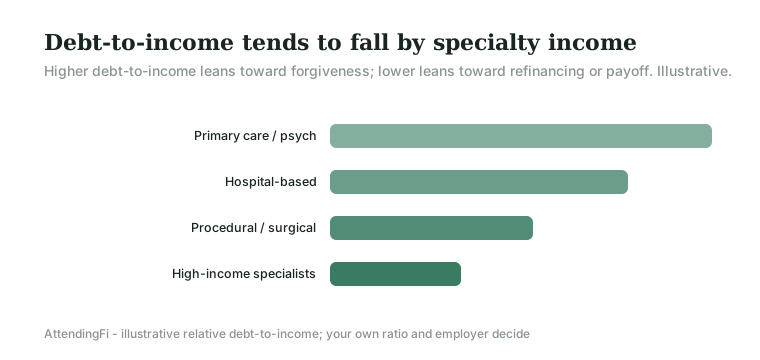
Specialty correlates with both variables, which is why it is a useful shorthand, but only a shorthand. Lower-income fields like primary care tend to have high debt-to-income ratios, which favors forgiveness; high-income specialties tend to have low ratios, which favors refinancing or fast payoff. But the correlation is loose. A primary-care physician in a for-profit practice cannot use PSLF, and a high-earning specialist at a nonprofit academic center sometimes can. The specialty hints at the answer; your specific income and employer determine it.
That is the central message of this hub, and it is why we do not publish a single verdict per specialty. Doing so would be misleading, because two physicians in the same specialty with different employers and balances can have opposite best strategies. What follows is how the decision usually leans by field, grouped by the income and debt-to-income patterns that actually move it, always with the reminder that your numbers, not your specialty, decide.
Primary-care and lower-income specialties
Family medicine, internal medicine, pediatrics, and psychiatry are the classic forgiveness-favorable fields. Their incomes, while solid, are modest relative to the large balances physicians carry, which produces a high debt-to-income ratio. On a PSLF path, that means income-driven payments stay low relative to the balance, leaving a large amount to be forgiven tax-free after ten years of qualifying work. For these physicians, especially those at nonprofit or government employers, forgiveness usually wins decisively.
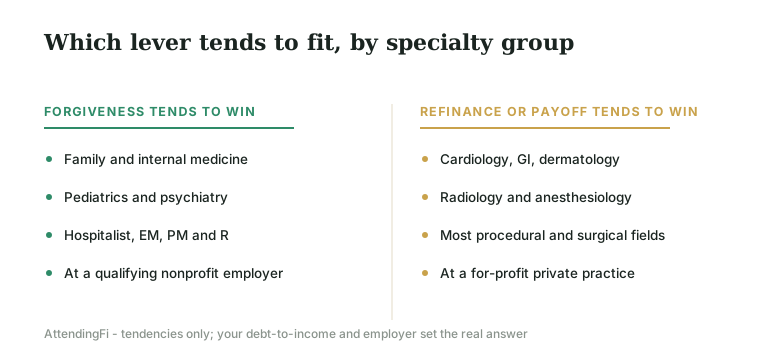
The hospital-based specialties sit close behind. Hospitalists, emergency physicians, physical medicine and rehabilitation specialists, neurologists, and pathologists often work for qualifying employers and earn moderate incomes, which frequently makes forgiveness the cheaper path as well. Emergency medicine is a notable wrinkle, because many emergency physicians are employed by for-profit staffing groups rather than the hospital itself, which can disqualify them from PSLF despite working in a hospital. For these fields, the employer question is the one to nail down first.
For all of these physicians, the most valuable move is usually to set up an income-driven plan and certify PSLF employment early in training, capturing the cheap qualifying payments residency provides. The trap to avoid is refinancing during residency, which forfeits forgiveness for a rate cut that rarely pays off for a high-debt, lower-income physician. When forgiveness is this likely to win, the priority is protecting eligibility, not chasing a private rate.
Mid-range specialties where it genuinely depends
A large group of specialties sits in the middle, where the answer truly depends on the specifics. OB-GYN, anesthesiology, endocrinology, nephrology, pulmonology and critical care, and hematology-oncology span a wide income range and a mix of employer types. For these physicians, the debt-to-income ratio is often moderate enough that forgiveness and refinancing can be close, and the deciding factors become the exact balance, the exact income, and above all the employer.
Endocrinology and nephrology, with more modest incomes, tend to lean toward forgiveness, particularly at academic or nonprofit centers. Anesthesiology, with a higher income, more often leans toward refinancing once a physician is in stable attending practice, though many anesthesiologists at qualifying employers still come out ahead with PSLF. The honest answer for this whole group is that the lean is too close to call from the specialty alone, which is exactly why modeling the real numbers matters most here.
For mid-range physicians, the worst outcome is guessing wrong in either direction: refinancing away a forgiveness that would have won, or grinding through a PSLF path when a quick refinanced payoff would have been cheaper. Because the margin is narrow, a careful comparison is worth the most for these fields. The lever that fits is the one your own debt, income, and employer point to, and small differences can flip the answer.
Procedural and surgical specialties
General surgery, orthopedic surgery, urology, otolaryngology, ophthalmology, and plastic surgery generally earn high incomes, which lowers their debt-to-income ratio and shifts the lean toward refinancing or aggressive payoff. For a surgeon in for-profit private practice with no qualifying employer, refinancing to a lower private rate and retiring the balance quickly is often the cheapest path, because the income comfortably services the debt and PSLF is off the table anyway.
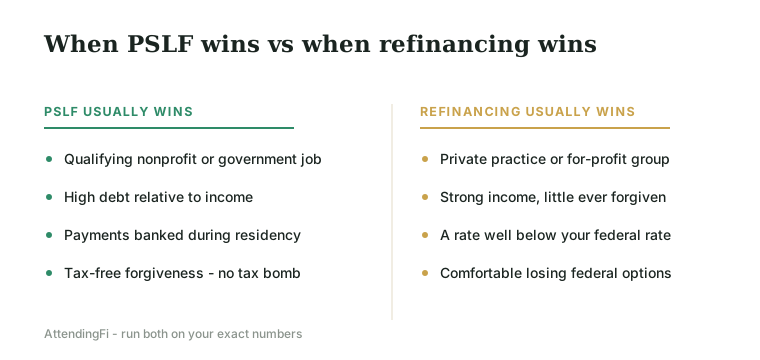
But the employer caveat applies forcefully here too. A surgeon employed by a nonprofit hospital or academic medical center may still capture meaningful PSLF, especially if a long residency and fellowship banked years of low-payment qualifying months during training. Those early qualifying months, made on a resident salary, are valuable regardless of how high the eventual attending income climbs. So even in these higher-income fields, the answer is not automatic, and the residency years often tilt it more toward forgiveness than the attending income alone would suggest.
The practical approach for procedural and surgical physicians is to confirm the employer question first. If you are or will be at a for-profit practice, plan around refinancing and payoff, and wait until the attending transition when rates improve. If you are at a qualifying employer, run the PSLF math carefully before giving it up, because the training-year payments may make forgiveness win even on a high attending income.
High-income specialists
Cardiology, gastroenterology, dermatology, and radiology are the highest-income fields, and their low debt-to-income ratios most often point toward refinancing or fast payoff. When a physician earns enough to comfortably retire a large balance in a handful of years, the tax-free forgiveness that PSLF offers has less room to exceed the interest savings of a lower private rate. For these specialists in private practice, refinancing aggressively and paying the loan off quickly is frequently the lowest-cost path.
The fellowship years are the interesting twist for these fields. Cardiology, gastroenterology, and similar specialties require additional fellowship training at low pay, which extends the window of cheap, qualifying PSLF payments if the physician is at a nonprofit. A cardiologist who banked many low-payment qualifying months through a long fellowship at an academic center can sometimes reach forgiveness before their high attending income would have paid the loan off. So even here, the answer is not a foregone conclusion, and the training history matters.
For most high-income specialists in private practice, though, the lean toward refinancing is real, and the key is timing. Waiting until the attending transition, when income jumps and refinancing offers improve, captures the best private rates. The decision should still be modeled rather than assumed, because a qualifying employer or a long low-paid fellowship can flip even a dermatologist or radiologist toward forgiveness.
Specialty deep dives
Every medical specialty at a glance
The table below summarizes how the decision usually leans for each major medical specialty, based on typical income relative to debt. Treat these as starting points, not verdicts: a qualifying nonprofit employer can move any row toward forgiveness, and an unusually large or small balance can shift it the other way. The only way to know your answer is to model your specific numbers.
| Specialty | Typical income vs debt | Usual lean |
|---|---|---|
| Family medicine | Lower | Forgiveness usually wins |
| Internal medicine | Lower | Forgiveness usually wins |
| Pediatrics | Lower | Forgiveness usually wins |
| Psychiatry | Lower-moderate | Forgiveness usually wins |
| Hospitalist | Moderate | Often forgiveness |
| Emergency medicine | Moderate | Depends on employer |
| Physical medicine & rehab | Moderate | Often forgiveness |
| Neurology | Moderate | Often forgiveness |
| Pathology | Moderate | Depends |
| OB-GYN | Moderate-high | Depends on employer |
| Anesthesiology | High | Depends; often refinance |
| Endocrinology | Moderate | Often forgiveness |
| Nephrology | Moderate | Often forgiveness |
| Pulmonology / critical care | High | Depends |
| Hematology-oncology | High | Depends |
| General surgery | High | Depends on employer |
| Orthopedic surgery | Very high | Refinance often wins |
| Urology | High | Depends |
| Otolaryngology (ENT) | High | Depends |
| Ophthalmology | High | Depends |
| Plastic surgery | Very high | Refinance often wins |
| Cardiology | Very high | Refinance often wins |
| Gastroenterology | Very high | Refinance often wins |
| Dermatology | High-very high | Refinance often wins |
| Radiology | Very high | Refinance often wins |
Notice how much of the table reads “depends on employer.” That is not a hedge; it is the actual structure of the decision. Two physicians in the same row, one at a nonprofit academic center and one in for-profit private practice, often have opposite best strategies. Use the table to understand the tendency for your field, then confirm it against your real debt, income, and employer.
What changed in 2026, across every specialty
The 2026 changes to federal repayment affect physicians in every specialty. A new Repayment Assistance Plan and a revised Income-Based Repayment replaced earlier income-driven options, and which plan you can use now depends partly on when you borrowed. These changes alter the payment math that determines how much PSLF forgives and whether an income-driven path beats refinancing, so a strategy that was clearly right a few years ago deserves a fresh look.
The implication is the same regardless of specialty: re-run your numbers under the current rules rather than relying on older advice. We cover the new plan landscape in our RAP vs IBR guide and the broader changes in our 2026 changes guide. For physicians with Parent PLUS loans in the household, note the separate, urgent consolidation deadline we cover in the consolidation guide.
The unchanged fundamentals are reassuring: PSLF still forgives tax-free after 120 qualifying payments at a qualifying employer, and refinancing still trades federal protections for a potentially lower rate. What the 2026 rules change is the precise payment math in between, which is exactly the part a current model captures and old rules of thumb miss.
How to find your actual answer
Because the right strategy depends on your debt, income, and employer rather than your specialty label, the only reliable way to decide is to model your own situation under the current rules. The engine compares your lowest-cost path across PSLF, the new income-driven plans, and refinancing, using your actual balance, income trajectory, and employer type, and shows the dollar difference between the options.
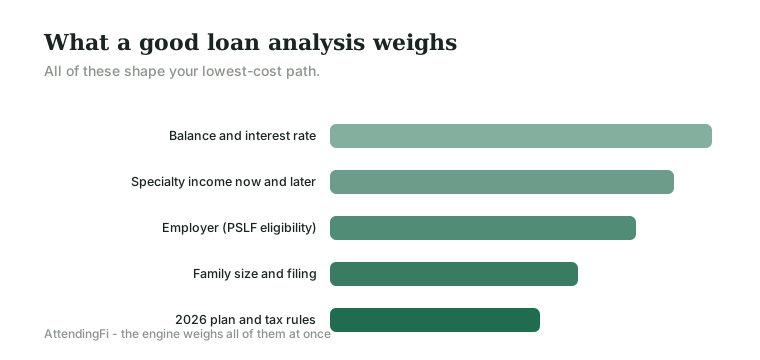
This is more accurate than any per-specialty rule because it uses your numbers, not an average. Two physicians in the same field get different answers if their balances, incomes, or employers differ, and the engine surfaces that difference instead of hiding it behind a specialty stereotype. It also recomputes as your situation evolves, so the answer stays right as you move from resident to attending, change employers, or adjust your plans.
Run your numbers below to see your lowest-cost path. Whatever your specialty, the output is built on your real situation, which is the only basis on which this decision should ever be made.
A note on income figures and your real numbers
The income and debt-to-income tendencies described above are generalizations, and they vary widely by region, practice setting, years in practice, and individual circumstances. Published physician income figures differ from one survey to the next, and any single number for a specialty hides a large range. We use broad bands rather than precise figures on purpose, because a precise-looking average would imply a certainty that does not exist and could lead you to the wrong decision. The tendency for your field is a useful starting point, not a substitute for your own situation.
This is also why we lean so heavily on modeling rather than rules of thumb. Your actual balance, your actual income trajectory, your actual employer, and the actual 2026 plan rules combine to produce an answer that no specialty average can capture. Two physicians who share a specialty, a city, and a graduation year can still have meaningfully different best strategies if one carries more debt or works for a qualifying employer and the other does not. The model uses your inputs, so its output reflects you, not a stereotype.
Treat this hub as a map of the terrain and the engine as your GPS. The map tells you which direction your field generally points; the GPS plots the actual route from where you are. For a decision that can swing tens of thousands of dollars on a physician-sized balance, that distinction is worth taking seriously, which is why every section here ends in the same place: model your real numbers before you commit.
Key takeaways
Across every medical specialty, the loan decision turns on debt-to-income and employer, not the specialty name. The tendencies by field are useful starting points, but only your own numbers give a real answer.
- Specialty is a shorthand for income and debt-to-income, not the decision itself.
- Primary-care and lower-income fields usually favor forgiveness.
- High-income specialists usually favor refinancing or fast payoff.
- A qualifying nonprofit employer can flip any specialty toward PSLF.
- Residency and fellowship years bank the cheapest qualifying payments.
- Re-run your numbers under the 2026 rules before deciding.
Find your field above for the usual lean, then model your real debt, income, and employer to confirm it. The engine does that comparison for you, free and without a signup.
See your lowest-cost path, whatever your specialty.
Answer a few questions and see your lowest-cost path across PSLF, the new RAP and IBR plans, and refinancing - free, no signup.
Run my numbersFrequently asked questions
Does my medical specialty determine my best loan strategy?
Not directly. Specialty correlates with income and debt-to-income, which do drive the decision, but two physicians in the same specialty with different employers or balances can have opposite best strategies. Model your own numbers to be sure.
Which specialties benefit most from PSLF?
Lower-income, high-debt fields like family medicine, internal medicine, pediatrics, and psychiatry tend to benefit most, especially at qualifying nonprofit employers. But any specialty can benefit if the physician works for a qualifying employer.
Which specialties should consider refinancing?
High-income specialists such as cardiology, gastroenterology, dermatology, and radiology in for-profit private practice most often find refinancing cheaper. Even then, a qualifying employer or long low-paid fellowship can tip the balance back toward forgiveness.
Why does the same specialty get different answers?
Because the real drivers are your balance, income, and employer, not the specialty label. Different employers, especially nonprofit versus for-profit, and different debt-to-income ratios produce different lowest-cost paths within the same field.
How do the 2026 changes affect my specialty?
The new RAP and revised IBR plans changed the payment math for everyone, and which plan you can use depends partly on when you borrowed. Re-run your numbers under the current rules rather than relying on older specialty advice.