NHSC loan repayment for physicians and dentists
NHSC loan repayment offers physicians a substantial, tax-free award toward their student loans in exchange for serving full-time at an approved site in an underserved area. For a doctor open to that service, the National Health Service Corps can retire a large chunk of debt faster than almost any other route, and it can stack with or substitute for PSLF. This guide explains how NHSC loan repayment works, who it fits, and how to weigh the substantial award against the service commitment it requires.
What NHSC loan repayment is
The National Health Service Corps Loan Repayment Program provides physicians, and other clinicians, with a substantial award to repay their student loans in exchange for a full-time service commitment at an NHSC-approved site located in a designated Health Professional Shortage Area. In short, you agree to practice where care is needed, and the program pays down your debt directly.
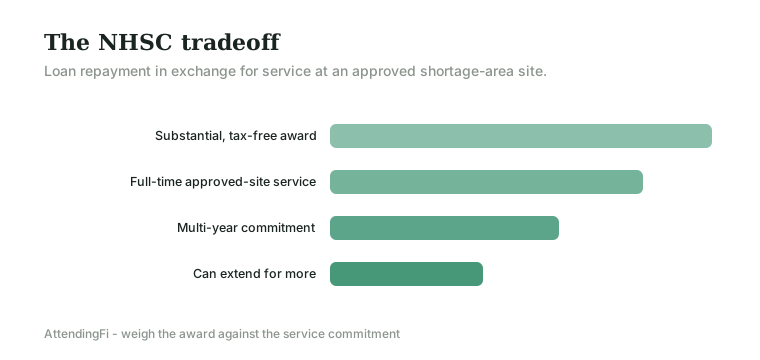
Unlike PSLF, which forgives a remaining balance after a decade of qualifying payments, NHSC makes a direct repayment toward your loans relatively quickly, after a defined service period rather than ten years. This makes it appealing to physicians who want meaningful debt relief on a shorter timeline and who are open to, or already planning, work in underserved settings.
The program exists to improve access to care in shortage areas, which is why the benefit is tied to where you practice. For a physician whose career interests align with community or underserved medicine, that requirement is a feature rather than a cost, the program rewards them for work they find meaningful. For others, the site requirement is the central tradeoff to weigh.
How the program works
In broad strokes, you apply, and if selected, commit to a period of full-time clinical service at an approved site in a shortage area. In return, the program provides an award toward your eligible student loans. Completing the initial commitment can open the door to continued service and additional repayment, letting some physicians retire a large share of their debt over a few years.
The specific award amounts, commitment lengths, and eligibility rules are set by the program and can change, so a physician interested in NHSC should confirm the current terms through the official NHSC channels rather than relying on general figures. What stays consistent is the structure: meaningful repayment in exchange for full-time service at a qualifying, underserved site.
Eligibility depends on your discipline, your loans being qualifying education debt, and the site being NHSC-approved. Because approved sites and shortage-area designations shift over time, part of the process is identifying a position at an eligible site that also fits your career and life, which is its own consideration beyond the financial terms.
Why the tax-free award matters
A defining advantage of NHSC loan repayment is that the award is generally tax-free. This matters enormously when compared to taxable forms of debt relief. A tax-free award goes entirely toward your loans, whereas a taxable benefit of the same headline size would be reduced by the income tax you owe on it, sometimes substantially for a physician in a high bracket.
The tax-free nature also puts NHSC in favorable company with PSLF, whose forgiveness is likewise tax-free, and in contrast to non-PSLF income-driven forgiveness, which can be taxable. For a physician comparing routes to debt relief, the after-tax value is what counts, and NHSC's tax-free award delivers its full stated value rather than a reduced, post-tax amount.
When you evaluate NHSC against other options, weigh the after-tax value of each. A tax-free NHSC award received over a few years of service can compare favorably to a taxable benefit or to interest saved through refinancing, especially for a physician whose career already points toward the kind of setting NHSC requires.
NHSC versus PSLF
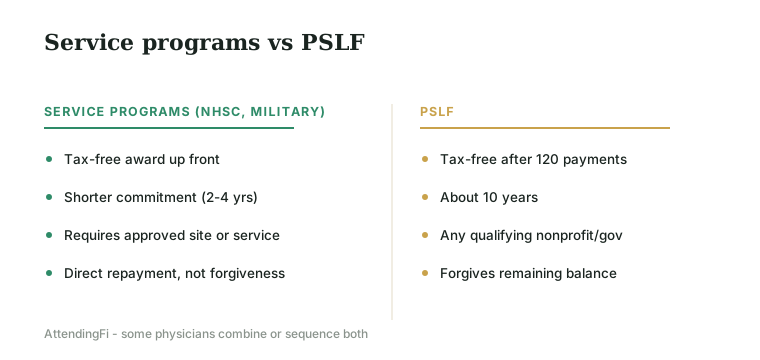
NHSC and PSLF both offer tax-free relief but differ in shape and requirements. NHSC provides a direct award after a relatively short service commitment at a specific type of site, while PSLF forgives your remaining balance after 120 qualifying payments, about ten years, at any qualifying nonprofit or government employer. The timelines and the site requirements are the key contrasts.
For a physician who wants substantial relief on a shorter horizon and is happy to work at an approved underserved site, NHSC can deliver faster than waiting a decade for PSLF. For one who prefers flexibility in where they work, or who is already on a long PSLF track at a qualifying employer, PSLF may fit better. Neither is universally superior; they suit different situations.
There is also a balance-size dimension. PSLF can forgive a very large remaining balance, scaling with how much you owe, while an NHSC award is a defined amount. A physician with an enormous balance might ultimately have more forgiven through PSLF, while one with a moderate balance might clear it efficiently with NHSC. The right answer depends on your numbers and your willingness to serve at an approved site.
Combining NHSC and PSLF
NHSC and PSLF are not necessarily mutually exclusive, and some physicians benefit from both. If your NHSC-approved site is also a qualifying PSLF employer, which many community health centers and similar sites are, the months you serve can count toward PSLF at the same time the NHSC award pays down your loans. In effect, you make progress on two fronts at once.
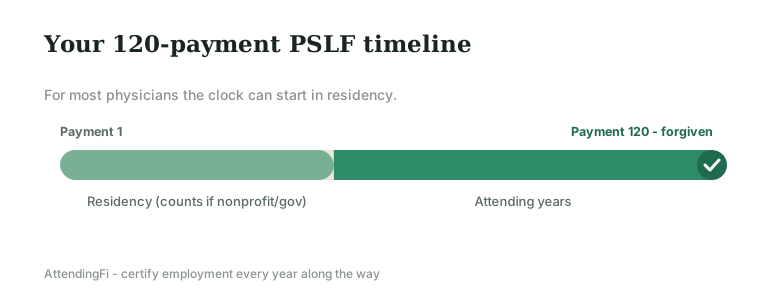
This combination can be powerful: a tax-free NHSC award reduces your balance directly, while qualifying months accumulate toward potential PSLF forgiveness of whatever remains. A physician planning extended service at an approved, qualifying site can capture both, retiring a large share of their debt through the award and positioning the remainder for forgiveness.
Whether combining makes sense depends on your site's PSLF eligibility, your balance, and your service plans. Confirm that your specific site qualifies for PSLF, set up your federal loans correctly, and certify employment so your months count. The engine can model the PSLF side, helping you see how it complements an NHSC award for your situation.
Who NHSC fits
NHSC fits physicians whose career interests align with serving underserved populations, and who want meaningful, tax-free debt relief on a shorter timeline than PSLF. Primary care and certain other specialties are often well represented at approved sites, so a physician in a relevant field who values community medicine is a natural candidate.
It fits less well for physicians whose specialties or career plans do not align with the approved-site requirement, or who prioritize flexibility in where they practice. For these doctors, the service-site condition is a real constraint, and PSLF at a qualifying employer of their choosing, or refinancing, may suit them better. As always, the program is a strong deal for those it fits and a poor one for those it does not.
The honest test is whether you would consider an approved underserved site even setting the loan benefit aside. If yes, NHSC rewards a choice you are inclined toward; if the loan benefit is the only thing drawing you, weigh carefully whether the service commitment is worth it. The program works best as an enhancement to a career direction you already value.
How to approach applying
If NHSC interests you, start by confirming the current program terms, award amounts, commitment lengths, and eligibility, through the official NHSC channels, since these can change. Then identify approved sites in shortage areas that fit your specialty and your life, since the position must be both NHSC-eligible and a genuine fit for your career.
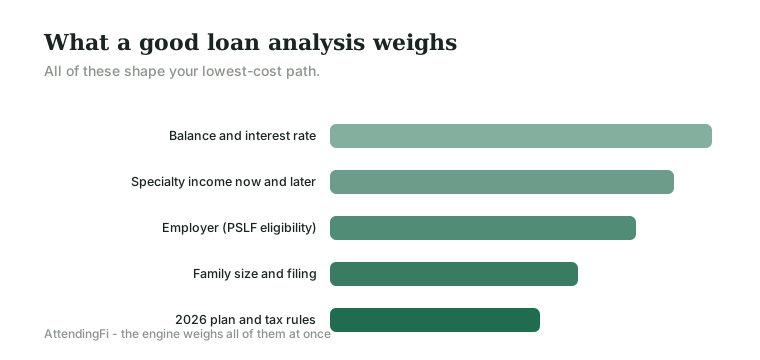
Consider how NHSC fits with your other options. If your target site also qualifies for PSLF, plan to capture both by setting up your federal loans correctly. If you have a very large balance, compare what NHSC would repay against what PSLF might ultimately forgive. Weigh the after-tax value of each route against the service commitment each requires.
The financial comparison is worth modeling. The engine can show how a PSLF path compares on your numbers, which helps you judge NHSC against the alternatives and decide whether to pursue it, combine it with PSLF, or choose a different route entirely. Run your numbers below as part of weighing the decision.
Key takeaways on NHSC
NHSC offers a substantial, tax-free award for serving at an approved underserved site. It fits physicians whose careers align with that service.
- NHSC repays loans directly in exchange for full-time service at an approved shortage-area site.
- The award is generally tax-free, delivering its full value.
- It can provide relief faster than the ten-year PSLF timeline.
- If your site also qualifies for PSLF, your service can count toward both.
- It fits physicians whose careers align with underserved-area service.
- Confirm current terms and eligibility through official NHSC channels.
NHSC rewards a service direction you already value. Run your numbers in the engine below to weigh it against PSLF and your other options.
Students to Service and related options
Beyond the loan repayment program for practicing clinicians, NHSC and related programs offer options aimed at students and trainees, such as a Students to Service path that provides support during the final years of school in exchange for a future service commitment. For a student already inclined toward underserved-area practice, planning around these earlier-stage options can be advantageous.
As with the main program, the specifics, eligibility, support amounts, and commitment terms, are set by the program and can change, so confirm the current state directly. The broader point is that service-based help exists at multiple career stages, and a physician drawn to this kind of medicine can often find a program that fits where they are, from student through practicing clinician.
Knowing these options early matters, because some are easier to plan around if you are aware of them before committing to a career path or taking on debt you might have had supported. A student considering community or underserved medicine should investigate the full range of service-based programs as part of mapping their loan strategy.
State and other service programs
NHSC is the best-known federal service-based program, but it is not the only one. Many states run their own loan repayment programs for clinicians who serve in underserved areas within the state, sometimes with their own terms and eligible sites. A physician open to underserved-area service should look at state options alongside NHSC, since the right fit may be a state program rather than, or in addition to, the federal one.
These programs share the same essential structure, debt help in exchange for service where care is needed, and the same essential tradeoff. For a physician whose career points toward this kind of work, the combination of federal, state, and possibly employer-based programs can add up to substantial, tax-advantaged relief, making underserved-area medicine financially viable as well as personally meaningful.
An NHSC decision in practice
Consider a family physician with $200,000 in loans who is genuinely drawn to community medicine. She takes a position at an NHSC-approved community health center in a shortage area, which happens also to be a qualifying nonprofit for PSLF. Over a few years of service, the tax-free NHSC awards retire a large share of her balance directly, while her qualifying months simultaneously accumulate toward PSLF for whatever remains.
For her, the program is close to ideal: she is doing work she values, receiving substantial tax-free help, and positioning the remainder of her debt for forgiveness, all at once. The service-site requirement, which would be a real constraint for a physician who did not want that setting, is for her simply where she wanted to practice anyway. The program rewards her direction rather than redirecting her.
Contrast that with a physician in a high-paying specialty with no interest in underserved-area practice. For him, the NHSC site requirement is a genuine cost, and PSLF at a qualifying employer of his choosing, or refinancing and rapid payoff, likely fits better. Same program, opposite verdicts, decided by whether the service aligns with the career. Run your numbers in the engine below to weigh NHSC against your alternatives.
One closing perspective: NHSC works best when it amplifies a career choice rather than dictating one. The physicians who are happiest with the program are those who would have considered underserved-area medicine regardless, for whom the tax-free award is a welcome bonus on top of meaningful work. Approached that way, NHSC is one of the most efficient debt-relief tools a physician can use, retiring a large balance quickly while serving where care is most needed. Use the engine below to confirm it beats your alternatives on the numbers before you commit.
Get your personalized plan
Don't guess — model your exact numbers. AttendingFi runs the real federal-rules math on your numbers and shows its work. Free, no login needed to see your answer.
Run my numbers →Frequently asked questions
Is the NHSC loan repayment award taxable?
Generally no. NHSC loan repayment awards are typically tax-free, which means the full award goes toward your loans rather than being reduced by income tax, an advantage over taxable forms of debt relief.
How does NHSC compare to PSLF?
NHSC provides a direct, tax-free award after a relatively short service commitment at an approved underserved site, while PSLF forgives your balance after about ten years at any qualifying employer. Which is better depends on your balance and service plans.
Can I do NHSC and PSLF at the same time?
Often yes. If your NHSC-approved site is also a qualifying PSLF employer, your service can count toward PSLF while the NHSC award pays down your loans, letting you progress on both fronts.
Who is NHSC loan repayment best for?
Physicians whose careers align with serving underserved populations and who want substantial, tax-free debt relief on a shorter timeline than PSLF. It fits less well for those needing flexibility in where they practice.
How much does NHSC repay?
Award amounts and commitment lengths are set by the program and can change, so confirm current figures through official NHSC channels. The awards are substantial and tax-free, structured around full-time service at an approved site.