Student loans for associate dentists
As a dental associate, your student loan strategy sits at a fork that depends on a detail many associates overlook: who, exactly, employs you. An associate at a nonprofit or community health center may have a real PSLF opportunity, while one at a private practice does not. Add in the likelihood that you may someday own a practice, and the right move for your dental associate student loans becomes genuinely situation-specific and worth thinking through carefully. This guide walks through the decision so you choose well from the start and avoid years of effort on a strategy your employment never supported.
Your employment status is everything
For a dental associate, the single most important question is the nature of your employer. PSLF eligibility turns entirely on whether you work full-time for a qualifying nonprofit or government organization. An associate at a community health center, academic clinic, or nonprofit hospital dental department can qualify; an associate at a private dental office, which is the single most common arrangement in dentistry, cannot.
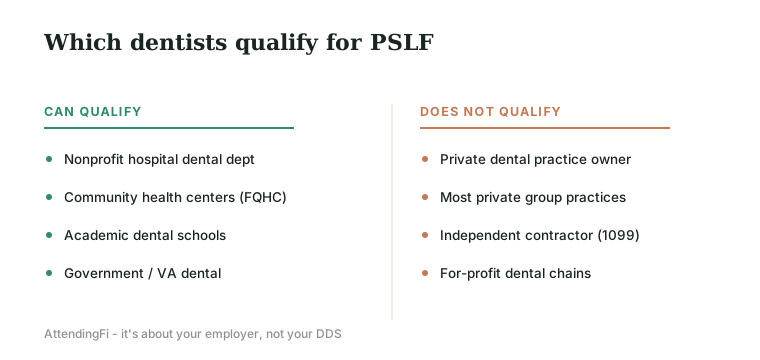
This is easy to get wrong because the job title, dental associate, is the same across both settings. Two associates doing identical clinical work can have completely different loan strategies simply because one works for a nonprofit and the other for a private practice. The work is the same; the employer determines whether forgiveness is even possible.
So the first thing to establish is your employer's tax status. Ask whether the practice or organization is a 501(c)(3) nonprofit or a government entity. That single answer tells you whether to build a PSLF strategy or to plan around income-driven repayment and refinancing, which is the foundation everything else rests on.
PSLF as a dental associate
If you are an associate at a qualifying employer, PSLF can be a major opportunity. Your years as an associate, often at a still-modest income relative to your debt, let you bank qualifying months at a manageable payment, building toward tax-free forgiveness after 120 payments. For an associate at a community health center carrying a large balance, this can be worth six figures.
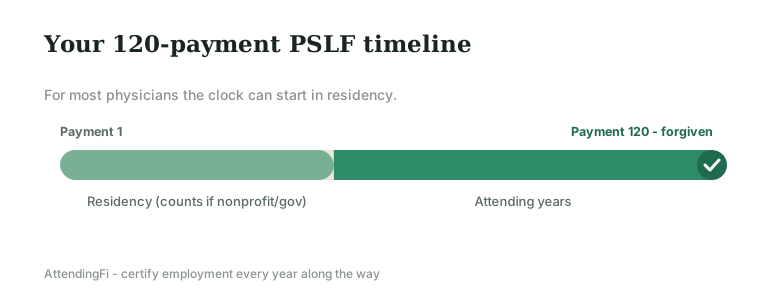
The setup is the standard PSLF checklist: federal Direct loans, a qualifying income-driven plan, full-time qualifying employment, and annual employer certification. As an associate, the certification step is especially important because associate arrangements and employers can change, and certifying each year keeps your count accurate across moves.
The risk for a PSLF-track associate is leaving for a private practice, or to own one, which stops the clock. That is a legitimate career choice, but it should be made knowing the loan consequence. If forgiveness is valuable to you and within reach, weigh it when deciding whether to move into private practice, since the move can forfeit a benefit you were close to earning.
If you work in private practice
The majority of dental associates work in private practices, which do not qualify for PSLF. If that is your situation, forgiveness through employment is off the table, and your real decision is between an income-driven plan and refinancing. This is not a worse position, simply a different one, and it calls for a refinancing-and-payoff strategy rather than a forgiveness one.
For a private-practice associate, the early years on a modest associate income are well suited to an income-driven plan, which keeps your payment manageable while you establish yourself. As your income grows, refinancing to a lower rate and paying the balance down becomes the path to clearing the debt efficiently, since there is no forgiveness to wait for.
The key is not to waste effort pursuing a PSLF strategy that your employer makes impossible. A private-practice associate who mistakenly believes they are building toward forgiveness can lose years before discovering the months never qualified. Confirming your employer's status up front prevents that costly misunderstanding.
Income-driven plans for associates
Whether or not PSLF applies, an income-driven plan is usually the right starting point for a dental associate. Associate income, while solid, is often modest relative to a large dental balance, especially early on, and an income-driven payment keeps the bill manageable. For a PSLF-eligible associate, the plan also determines how much is ultimately forgiven.
The plan choice should fit your path. A PSLF-eligible associate picks the qualifying plan with the lowest payment to maximize forgiveness. A private-practice associate uses an income-driven plan as a bridge while income grows, then transitions to refinancing. The 2026 menu pairs RAP with a revised IBR, compared in RAP vs IBR.
As an associate, your income and employer may change more than once before you settle, so treat the plan as adjustable rather than permanent. Revisiting it when you change jobs or your income jumps ensures you stay on the cheapest path for your current situation, which can shift meaningfully across the associate years.
Refinancing as a dental associate
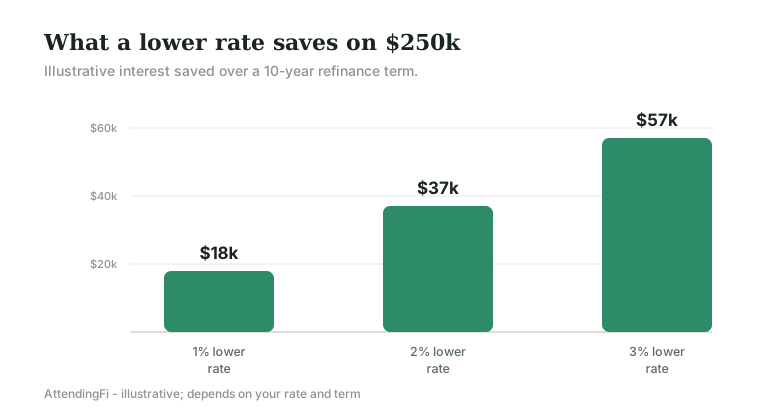
For a private-practice associate not pursuing PSLF, refinancing is often the central tool, though timing matters. Early on, an associate income may not yet qualify you for the best rates, and keeping federal loans on an income-driven plan preserves flexibility. As your income strengthens, refinancing to a meaningfully lower rate can save substantial interest on a large dental balance.
The permanent caveat holds: refinancing forfeits PSLF and federal protections. For an associate who might still work for a qualifying employer, that is a reason to wait. For one firmly in private practice with no qualifying employer ahead, refinancing carries little downside, since forgiveness was never available, and a fixed rate on a short, sustainable term maximizes the savings.
Some associates also carry private loans from school, which can be refinanced safely at any time since they never had federal benefits. Knowing which of your loans are federal and which are private lets you optimize the private slice immediately while making a deliberate, well-timed decision about the federal portion.
Planning for future practice ownership
Many dental associates aspire to own a practice, and that ambition should shape your loan strategy today. Practice ownership generally ends PSLF eligibility, since owners are self-employed rather than employees of a qualifying nonprofit. If ownership is in your near-term plans, building a multi-year PSLF strategy may not pay off before you transition out of eligibility.
For an associate planning to own soon, the practical approach is often to keep federal loans on an income-driven plan during the associate years, preserving flexibility, then address them as part of the broader financing picture once you own. Student loans will compete with practice debt and equipment financing, so an income-driven payment that stays manageable through the transition is valuable.
The timing of any refinance for a future owner deserves thought. Refinancing before buying a practice changes your debt profile, which can affect practice financing; some associates wait until after the practice purchase to refinance. The right sequence depends on your numbers and lender requirements, which is exactly the kind of decision worth modeling before you commit.
Employee versus independent contractor
A subtlety that catches dental associates is employment classification. PSLF requires that you be a full-time W-2 employee of a qualifying employer. Many associate positions, however, are structured as independent contractor (1099) arrangements, and contractor work generally does not count toward PSLF even if the practice itself is a qualifying nonprofit.
This means a dental associate pursuing PSLF should confirm not only that the employer qualifies, but that their own arrangement is W-2 employment rather than contracting. An associate who assumes their nonprofit role counts, only to discover it was structured as 1099 contracting, can lose qualifying months they thought they were banking.
If you have a choice or can negotiate, and PSLF is valuable to you, W-2 employment at a qualifying employer is what preserves eligibility. Where contracting is unavoidable, understand that those months likely will not count, and plan accordingly. Clarifying your classification early prevents a painful surprise later.
Your dental associate loan plan
Pull it together by starting with the two questions that decide everything: is your employer a qualifying nonprofit or government entity, and are you a W-2 employee. If both are yes and PSLF is valuable, build a forgiveness strategy on the lowest-payment qualifying plan and certify annually. If either is no, plan around an income-driven bridge and a well-timed refinance.
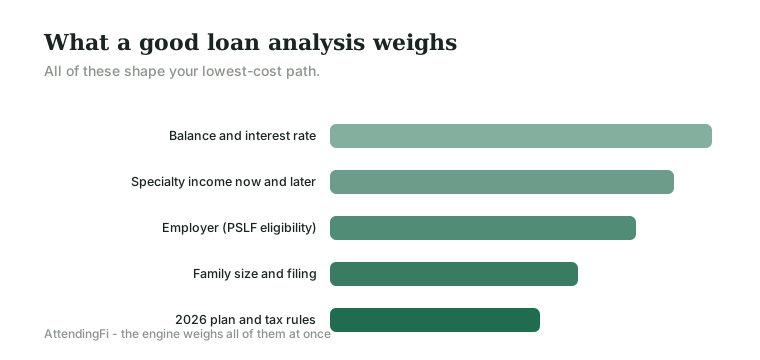
Then keep the plan current as your associate years unfold, because your employer, classification, income, and ownership plans may all change. Each change can shift the right strategy, so a brief annual review keeps you on the cheapest path for your present situation rather than one you chose under different circumstances.
The most efficient way to decide is to model your numbers. The engine compares PSLF, income-driven plans, and refinancing for your exact situation, so whether you are a community-health associate banking forgiveness or a private-practice associate planning to refinance, you leave with a clear, optimized plan for your dental associate student loans.
Key takeaways for dental associates
As a dental associate, your employer and your classification decide your strategy. Confirm both of these before committing to a long-term repayment path.
- PSLF eligibility depends on a qualifying employer and W-2 employment.
- Community-health and academic associates can pursue PSLF; private-practice associates cannot.
- Independent-contractor (1099) months generally do not count toward PSLF.
- Private-practice associates plan around income-driven plans and refinancing.
- If you plan to own a practice soon, weigh that against a multi-year PSLF strategy.
- Revisit your plan whenever your employer, your classification, or your income changes over time.
Confirm your employer and classification, then choose deliberately. Run your numbers in the engine below to find your lowest-cost path as a dental associate, whether that path runs through forgiveness or refinancing.
Loans and your associate contract
Your associate employment contract interacts with your loan strategy in ways worth noting at signing. Whether you are classified as a W-2 employee or a 1099 contractor directly affects PSLF eligibility, so if forgiveness is part of your plan and you have any negotiating room, W-2 status at a qualifying employer is what preserves it. This is a detail to clarify before you sign, not after.
Compensation structure matters too. Associate pay is often tied to production or collections, which makes your income variable, and income-driven payments respond to that income. Understanding how your pay translates into your loan payment helps you plan cash flow, especially in the early associate years when both income and payment may fluctuate.
None of this should override the clinical and professional fit of an associate position, which matters most. But where loan considerations are a genuine factor, being aware of how classification and pay structure affect your strategy lets you make an informed choice rather than discovering the loan consequences after you have committed.
Associate loan mistakes to avoid
A few errors recur among dental associates. Assuming a nonprofit employer means PSLF without confirming W-2 status is a common one, leading associates to bank months that never counted. Refinancing federal loans before ruling out a possible qualifying employer is another, forfeiting forgiveness prematurely. And neglecting the loans entirely during busy early associate years lets the cheapest decisions slip by.
Each is avoidable with a short, deliberate review at the start of each associate role. The associates who handle loans well are simply the ones who confirm their employer and classification, choose a plan to match, and revisit it when their situation changes. On a dental-sized balance, that modest diligence is worth six figures over time.
Two associates, two strategies
Consider two dental associates with identical $290,000 balances. The first works full-time as a W-2 employee at a community health center, a qualifying nonprofit. She enrolls in the lowest-payment qualifying income-driven plan, certifies employment each year, and banks qualifying months toward tax-free PSLF forgiveness. Her modest associate income keeps those months cheap, and a large balance is on track to be forgiven with no tax.
The second works at a private dental group, often as a 1099 contractor. PSLF is unavailable to him on both counts, the employer is for-profit and the arrangement is contracting, so chasing forgiveness would be wasted effort. His strategy is to use an income-driven plan as a bridge while his income grows, then refinance to a lower rate and pay the balance off aggressively. Same debt, opposite right answers.
The lesson is that for dental associates, the employer and the employment classification, not the clinical work, determine the strategy. Confirming both before you commit is what separates an associate who captures the right opportunity from one who spends years pursuing a forgiveness path that was never actually available to them. Run your numbers in the engine below to see which strategy fits your exact employer, classification, income, and goals.
Get your personalized plan
Don't guess — model your exact numbers. AttendingFi runs the real federal-rules math on your numbers and shows its work. Free, no login needed to see your answer.
Run my numbers →Frequently asked questions
Do dental associates qualify for PSLF?
Only if they work full-time as a W-2 employee for a qualifying nonprofit or government employer, such as a community health center or academic clinic. Private-practice associates and independent contractors generally do not qualify.
Should a dental associate refinance student loans?
Only after confirming PSLF is off the table. A private-practice associate with strong income relative to their debt can save substantial interest by refinancing once their income qualifies them for a good rate.
Does independent-contractor work count toward PSLF?
Generally no. PSLF requires W-2 employment by a qualifying employer. Many associate roles are structured as 1099 contracting, which does not count even at a qualifying nonprofit, so confirm your classification.
Should I pursue PSLF if I plan to own a practice?
Weigh the timeline. Practice ownership ends PSLF eligibility, so a multi-year forgiveness strategy may not pay off if you will own soon. An income-driven bridge plus later refinancing may fit better.
What plan should a dental associate be on?
Usually an income-driven plan to start, given a modest associate income against a large balance. PSLF-eligible associates pick the lowest-payment qualifying plan; others use it as a bridge to refinancing.