Student loans for dental practice owners
As a dental practice owner, your student loan strategy is fundamentally different from an employee's, because owning a practice generally takes PSLF off the table and adds a second large debt, the practice itself, to your financial picture. The right approach for a dental practice owner's student loans is built around refinancing, strategic payoff, and fitting your education debt alongside practice financing. This playbook walks through every decision an owner faces, so your six-figure dental debt and your practice work together rather than against each other.
Why ownership changes everything
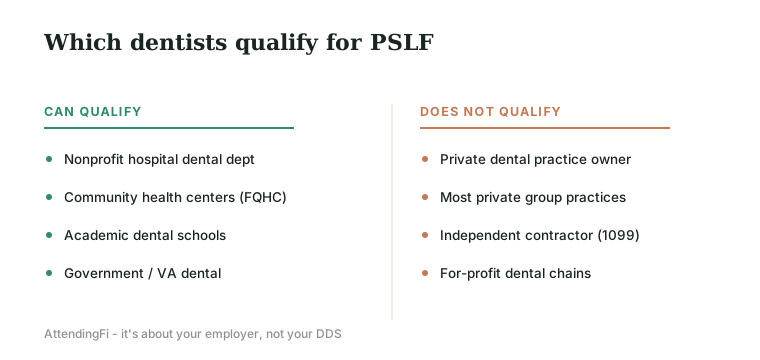
The moment you become a dental practice owner, your relationship to your student loans shifts. You are no longer an employee of any organization; you are self-employed, running a business. That single change removes the employer-based programs, chiefly PSLF, that drive strategy for physicians and for dentists at qualifying nonprofits. Your toolkit becomes refinancing, payoff, and cash-flow management instead.
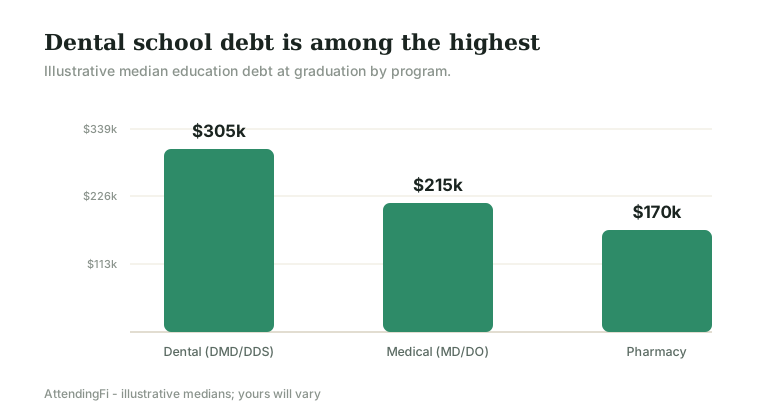
Ownership also adds a second major debt. Buying or building a practice typically means a practice loan, equipment financing, and the working-capital demands of a business, often layered on top of a six-figure student balance. Your student loan strategy can no longer be considered in isolation; it has to fit within the larger picture of financing and running a practice.
This is not a disadvantage, just a different game. Practice ownership is one of the most reliable paths to high income in dentistry, and a high income against a fixed student balance is exactly the profile where refinancing and aggressive payoff shine. The owner's playbook is about using that income efficiently across both your student loans and your practice debt.
Why PSLF usually does not apply to owners
PSLF requires that you be employed full-time by a qualifying nonprofit or government organization. A dental practice owner is, by definition, self-employed, running their own business rather than being employed by a qualifying entity. As a result, the years you spend owning and operating your practice generally do not count toward PSLF, even though you are working hard and earning.
There are narrow edge cases, for instance a dentist who owns a practice but also works part-time as a W-2 employee of a qualifying nonprofit might earn some PSLF credit through that separate role, if it meets the full-time threshold across employers. But for the typical owner whose income comes from their own practice, PSLF is simply not a path, and planning around it would be a mistake.
Recognizing this early prevents wasted effort. A dentist who buys a practice expecting to keep building toward forgiveness can lose time before realizing their owner income never qualified. The clean approach is to treat ownership as the point where your strategy pivots decisively to refinancing and payoff, leaving forgiveness behind unless a genuine qualifying-employment situation exists.
Income-driven plans as a bridge to ownership
Before and during the early phase of ownership, an income-driven repayment plan can still play a useful role as a bridge. In the uncertain early years of buying or building a practice, when income may be irregular and cash is tight, an income-driven plan keeps your student loan payment proportional to your income, freeing cash for the practice.
This bridge strategy, staying federal on an income-driven plan while establishing the practice, preserves flexibility during the riskiest period. If something goes wrong with the practice, federal income-driven repayment adjusts to your lower income, a protection a private refinance loan does not offer. For some owners, that flexibility is worth keeping through the startup years.
Once the practice stabilizes and your income is reliable, the calculus shifts toward refinancing. The income-driven bridge is a temporary tool for the transition, not a permanent strategy, since without PSLF there is no forgiveness to wait for. The art is in timing the move from bridge to refinance as your practice and income mature.
Refinancing as a dental practice owner
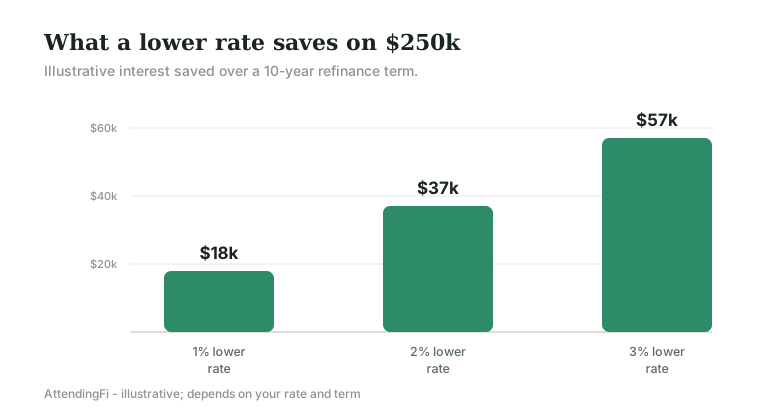
For most practice owners, refinancing is the central student loan tool. Once your practice income is strong and stable, refinancing your federal loans to a lower private rate can save substantial interest over the life of a large dental balance. The strong, established income of a successful practice owner often qualifies you for attractive rates.
The usual caveats apply, but they bite less for owners. Refinancing forfeits PSLF and federal protections, but as an owner you generally could not use PSLF anyway, so the main thing you give up is income-driven flexibility, which matters less once your income is high and stable. Choose a fixed rate and the shortest term whose payment your practice cash flow comfortably supports.
Timing relative to practice financing deserves thought. Refinancing changes your personal debt profile, which lenders consider when financing a practice purchase or expansion. Some owners refinance before a practice transaction, others after, depending on how it affects their borrowing capacity. Coordinating the two is part of the owner's playbook, and worth modeling before you act.
Balancing student loans against practice debt
The defining challenge for an owner is managing two large debts at once: student loans and practice debt. These compete for the same cash flow, and the right balance depends on their relative interest rates, terms, and tax treatment. Practice debt is often tied to a business asset and may carry different rates and deductibility than your student loans.
A common question is which debt to prioritize. Generally, you attack the higher-rate, non-deductible debt first while making required payments on the other, but the specifics depend on your rates, the tax treatment of each, and your risk tolerance. There is no universal answer; it is a math problem unique to your practice and loans.
The key is to treat both debts as part of one coherent plan rather than managing them separately. An owner who optimizes student loans in isolation, ignoring how the strategy interacts with practice financing, can end up with a worse overall outcome. The playbook is about the combined picture, which is exactly what a full model captures.
Strategic payoff decisions
Without forgiveness in the picture, a practice owner's student loans will ultimately be paid off, and the strategic question is how aggressively. Paying the loan down faster saves interest but ties up cash that could fund practice growth, retirement savings, or other goals. The right pace depends on your loan rate, your expected return on alternative uses of the money, and your appetite for being debt-free.
For an owner with a relatively high student loan rate, accelerating payoff, especially after refinancing to a lower rate, can be a strong, low-risk return. For one with a low rate, investing in the practice or in markets may offer better expected returns, making a slower payoff rational. This is a personal optimization with no single correct answer, only the answer that fits your situation and preferences.
What matters is making the decision deliberately rather than defaulting. An owner who consciously chooses a payoff pace, integrated with their practice and personal financial goals, captures more value than one who simply pays the minimum or overpays without weighing the alternatives. Modeling the tradeoffs turns this into an informed choice.
Taxes and your two debts
Tax treatment differs between your student loans and your practice debt, and it should inform your strategy. Student loan interest deductibility is limited and phases out at higher incomes, so a successful owner may get little or no deduction on student loan interest. Practice debt interest, as a business expense, is generally deductible, which can make it effectively cheaper after taxes than its stated rate suggests.
This tax asymmetry often argues for prioritizing student loan payoff over practice debt, all else equal, since the student debt is the more expensive after-tax obligation for a high-earning owner. But the specifics depend on your rates, your income, and current tax rules, so this is a guideline to verify rather than a universal rule.
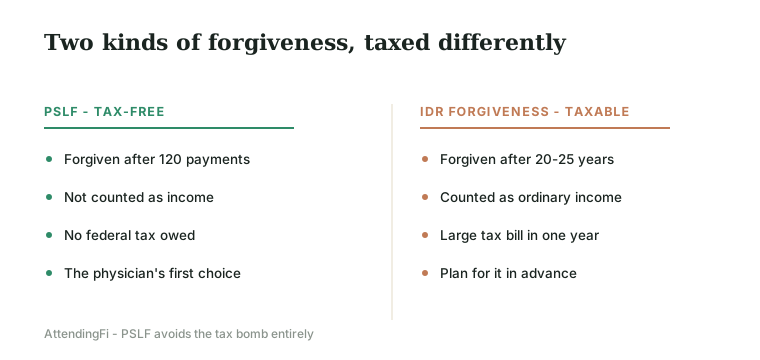
Because owners generally are not pursuing forgiveness, the forgiveness tax bomb that concerns some borrowers does not apply, you will pay the loans off rather than have them forgiven. Your tax planning instead focuses on the deductibility of each debt and how that shapes the optimal payoff order, which a full analysis can clarify.
Your dental practice owner loan playbook
Bring it together with an owner's mindset. Use an income-driven plan as a bridge through the early, uncertain years of ownership, preserving flexibility. As your practice income stabilizes, refinance your student loans to a lower rate, coordinated with your practice financing. Then choose a deliberate payoff pace that balances debt freedom against practice growth and other goals.
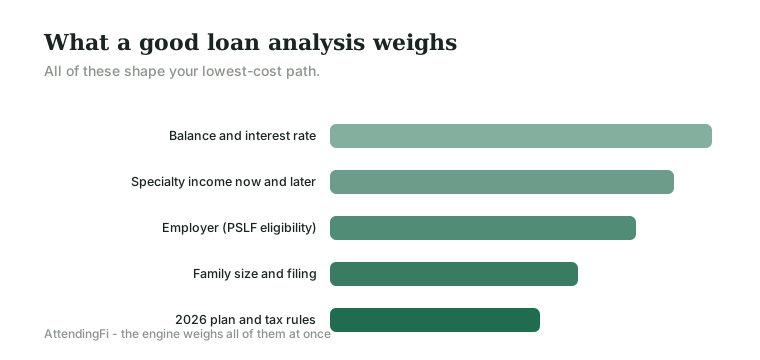
Throughout, treat your student loans and practice debt as one integrated plan, optimizing the combined picture rather than each in isolation. Revisit the strategy as your practice matures and your income grows, since the right balance shifts over time. An owner who manages both debts coherently builds wealth faster than one who treats them as separate problems.
The most efficient way to optimize is to model your numbers. The engine compares refinancing and payoff scenarios for your student loans on a lifetime-cost basis, so you can see how your education debt fits alongside your practice and your goals, and run your practice and your loans as the single financial system they really are.
Key takeaways for practice owners
As a dental practice owner, PSLF is off the table and a second debt is on it. The playbook is refinancing, strategic payoff, and integration with practice debt.
- Ownership is self-employment, so PSLF generally does not apply.
- Use an income-driven plan as a bridge through the uncertain early years.
- Refinance once your practice income stabilizes, coordinated with practice financing.
- Balance student loans against practice debt as one integrated plan.
- Prioritize the more expensive after-tax debt, often the student loans.
- Choose a deliberate payoff pace that fits your growth and personal goals.
Run your student loans and practice as one financial system. Use the engine below to find your lowest-cost path as a dental practice owner.
The early ownership years
The first few years of practice ownership are financially turbulent, and your student loan strategy should respect that. Income may swing as you build a patient base, and cash is often consumed by the practice. This is precisely when the flexibility of a federal income-driven plan is most valuable, since it scales your student loan payment to your actual income rather than demanding a fixed sum during a fragile period.
Refinancing in these earliest years can be premature, both because your income may not yet qualify you for the best rates and because giving up federal flexibility before the practice stabilizes adds risk. Many successful owners deliberately wait, keeping federal loans on a bridge plan until the practice is on solid footing, then refinancing from a position of strength.
The discipline is to match your loan strategy to the practice's maturity. Aggressive moves like refinancing and accelerated payoff belong to the stable, high-income phase; the startup phase calls for flexibility and patience. An owner who sequences these correctly protects themselves during the risky period and optimizes once the foundation is secure.
Loans, payoff, and retirement saving
For a practice owner, student loan payoff competes not only with practice investment but with retirement saving, which is especially important for the self-employed who lack an employer plan. Aggressively paying off a low-rate loan while neglecting tax-advantaged retirement contributions can be a poor tradeoff, since the long-run, tax-advantaged growth of retirement savings may exceed the interest saved.
The balance depends on your loan rate, your available retirement vehicles, and your timeline. The point is that student loan payoff is one element in a broader wealth plan, not an isolated goal to maximize at all costs. An owner who weighs payoff against retirement and practice investment, rather than fixating on debt freedom alone, typically ends up wealthier.
An owner strategy in practice
Consider a dentist who buys an established practice with $260,000 in student loans and a sizable practice loan. In the first two years, while building the patient base, she keeps her student loans on an income-driven plan, keeping that payment proportional to a still-growing income and preserving cash for the practice. The federal flexibility protects her during the riskiest phase of ownership.
By year three, her practice income is strong and stable. She refinances her student loans to a meaningfully lower fixed rate on a short term, coordinated so it does not disrupt her practice financing, and begins an accelerated payoff of the higher-cost, less-deductible student debt while making scheduled payments on the practice loan. The result is a coherent plan that retires both debts efficiently rather than letting them compete haphazardly.
The contrast with an owner who ignores the interplay, refinancing too early, neglecting the deductibility differences, or paying both debts down at random, is a meaningfully worse outcome on a six-figure balance. The owner who treats student loans and practice debt as one system, sequenced over the life of the practice, builds wealth faster. Run your numbers in the engine below to design that sequence for your own practice.
Get your personalized plan
Don't guess — model your exact numbers. AttendingFi runs the real federal-rules math on your numbers and shows its work. Free, no login needed to see your answer.
Run my numbers →Frequently asked questions
Do dental practice owners qualify for PSLF?
Generally no. Practice owners are self-employed rather than employed by a qualifying nonprofit, so their ownership income does not count toward PSLF. A separate part-time W-2 role at a qualifying employer could be an exception.
Should a dental practice owner refinance student loans?
Usually yes, once practice income is stable. Since PSLF is off the table for owners, refinancing to a lower rate to save interest is typically the central tool, coordinated with practice financing.
Should I pay off student loans or practice debt first?
It depends on the rates and tax treatment of each. Often student loan payoff is prioritized because student loan interest is less deductible for high earners than business debt, but verify on your specifics.
Can I use an income-driven plan as a practice owner?
Yes, as a bridge. During the uncertain early years of ownership, an income-driven plan keeps your student loan payment proportional to income and preserves flexibility before you refinance.
Does the tax bomb apply to dental practice owners?
Generally no, since owners are not pursuing forgiveness and will pay the loans off rather than have them forgiven. Tax planning instead focuses on the deductibility of each debt.