“Legacy Borrower” Status Won’t Protect Your Repayment Plan: The 2026 Student-Loan Trap
If you’re a current medical, dental, law, pharmacy, or graduate student, you’ve probably been told you’re a legacy borrower (a “continuing” borrower) who is grandfathered in. That protection is real, but it only covers your borrowing limits, not your repayment plan. Any new federal loan disbursed on or after July 1, 2026 — even a routine annual disbursement for the same degree — removes your access to the older income-driven plans (IBR, PAYE, ICR) and locks every one of your Direct loans into the new Repayment Assistance Plan (RAP) or the new tiered Standard plan. Because you have to keep borrowing to finish school, this reset is effectively unavoidable for most students still enrolled. For some future high earners, it can mean a higher monthly payment and an additional five to ten years before forgiveness.
What legacy borrower status actually protects
When the OBBBA reshaped federal student loans, it created a transition rule for students who were already enrolled and already borrowing. If you received a federal Direct loan for your current program before July 1, 2026, and you stay continuously enrolled in that same program at the same school, you keep access to the old, higher borrowing limits, including Grad PLUS, for up to three more academic years (or until you finish your program, whichever comes first).
That is a genuinely valuable protection. New graduate and professional students who start after July 1, 2026 face hard caps: $20,500 per year for graduate students (a $100,000 program aggregate) and $50,000 per year for professional students such as those in medicine, dentistry, law, and pharmacy (a $200,000 program aggregate), inside a $257,500 lifetime federal ceiling. Grad PLUS is eliminated entirely for new borrowers. As a legacy borrower, you can sidestep those caps for the remainder of your program.
Here is the problem almost nobody is explaining clearly: the legacy provision is tied to your loan limits, not your repayment plan. Those are two separate systems with two separate sets of rules, and the protection only reaches one of them.
How the repayment-plan reset is triggered
The repayment side of the OBBBA runs on a simple and unforgiving rule: your repayment-plan eligibility is determined by the disbursement date of your loans.
If all of your federal loans were disbursed before July 1, 2026, you can keep using the legacy repayment plans: the 10-year Standard, Graduated, and Extended plans, plus the income-driven plans IBR, PAYE, and ICR (PAYE and ICR are themselves being phased out by July 1, 2028, leaving IBR and RAP as the long-term legacy options).
But if any of your federal loans is disbursed on or after July 1, 2026, you lose access to all of those legacy plans for every loan you hold. From that point forward, your only repayment options are RAP or the new tiered Standard plan. The Department of Education guidance is blunt on this point: receiving a new Direct loan on or after July 1, 2026 makes a borrower permanently ineligible for IBR, PAYE, and ICR.
Now connect that to your situation as a current student. You are not done borrowing. A second-year medical student, a first-year dental student, a continuing law student — all of them will take at least one more disbursement after July 1, 2026 to finish their degree. That single post-July-1 disbursement is the trigger. It does not matter that your earliest loans were “legacy.” The moment a new loan hits your account, your whole portfolio is repaid under the new rules.
This is the legacy borrower asymmetry that catches people. A borrower who is already out of school and finished borrowing can sit on IBR indefinitely. A borrower who is still enrolled cannot, because they are structurally forced to keep borrowing, and each new loan re-triggers the reset.
Why the reset matters: RAP vs. IBR for high earners
If the new plan were equivalent to the old ones, none of this would be worth an article. It is not equivalent, and the differences land hardest on exactly the people reading this: future physicians, dentists, and attorneys with high projected incomes.
How the old plans calculate your payment. Legacy income-driven plans like IBR and PAYE base your monthly payment on your discretionary income — your AGI minus 150% of the federal poverty guideline for your family size. That poverty-line deduction meaningfully lowers the income your payment is calculated from. Just as important, IBR caps your monthly payment at the 10-year Standard amount, so no matter how high your attending income climbs, your IBR payment can never exceed what you would have paid on the Standard plan. New IBR forgives any remaining balance after 20 years; the older IBR after 25.
How RAP calculates your payment. RAP bases your monthly payment on your total AGI — with no poverty-line deduction — at a percentage that scales up to 10% of income at higher earnings, and there is no cap. RAP forgives any remaining balance after 30 years (360 qualifying payments).
Put those side by side for a new attending. Under capped IBR, a high earner’s payment is limited to the 10-year Standard amount and the loan is forgiven in 20–25 years. Under RAP, that same earner pays a percentage of their entire AGI with no ceiling, and waits 30 years for forgiveness. The math varies by income, balance, and family size, but the direction is consistent: RAP tends to cost high earners more, both monthly and over the life of the loan, when forgiveness is the goal.
| Feature | Legacy IBR (new IBR) | Repayment Assistance Plan (RAP) |
|---|---|---|
| Payment formula | 10% of discretionary income (AGI − 150% of poverty line) | 1%–10% of total AGI (no poverty-line deduction) |
| High-earner cap | Capped — never exceeds the 10-year Standard payment | Uncapped — scales with income, no ceiling |
| Forgiveness timeline | 20 years (25 on older IBR) | 30 years (360 payments) |
| Unpaid interest | Can accrue / capitalize depending on circumstances | Waived if your payment doesn’t cover the monthly interest |
| Principal benefit | None | $50/month principal match if your payment doesn’t reduce principal by $50 |
| Dependent credit | Factored into the poverty-line deduction | Flat $50/month reduction per dependent |
| PSLF-eligible | Yes | Yes — RAP payments count toward the 120 |
The honest other side: RAP is not all bad
This is not a doom story, and any honest analysis has to say so.
RAP has one feature the old plans lack that is genuinely valuable, especially during training: an interest waiver. If your calculated RAP payment does not cover the monthly interest that accrues, RAP waives the remaining unpaid interest — your balance does not balloon. For a resident or clerkship-year student earning very little, whose payment may be as low as the $10 monthly minimum, this means the balance stays flat rather than growing month after month. RAP also adds a $50/month principal match: if your payment wouldn’t reduce principal by at least $50, a subsidy makes up the difference, so your balance actually ticks down.
RAP is also PSLF-eligible. Public Service Loan Forgiveness still forgives your remaining balance, tax-free, after 120 qualifying monthly payments while you work full-time for a qualifying nonprofit or government employer. RAP payments count toward those 120. So if you are pursuing PSLF, the plan you are on matters far less — your balance is forgiven at 120 payments regardless of whether you got there on IBR or RAP, and the interest waiver simply protects you along the way.
This is why the reset hits one group hardest: borrowers who are not pursuing PSLF and have a high income trajectory. If you are heading for a private-practice or otherwise non-qualifying job and plan to ride income-driven repayment to forgiveness, the move from capped IBR to uncapped, longer-timeline RAP is a real and unwelcome change. If you are PSLF-bound, you can mostly stop worrying about it.
A timing detail worth knowing: the 2028 sunset
Even setting aside the new-loan trigger, the legacy plans are not all permanent. PAYE and ICR fully sunset on July 1, 2028 for everyone, regardless of when you borrowed. After that date, IBR is the only legacy income-driven plan left standing for pre-2026 loans, alongside RAP. So when we talk about “keeping your legacy plan,” for most people the plan worth keeping is IBR — and that is precisely the plan the new-loan reset takes away from you.
- Before July 1, 2026The legacy-protected era
You take out federal Direct loans for medical, dental, or grad school. You’re safely under the legacy umbrella for the old borrowing limits and the old income-driven plans.
- July 1, 2026OBBBA implementation
The new rules go live. The new borrowing caps take effect, Grad PLUS ends for new borrowers, and the RAP framework officially launches.
- Your next disbursementThe trap snaps
Your financial-aid office processes your next routine loan disbursement. That single post-deadline loan permanently resets your entire portfolio to RAP or tiered Standard only — IBR, PAYE and ICR are gone for all of your loans.
- July 1, 2028The final sunset
PAYE and ICR sunset for everyone. Any pre-2026 legacy balance not on IBR effectively lands on RAP. IBR remains for those who never took a post-July-1-2026 loan.
What you can actually do about it
If you’re a legacy borrower, be wary of anyone selling a clever workaround here. The honest options are limited, and the most useful thing is informed planning rather than a magic trick.
If you are pursuing PSLF, mostly relax. Enroll in RAP when the time comes, certify your qualifying employment every year, and let the 120-payment clock run. The plan difference is not what determines your outcome; your employer and your payment count are. The RAP interest waiver works in your favor during low-income training years.
If you are not pursuing PSLF, model RAP before you graduate. Run your projected attending income through RAP’s formula so the no-cap payment and the 30-year timeline don’t surprise you. Plan your AGI levers in advance: contributing to traditional (pre-tax) retirement accounts and an HSA once you’re earning lowers your AGI, which lowers your RAP payment, since RAP is calculated on AGI. This is one of the few genuine levers you control.
If you are in your final year, ask whether you can finish borrowing before July 1, 2026. The only clean way to avoid the reset is to take no disbursement on or after that date. For a student who can complete all remaining borrowing before the deadline and won’t need another loan, this preserves legacy repayment access. For most continuing students this is not feasible — you will need to borrow again — so confirm with your financial-aid office whether it’s even possible for your timeline rather than assuming it is.
What not to do: do not over-borrow now just to “lock in” old terms. Borrowing more than you actually need, to dodge a future repayment-plan change, almost always costs more in accrued interest than it saves. The reset is a planning problem, not a borrow-more problem.
The blindside: what RAP actually costs at an attending income
Most students assume income-driven plans always stay low. They don’t. Because RAP is a percentage of your entire AGI with no cap, the payment climbs steeply as your income does. The figures below are modeled with AttendingFi’s own repayment engine for a single borrower with no dependents.
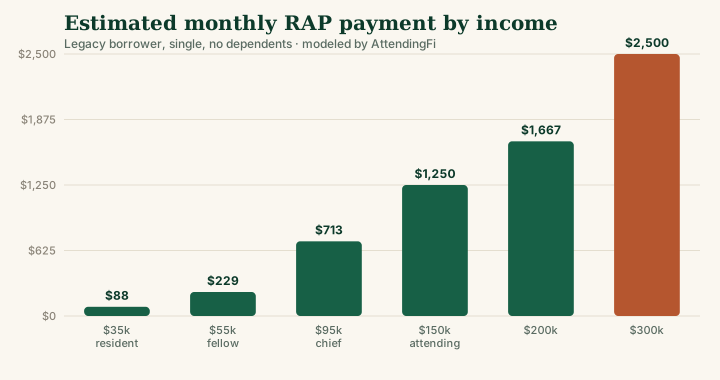
| Adjusted gross income (AGI) | RAP rate | Est. monthly RAP payment |
|---|---|---|
| Up to $10,000 | minimum | $10 (fixed floor) |
| $35,000 (resident / clerk) | 3% | $88 |
| $55,000 (resident / fellow) | 5% | $229 |
| $95,000 (chief resident / fellow) | 9% | $713 |
| $150,000 (early attending) | 10% | $1,250 |
| $200,000 (attending) | 10% | $1,667 |
| $300,000 (attending MD / DDS / partner) | 10% | $2,500 |
The bottom line
The 2026 overhaul has been dominated by news about the end of SAVE and the new borrowing caps. The repayment-plan reset for continuing students has slipped through the cracks, and the reassuring “you’re a legacy borrower” language is giving current med, dental, law, pharmacy, and grad students a false sense that nothing changes for them. The legacy borrower borrowing-limit protection is real. The repayment-plan protection does not exist once you take your next loan. Knowing that now — while you still have time to plan your career path, your PSLF decision, and your AGI strategy — is the difference between being blindsided at graduation and walking in with a plan.
Legacy borrower FAQ
Does legacy borrower status protect my repayment plan?
No. The legacy (or “continuing”) borrower provision protects your higher borrowing limits, including Grad PLUS, for the rest of your program. It does not protect your repayment plan — eligibility is set by your loan’s disbursement date.
What triggers the repayment-plan reset?
Any federal Direct loan disbursed on or after July 1, 2026 — including a routine annual disbursement for the same degree — permanently removes IBR, PAYE and ICR for all of your loans. Your only options become RAP or the new tiered Standard plan.
Is RAP worse than IBR for a legacy borrower?
For a high earner not pursuing PSLF, usually yes: RAP charges 1–10% of total AGI with no cap and forgives after 30 years, versus capped IBR (never above the 10-year Standard payment) forgiving in 20–25 years. But RAP waives unpaid interest and adds a $50 monthly principal match during low-income training, and RAP still counts toward PSLF.
When do PAYE and ICR end?
Both sunset on July 1, 2028 for everyone. After that, IBR is the only legacy income-driven plan left for pre-2026 loans, alongside RAP.
Sources & further reading: One Big Beautiful Bill Act (P.L. 119-21); Congressional Research Service, “The Repayment Assistance Plan (RAP)”; U.S. Department of Education rulemaking and studentaid.gov guidance; The Institute of Student Loan Advisors (TISLA). RAP payment figures modeled with AttendingFi’s repayment engine. Related: The 2026 student-loan changes every physician needs to understand.