Do physicians actually benefit from PSLF? An honest look for trainees
Do physicians actually benefit from PSLF? For a large share of doctors the honest answer is yes, often six figures of tax-free forgiveness, but it is not universal. Whether Public Service Loan Forgiveness is worth pursuing depends on your employer, your debt relative to income, and how you set things up. The skepticism is healthy, because plenty of online advice oversells PSLF to people it cannot help. This guide gives the honest case for and against, with the numbers that decide it.
Which physicians benefit most from PSLF
PSLF rewards a specific profile: a doctor with a large federal balance who works for a qualifying nonprofit or government employer. The more your debt outruns what an income-driven payment collects over ten years, the more is left to forgive, tax-free. Residents who bank low-income payments during training and then work as hospital-employed attendings sit almost exactly at the center of that target.
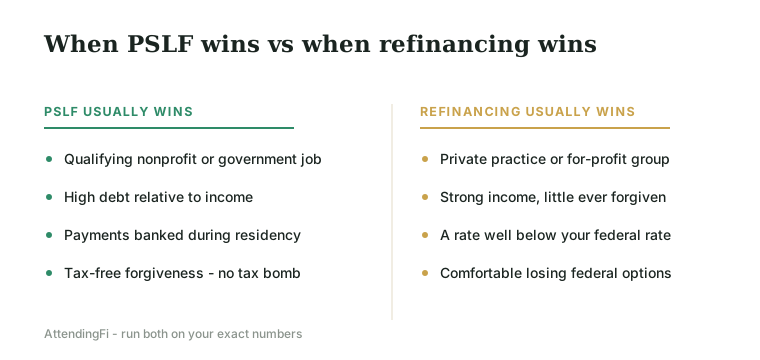
If that describes your path, PSLF usually beats refinancing or aggressive payoff by a wide margin. The benefit is largest for high-debt primary-care and hospital-based physicians whose incomes, while strong, are modest relative to their balances. A pediatrician or an internist at an academic medical center is far more likely to capture a large forgiveness than a high-earning specialist in private practice with a small balance.
The single most important variable is your debt-to-income ratio combined with your employer. When a big balance meets a qualifying nonprofit job and a low-income training window, the math points firmly toward forgiveness. When any of those three is missing, the case weakens. That is why a one-size-fits-all answer is useless and why your own numbers, not a rule of thumb, should decide.
How much PSLF is actually worth
The reason the answer is often an emphatic yes is the size of the number. Because forgiveness is tax-free and physician balances are large, the amount erased frequently exceeds a full year of attending take-home pay. There is no cap on how much can be forgiven, so the benefit scales directly with your remaining balance at payment 120.
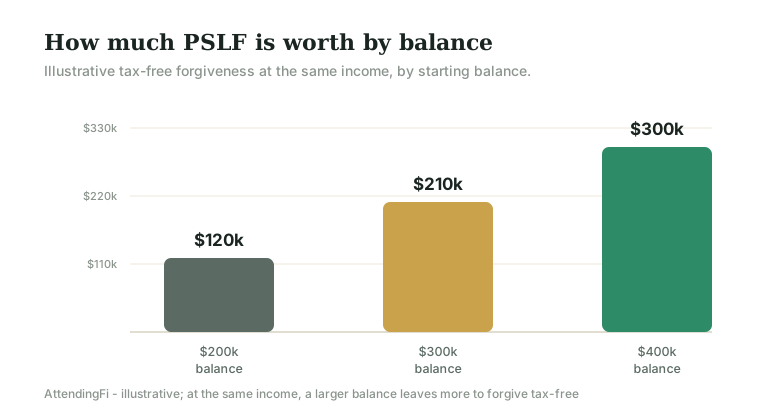
Consider a physician finishing training with $300,000 in Direct loans who moves into a hospital-employed role. Across roughly ten years of qualifying payments, much of it small resident-salary payments, a large remaining balance can be forgiven with no tax bill. To beat that with refinancing, a lender would have to erase an enormous amount of interest, which almost never happens at these balances.
Compare that to the alternative. A borrower who refinances away from PSLF to chase a lower rate gives up that tax-free forgiveness in exchange for interest savings that, on a large balance, rarely come close. The gap between the two outcomes is precisely the value of PSLF, and for the right physician it is the most valuable financial decision of their early career, worth more than most investment moves they will make in the same window.
Who qualifies, and why most physicians can
PSLF eligibility is about your employer, not your specialty or your job duties. Government employers at any level and 501(c)(3) nonprofits qualify; for-profit hospitals and most private practices do not. Because a large share of U.S. healthcare employers are nonprofit or government, a great many physicians can qualify if they plan around it.
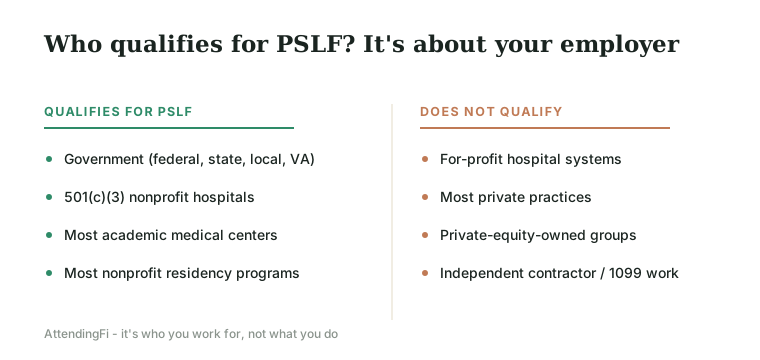
This is why the benefit is so widely available to doctors specifically: the training pipeline runs through nonprofit teaching hospitals, and many attending jobs are at qualifying systems. A physician can often qualify simply by choosing among the employed positions already common in their specialty, without taking a pay cut to do it.
The borrowers who cannot benefit are those firmly in private, for-profit practice, where the real choice becomes an income-driven plan versus refinancing. If you are unsure of your employer's status, ask HR whether it is a 501(c)(3) or government entity; that single answer determines whether PSLF is even on the table for you.
The 10-year path that delivers the benefit
The mechanism is simple: 120 qualifying monthly payments, about ten years, after which the remaining balance is forgiven tax-free. The payments need not be consecutive, and time spent at a qualifying employer during training counts toward the total just as attending years do.
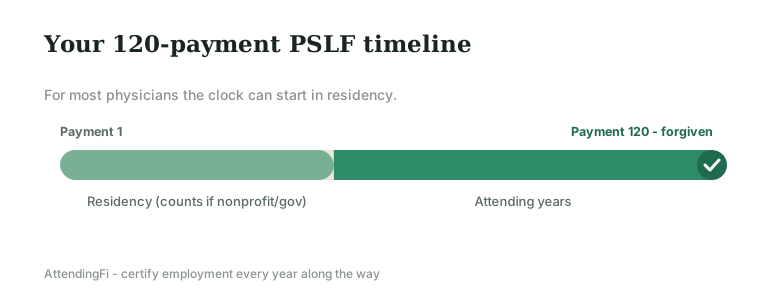
The early months, made on low resident income, are the most valuable because they cost so little while counting the same as expensive attending months. A resident might bank three to seven years of qualifying payments at a few hundred dollars a month, then finish the clock as an attending. That structure is the heart of why PSLF benefits physicians so disproportionately.
It also means the benefit is largely won or lost early. A doctor who sets up PSLF correctly in intern year captures those cheap months; one who delays or refinances during training forfeits them and can never get them back. The ten-year path is forgiving of almost everything except inattention at the start.
When PSLF is not worth it
Honesty cuts both ways. PSLF does not benefit everyone, and pretending otherwise is how people end up disappointed. If you work, or will work, in private practice with no qualifying employer, you cannot earn credit at all, full stop. If your income is high relative to a modest balance, you would pay the loan off long before any forgiveness arrived, so forgiveness has no value to capture.
There is also a non-financial cost worth naming. If pursuing PSLF would chain you to a job you dislike purely for the loan benefit, the lost flexibility can outweigh the savings, especially for a borrower whose forgiveness would be modest. Money is only one input; a career you resent for a decade is a real price.
The honest test is to estimate your tax-free forgiveness on a PSLF path and compare it against the interest you would save by refinancing, then weigh lifetime cost alongside your career preferences. For some high earners, paying the loan off fast genuinely wins. PSLF should be chosen because the math and your plans both favor it, not by reflex because someone online called it free money.
How to make PSLF actually pay off
The benefit only materializes if you execute. Confirm your loans are federal Direct, consolidating older FFEL or Perkins loans first if needed. Enroll in a qualifying income-driven plan, choosing the one with the lowest payment so more of your balance survives to be forgiven. File an employer certification through the official PSLF Help Tool, signed by HR, and re-certify every single year.
Then track your qualifying-payment count and investigate immediately if it stalls. Most PSLF disappointments trace back to skipped certifications, the wrong loan type, or a non-qualifying repayment plan, every one of which is avoidable with a small amount of annual attention. Treating PSLF as a ten-year administrative habit, rather than a one-time decision, is what separates the borrowers who reach forgiveness from those who arrive short.
If your count looks short near the finish line, PSLF buyback may recover missing months from certain forbearances. And throughout, keep checking that PSLF remains your lowest-cost path as your income and employer evolve, because the right answer can shift over a decade. The engine recomputes that comparison whenever your situation changes.
The honest verdict
So, do physicians benefit from PSLF? For a high-debt doctor at a qualifying employer, the answer is a confident yes, frequently worth six figures of tax-free forgiveness and almost always better than refinancing. For a high-income physician in private practice with a small balance, the answer is usually no, and refinancing or fast payoff serves them better. Most doctors fall clearly into one camp or the other once they look at their actual numbers.
The mistake is deciding by reputation rather than arithmetic. PSLF is neither a scam nor free money; it is a specific program that pays off handsomely for a specific, common physician profile. Run your balance, income, and employer through the engine below, and the verdict for your situation will be obvious rather than a matter of opinion.
Three PSLF myths that mislead physicians
The first myth is that PSLF is too good to be true or likely to be cancelled. In reality the program is written into federal law, has forgiven balances for hundreds of thousands of borrowers, and can only be repealed by Congress; payments you have already earned are protected. Skepticism is reasonable, but treating PSLF as a trap leads many physicians to refinance away a benefit they were entitled to.
The second myth is that you must take a low-paying job to qualify. You do not. Most academic and hospital-employed physician positions are at qualifying nonprofits and pay competitively; PSLF eligibility is about the employer's tax status, not your salary. Many doctors qualify without changing the kind of job they would have taken anyway.
The third myth is that PSLF only helps primary care. While high-debt, hospital-based physicians benefit most, specialists at qualifying employers with large balances can benefit substantially too. The deciding factors are your debt-to-income ratio and your employer, not your specialty label. The only way to cut through the myths is to run your own numbers.
Your PSLF benefit checklist
If you want to capture the benefit, work through a short list. Confirm your employer is a qualifying nonprofit or government entity. Confirm your loans are federal Direct, and consolidate older FFEL or Perkins loans if they are not. Enroll in a qualifying income-driven plan with the lowest available payment, and file your first employer certification through the PSLF Help Tool.
Then make it a habit: re-certify employment every year, watch your qualifying-payment count climb, and act quickly if it stalls. Revisit the PSLF-versus-refinancing comparison whenever your income or employer changes, because the right answer can shift over a decade. These few steps, maintained consistently, are the entire difference between a physician who reaches forgiveness and one who arrives short or gives up early.
None of it requires expertise, only attention. Set the system up correctly once, keep the yearly habit, and the benefit, if it applies to you, arrives on schedule. To confirm whether it applies to you specifically, run your real balance, income, and employer through the engine below.
A side-by-side example
Two physicians make the point concrete. The first is a hospital-employed internist at a nonprofit with $300,000 in Direct loans who banked four years of qualifying payments in residency. On a PSLF path she finishes 120 payments about a decade after starting, and a large remaining balance is forgiven with no tax. The interest she avoided plus the principal forgiven dwarf anything refinancing could have saved her.
The second is a private-practice dermatologist earning well into the mid-six figures with a $150,000 balance and no qualifying employer in his future. No forgiveness will ever reach him, so refinancing to a lower rate and paying the loan off quickly is clearly his best move. Same profession, opposite answer, because their employers and debt-to-income ratios point in opposite directions.
That contrast is why the only honest answer to whether physicians benefit from PSLF is: it depends, and it is knowable. Plug your balance, income, and employer into the engine below and you will see, in dollars, whether PSLF is your lowest-cost path or whether another route serves you better. The verdict for your situation is a calculation, not a matter of opinion.
It is also worth remembering that the benefit compounds with good execution. A physician who enrolls in the lowest-payment qualifying plan, certifies every year, and times recertification well around the residency-to-attending jump can increase the amount ultimately forgiven by tens of thousands of dollars beyond a borrower who simply drifts on autopilot. The program rewards not just eligibility but attention, which means part of the answer to whether you benefit is within your own control.
For that reason, treat the question as the beginning of a plan rather than a yes-or-no verdict. If the numbers favor PSLF, the next step is to set it up correctly and protect it for a decade; if they do not, the next step is to optimize a refinance or payoff instead. Either way, the engine below turns the abstract debate into a concrete, personalized answer you can act on today.
Get your personalized plan
Don't guess — model your exact numbers. AttendingFi runs the real federal-rules math on your numbers and shows its work. Free, no login needed to see your answer.
Run my numbers →Frequently asked questions
Do most physicians benefit from PSLF?
Many do. A physician with a large federal balance and a qualifying nonprofit or government employer typically benefits substantially, often six figures of tax-free forgiveness. Those in private, for-profit practice or with small balances relative to high income usually benefit little or not at all.
Is PSLF forgiveness really tax-free?
Yes. PSLF forgiveness is tax-free under federal law, unlike income-driven forgiveness, which can be taxable at the end of a 20- or 25-year term. That tax-free status is a large part of why PSLF is so valuable for physicians.
Does residency count toward the PSLF benefit?
Usually yes, if your residency is at a nonprofit or government teaching hospital. Those low-income years count toward your 120 payments and are the cheapest, most valuable months in the program.
Can PSLF be taken away from physicians?
The core program is written into federal law and can only be repealed by Congress. Payment counts you have earned and forgiveness already granted are protected.
How do I know if PSLF beats refinancing for me?
Compare your estimated tax-free forgiveness on a PSLF path against the interest you would save by refinancing, on a lifetime-cost basis. Our engine runs that comparison on your exact numbers.
Free tools & reports
All free, no signup. Keep going: