Dental specialty student loans: your 2026 repayment strategy
Dental specialty student loans carry their own version of a familiar problem: dentists finish school with some of the largest education debt of any profession, and the right repayment strategy depends on how that debt compares to income and on whether a qualifying employer is in the picture. A general dentist, an orthodontist, and an oral surgeon can leave the same school with similar debt but face very different best paths. This hub explains how the decision tends to break down across dental fields, and points you to the model that gives your real answer.
Why dental debt is uniquely high
Dentists routinely graduate with debt that rivals or exceeds physicians, often well into the high six figures, because dental school is expensive and many programs leave little room for outside income during training. Unlike physicians, most dentists do not complete a long, employed residency, which shapes the repayment picture: there are fewer years of low-income, qualifying PSLF payments to bank before income rises. That makes the debt-to-income relationship, and the employer question, especially important to get right early.
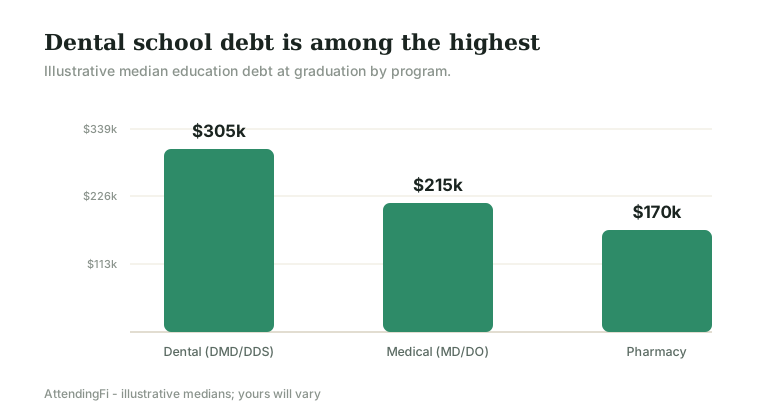
The high starting balance means the stakes of the repayment decision are large in absolute dollars. A dentist choosing the wrong path, refinancing away a forgiveness that would have helped, or grinding through an income-driven plan when payoff would have been cheaper, can leave or lose tens of thousands. Because dental incomes vary so much by field and practice setting, the right answer is genuinely individual, which is why a per-field rule of thumb is only a starting point.
The encouraging part is that the same tools and programs available to physicians apply to dentists. PSLF, the income-driven plans, and refinancing all work the same way; what differs is the typical income-to-debt pattern and the employment setting. Understanding where your dental field tends to fall is the first step toward choosing the lever that fits.
What drives the dental repayment decision
As with physicians, the dental decision turns on two things: your debt-to-income ratio and your employer. A high balance relative to income favors forgiveness, because income-driven payments stay low and more is left to forgive. A lower ratio favors refinancing or fast payoff, because the income comfortably services the debt and a lower private rate saves more than forgiveness would. And PSLF is only available to those working for a qualifying nonprofit or government employer.
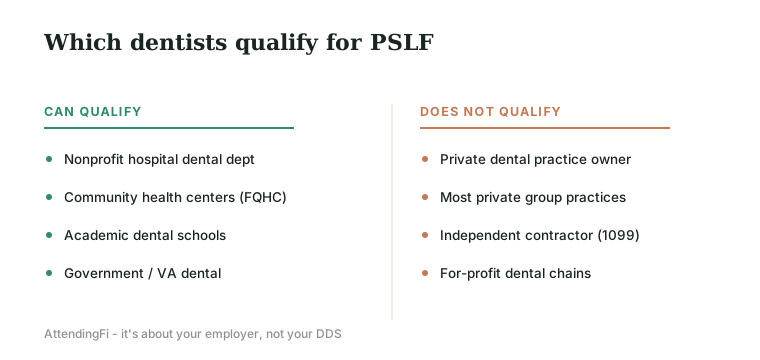
The employer question is where dentistry differs most from medicine. Many dentists work in private practice or own their practices, which are for-profit and do not qualify for PSLF. But a meaningful number work at qualifying employers, community health centers, public hospitals, academic dental schools, and government clinics, where PSLF is very much on the table. For a dentist with a high balance at one of these employers, forgiveness can be the clear winner.
So the first question for any dentist is not which field they are in, but where they work and how their debt compares to their income. The field tends to predict the income, which is why we group the discussion that way, but the employer can override the field entirely. A high-earning specialist at a community health center may still come out ahead with PSLF, while a general dentist who owns a private practice will not have that option.
General dentists
General dentists earn moderate incomes that, against a very high dental-school balance, often produce a debt-to-income ratio high enough to make forgiveness attractive, provided they work for a qualifying employer. A general dentist at a community health center or public clinic with a large balance is frequently a strong PSLF candidate, banking qualifying payments at a manageable income-driven amount and forgiving a substantial balance tax-free after ten years.
The complication is that many general dentists work in or own private practices, which are for-profit and disqualify them from PSLF. For these dentists, the realistic choice is between an income-driven plan and refinancing, and with a moderate income against a large balance, the answer can go either way. Refinancing to a lower rate and paying the balance off over time often wins for an established private-practice dentist with stable income, but the large starting balance means the comparison deserves real modeling.
The practical guidance for general dentists is to identify the employer situation first. If you are at a qualifying employer, evaluate PSLF seriously, because your debt-to-income ratio may make it the cheapest path. If you are in private practice, compare an income-driven plan against refinancing on your actual numbers, and consider timing refinancing for when your income and credit are strongest.
Dental specialists: ortho, endo, perio, prosth, peds
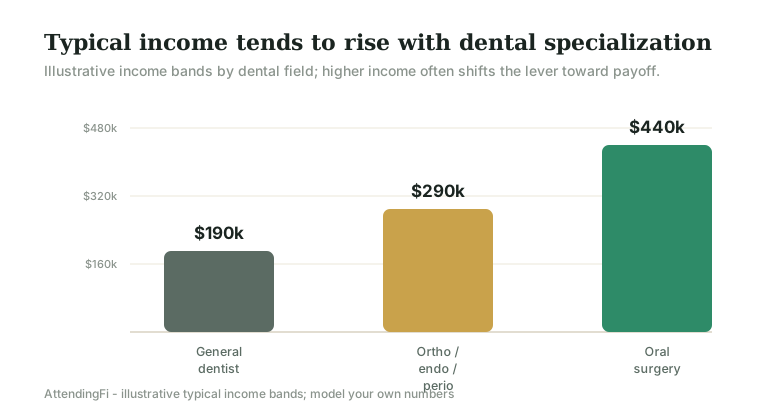
Orthodontists, endodontists, periodontists, and prosthodontists complete additional specialty training and earn higher incomes than general dentists, which lowers their debt-to-income ratio and shifts the typical lean toward refinancing or fast payoff. For a specialist in private practice with a strong income, refinancing to a lower private rate and aggressively retiring the balance is often the cheapest path, since the income comfortably services even a large dental-school debt.
Pediatric dentists are a middle case. Their incomes are often somewhat lower than the procedural specialists, and a meaningful number work at qualifying employers such as children's hospitals, academic centers, and community health programs, which keeps PSLF realistically in play. For a pediatric dentist at a qualifying nonprofit with a high balance, forgiveness can still win, while one in private practice will more often lean toward refinancing.
Across all the dental specialties, the same caveat holds: the higher income makes refinancing more often the answer, but a qualifying employer can flip it back to forgiveness. The specialty training itself, if completed at a qualifying academic institution, can also bank some early qualifying payments. As always, the field predicts the tendency, but the employer and the specific numbers decide.
Oral and maxillofacial surgeons
Oral and maxillofacial surgeons earn the highest incomes in dentistry, often comparable to surgical physicians, which gives them the lowest debt-to-income ratios in the field. For most oral surgeons in private practice, that points clearly toward refinancing and fast payoff: the income retires even a very large balance in a few years, and a lower private rate saves more than forgiveness realistically could.
The twist for oral and maxillofacial surgeons is their long training. The path often includes a multi-year, sometimes hospital-based residency, and for those who train at qualifying nonprofit institutions, those years can bank qualifying PSLF payments at a low trainee income. An oral surgeon who accumulated several years of qualifying payments during a long residency and then works at a qualifying employer could still find forgiveness competitive, though most who enter private practice will lean toward refinancing.
For oral surgeons, the decision is usually the most refinance-leaning in dentistry, but the long training window means the PSLF math is worth checking before dismissing it. If you trained at a qualifying institution and are considering a qualifying employer, run the numbers; otherwise, plan around refinancing at the point your income and credit are strongest.
Specialty deep dives
Dental fields at a glance
The table summarizes how the decision usually leans across dental fields, based on typical income relative to debt. As with physicians, treat these as starting points: a qualifying nonprofit employer can move any row toward forgiveness, and an unusually large balance can shift the lean. Your real numbers and employer give the actual answer.
| Dental field | Typical income vs debt | Usual lean |
|---|---|---|
| General dentist | Moderate | Depends on debt & employer |
| Orthodontist | High | Often refinance / payoff |
| Endodontist | High | Often refinance / payoff |
| Periodontist | High | Often refinance / payoff |
| Prosthodontist | High | Often refinance / payoff |
| Pediatric dentist | Moderate-high | Depends on employer |
| Oral & maxillofacial surgeon | Very high | Refinance / payoff usually wins |
The recurring “depends on employer” is the heart of the dental decision. Because so many dentists are in for-profit private practice while a meaningful minority are at qualifying employers, the same field can point in opposite directions depending on where you work. Use the table for your field's tendency, then confirm against your debt, income, and employer.
What changed in 2026 for dentists
The 2026 federal repayment changes apply to dentists exactly as they do to physicians. The new Repayment Assistance Plan and revised Income-Based Repayment replaced earlier income-driven plans, and eligibility now depends partly on when you borrowed. These changes alter the payment math that determines how much PSLF forgives and whether an income-driven path beats refinancing, so dentists should re-evaluate under the current rules.
The practical step is the same regardless of dental field: model your numbers under the 2026 plans rather than relying on older guidance. We cover the new plan landscape in our RAP vs IBR guide, which applies to dentists as well as physicians, and the broader picture in our 2026 changes guide.
The fundamentals are unchanged: PSLF still forgives tax-free after 120 qualifying payments at a qualifying employer, and refinancing still trades federal protections for a potentially lower rate. The 2026 rules change the payment math in between, which a current model captures and a stale rule of thumb misses, an important distinction given how large dental balances are.
How to find your actual answer
Because the right strategy depends on your debt, income, and employer rather than your dental field alone, the reliable way to decide is to model your own situation under the current rules. The engine compares your lowest-cost path across PSLF, the new income-driven plans, and refinancing, using your actual balance, income, and employer type, and shows the dollar difference between the options.
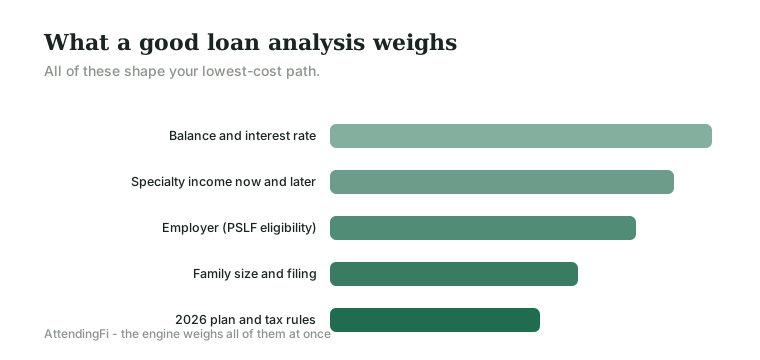
This matters especially for dentists because the balances are so large and the income range so wide. A general dentist and an oral surgeon, or two general dentists at different employers, get different answers, and the engine surfaces that difference rather than hiding it behind a field stereotype. It also recomputes as your situation changes, so the answer stays right as your income grows or your employer changes.
Run your numbers below to see your lowest-cost path. Whatever your dental field, the output is built on your real situation, which is the only sound basis for a decision this large.
A note on dental income figures and your numbers
The income bands and tendencies described for dental fields are generalizations that vary widely by region, practice ownership, years in practice, and individual circumstances. Published dental income figures differ between surveys, and any single number for a field hides a wide range, particularly because practice ownership can change a dentist's income dramatically. We use broad bands rather than precise figures deliberately, since a precise-looking average would imply a false certainty and could push you toward the wrong decision. The tendency for your field is a starting point, not a stand-in for your own situation.
This is why dentists, even more than physicians, benefit from modeling rather than rules of thumb. Dental balances are among the largest in any profession, and dental incomes span an unusually wide range depending on specialty, ownership, and setting. A general dentist who owns a thriving practice and one who is employed at a community health center may earn very differently and face opposite best strategies, despite sharing a credential. The model uses your actual inputs, so its output reflects your reality rather than a field-wide average.
Use this hub as a map and the engine as your GPS. The map shows which direction your dental field generally points; the GPS plots the actual route from your specific balance, income, and employer. Given how large dental debt is, the difference between a generic tendency and your real route can be substantial, which is why every section here lands in the same place: model your own numbers under the current rules before making a decision this consequential.
One factor specific to dentistry deserves emphasis here: practice ownership. Many dentists eventually buy into or open a practice, which can sharply raise income while also fixing the employer question, since an owned private practice is for-profit and does not qualify for PSLF. A dentist planning that path should factor the future income and employer change into the decision now, because it can shift the answer from forgiveness toward refinancing over a career. Modeling the whole trajectory, not just today, is what keeps the choice right as your practice and income evolve.
Key takeaways
Across dental fields, the loan decision turns on debt-to-income and employer, not the field name. Dental debt is uniquely high, so getting the choice right is worth a great deal.
- Dentists carry some of the largest education debt of any profession.
- The decision turns on debt-to-income and employer, not the dental field.
- General dentists at qualifying employers are often strong PSLF candidates.
- Higher-income specialists usually lean toward refinancing or payoff.
- A qualifying nonprofit employer can flip any field toward forgiveness.
- Re-run your numbers under the 2026 rules before deciding.
Find your field above for the usual lean, then model your real debt, income, and employer to confirm it. The engine does that comparison for you, free and without a signup.
See your lowest-cost path, whatever your dental field.
Answer a few questions and see your lowest-cost path across PSLF, the new RAP and IBR plans, and refinancing - free, no signup.
Run my numbersFrequently asked questions
Do dentists qualify for PSLF?
Yes, if they work for a qualifying nonprofit or government employer such as a community health center, public hospital, academic dental school, or government clinic. Dentists in for-profit private practice do not qualify for PSLF.
Which dental fields benefit most from PSLF?
General dentists and pediatric dentists at qualifying employers, especially with high balances, tend to benefit most because their debt-to-income ratio is higher. Higher-income specialists benefit less often, though a qualifying employer can still make forgiveness win.
Should dental specialists refinance their loans?
Often, if they are in for-profit private practice with strong incomes, because a lower private rate and fast payoff usually beat forgiveness at a low debt-to-income ratio. But a qualifying employer or long qualifying residency can tip the balance back toward PSLF, so model it first.
Why is dental student debt so high?
Dental school is expensive and offers little room for outside income, and most dentists do not complete a long employed residency that would bank low-income qualifying payments. The result is large balances that make the repayment decision especially consequential.
How do the 2026 changes affect dentists?
The new RAP and revised IBR plans changed the payment math for everyone, with eligibility depending partly on when you borrowed. Dentists should re-run their numbers under the current rules rather than relying on older guidance.